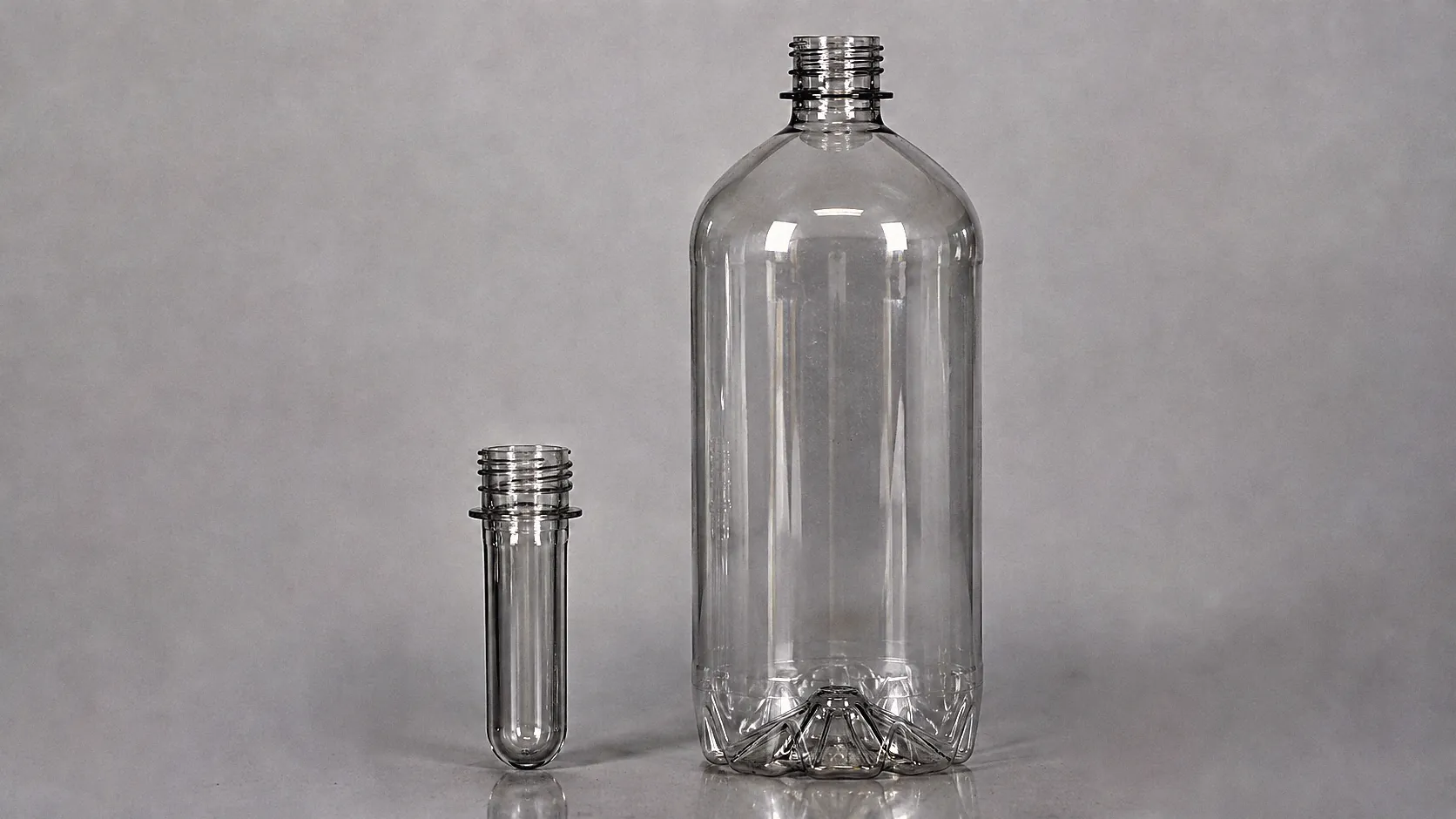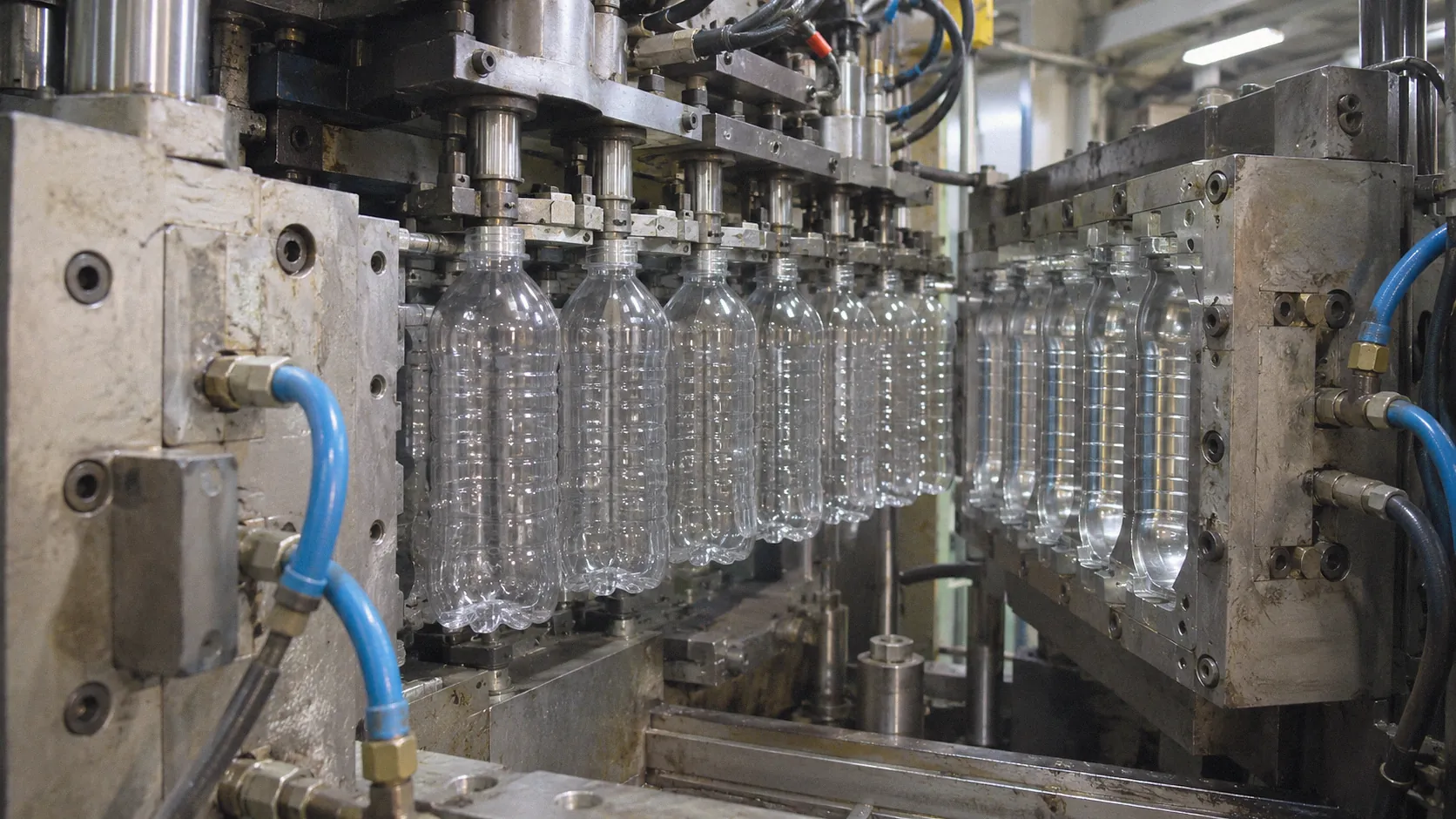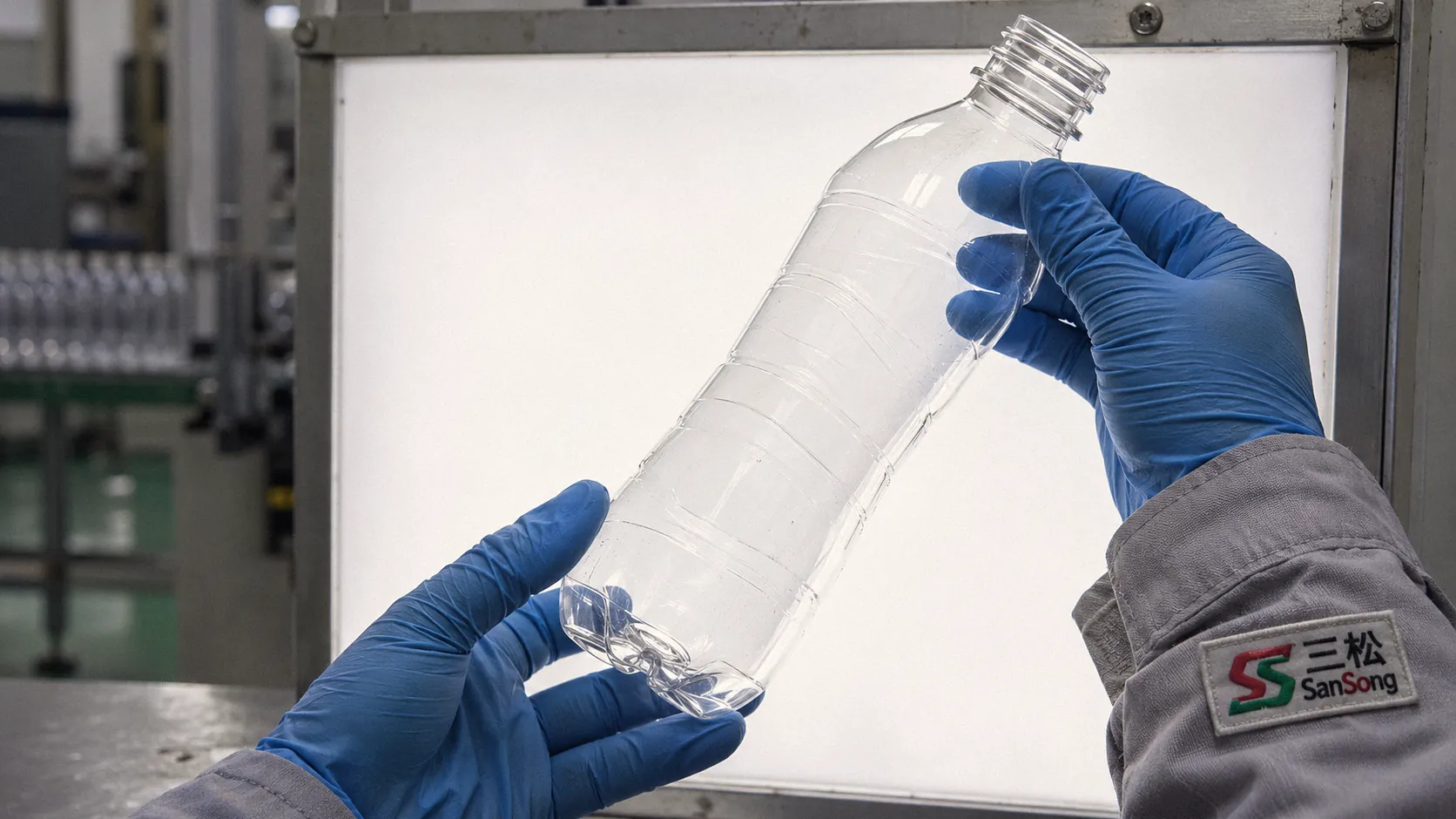
Most ISBM defects trace back to one of three things: the preform temperature at the moment of stretching, the centering of the preform in the blow mold, or the quality of the melt at injection. Pearlescence, haze, rocker bottoms and weak drop impact are temperature and orientation problems; uneven walls are usually centering problems; splay and streaks are melt problems.
This guide lists the defects buyers and process engineers see most often on injection stretch blow molded (also written moulded) containers, with their usual causes and the first checks to make.
Quick reference
| Defect | Where it shows | Usual cause | First check |
|---|---|---|---|
| Pearlescence (stress whitening) | Inside wall, pearly white | Preform too cold in that zone, so it overstretches | Warm that zone; adjust cooling and hold time |
| Haze | Outside surface, milky | PET held above about 115 °C, then crystallized | Lengthen cooling or hold time |
| Uneven wall | One side thick, one thin | Off-center gate | Rod-to-base gap, preblow timing, rod straightness |
| Rocker bottom | Base bulges, bottle rocks | Base too hot after blowing | Less heat in the preform bottom, more cooling |
| Drop-impact failure | Cracks on dropping | Too little orientation | Cooler preform, more hold time; check stretch ratios |
| Splay or bubbles | Silver streaks, voids | Moisture, high melt temperature, long residence | Drying, melt temperature, residence time |
| Streaks from the gate | Lines tracing back to the gate | Hot spot in nozzle or hot runner | Hot-runner and nozzle temperatures |
The PET temperature figures and the pearlescence, haze, base and impact diagnoses follow Ottmar Brandau’s guidance in Plastics Technology.[1] Other resins have their own temperature windows; use the supplier’s datasheet.
Pearlescence and haze: two opposite temperature problems
Pearlescence and haze look alike from a distance but have opposite causes, so check which side of the wall is affected before changing anything. Brandau explains that pearlescence “always happens on the inside of the bottle because the inside of the preform has to stretch so much more,” while haze “always happens on the outside of the preform”.[1]
- Pearlescence means the material was too cold to stretch that far. Raise the temperature of the affected zone or of thick sections. In single-stage molding the levers are injection speed, hold time and cooling time.
- Haze in PET forms when the preform is heated above roughly 115 °C and then cools slowly enough to crystallize. Keep the preform below that temperature; in single-stage molding, lengthen cooling or hold time.[1]
Thick preforms make both harder. Paul Atkin of Nissei ASB notes that thick PET preforms can crystallize and turn hazy, a problem that has traditionally pushed processors toward more costly copolymers.[2]
Uneven wall thickness: start at the gate
An off-center gate is the most common cause of uneven walls. Brandau’s rule is short: “wall thickness will go where the gate goes”.[3] If the gate drifts during blowing, the side it moves toward stays thick.
Check these in order:
- Rod-to-base gap. Brandau recommends setting the stretch-rod-to-mold-bottom distance 0.040 in. (about 1 mm) less than the preform gate wall thickness, so the rod pins the gate firmly.[3]
- Preblow timing and pressure. Preblow that starts too early or too high can push the preform off center before the rod engages.
- High-pressure timing. High pressure should start only after the rod has seated the preform.
- Stretch rod. A bent rod skews the gate in one consistent direction; replace it.
- Preform temperature. A cooler side stretches less and stays thicker.
- Stretch ratios. Brandau gives minimum ratios of about 2:1 axially and 4:1 in the hoop direction; below that, cool areas stay thick.[3]
Our preform design guide explains how to calculate stretch ratios before a mold is cut.
Rocker bottoms and weak drop impact
Base and impact defects are about what happens after the wall touches the mold. Brandau explains that a base that is still too hot after molding “will shrink outward and form a center leg” that makes the bottle rock; the fix is less heat in the preform bottom or more cooling time.[1]
Drop-impact failures usually point to too little orientation rather than a thin wall. Brandau notes this is most common in custom bottles with small stretch ratios and in single-stage molding, and recommends more cooling or, preferably, more hold time in single-stage processes.[1]
Splay, bubbles and streaks: injection-side defects
Some defects are made before the preform is ever stretched. Wet resin, melt that is too hot or held too long, and hot spots in the hot runner all show up in the finished container.
- Splay. Eastman’s processing guide for Tritan copolyester notes that splay can occur at high melt temperatures or long residence times, and that back pressure can be raised gradually to remove trapped air.[4]
- Moisture. The same guide sets a moisture limit of 0.03% or lower for Tritan before molding, reached by drying at least 4 hours at 88 °C with dry air at a dew point of -29 °C.[4]
- Streaks and haze from contamination or crystallinity. Eastman’s copolyester troubleshooting guide traces haze throughout the part to contamination, and streaks to hot spots in the nozzle or hot runner. It suggests purging, checking the purge for clarity, running without regrind as a test, and keeping melt residence time under 5 minutes.[5]
Work in a fixed order
Change one variable at a time and record it. A practical order is: confirm the resin is dry, confirm melt temperature and residence time, check hot-runner zones, check preform weight and cavity balance, then move to conditioning, stretch and blow settings. Many apparent blow-station problems disappear once the preform is consistent.
When a defect persists across settings, the preform design or the mold may be the cause. Our guide on bottle material data lists what to collect before that discussion.
How SanSong can help
SanSong builds one-step ISBM machines and molds, and reviews containers for their preform design, stretch ratios and station layout before a mold is cut. The SS-400-110-04-02 four-station machine adds a conditioning station for containers that need a tailored preform temperature profile; the SS-400-60-03-01 three-station machine covers containers up to 4.6 L with 1 to 12 cavities.
If a container is giving you trouble on an existing process, send us samples, the drawing and the resin grade, or see the ISBM machines.
Frequently asked questions
Why is my PET bottle white on the inside?
White, pearly marks on the inside wall are usually pearlescence, also called stress whitening. The inside of the preform stretches more than the outside, so if that area is too cold it overstretches. Warm the affected zone or the whole preform, or change cooling and hold time in single-stage molding.
Why is my bottle hazy on the outside?
In PET, haze on the outside usually means the preform was heated above about 115 °C and crystallized as it cooled. In single-stage molding, lengthen cooling or hold time to bring the preform temperature down.
Is a bottle defect always a process problem?
No. Many defects come from preform design, such as stretch ratios that are too small, or from wet resin. Fix the root cause rather than compensating with machine settings.
Should I use regrind in an ISBM preform?
Only if the container specification allows it, and only with clean, dry, well-mixed regrind. Eastman’s troubleshooting guide suggests running without regrind as a test when haze appears.
Sources
- Solve Four Common Problems in PET Stretch-Blow Molding, Plastics Technology (Ottmar Brandau).
- Update on one step injection stretch blow molding, PETnology (Paul Atkin, Nissei ASB), .
- How to Address Uneven Wall Thickness in Stretch Blow Molding, Plastics Technology (Ottmar Brandau).
- Drying and processing guidelines for injection molding, Eastman Tritan copolyester (TRS-DUR-244), Eastman Chemical Company.
- Injection Molding Troubleshooting Guide, Eastman Copolyesters (PPD-407B), Eastman Chemical Company, .
Editorial note: written from the public sources listed above and SanSong’s published product information, checked on the dates shown. It is general guidance, not legal or compliance advice. Specifications not yet published by SanSong are confirmed during the project review.