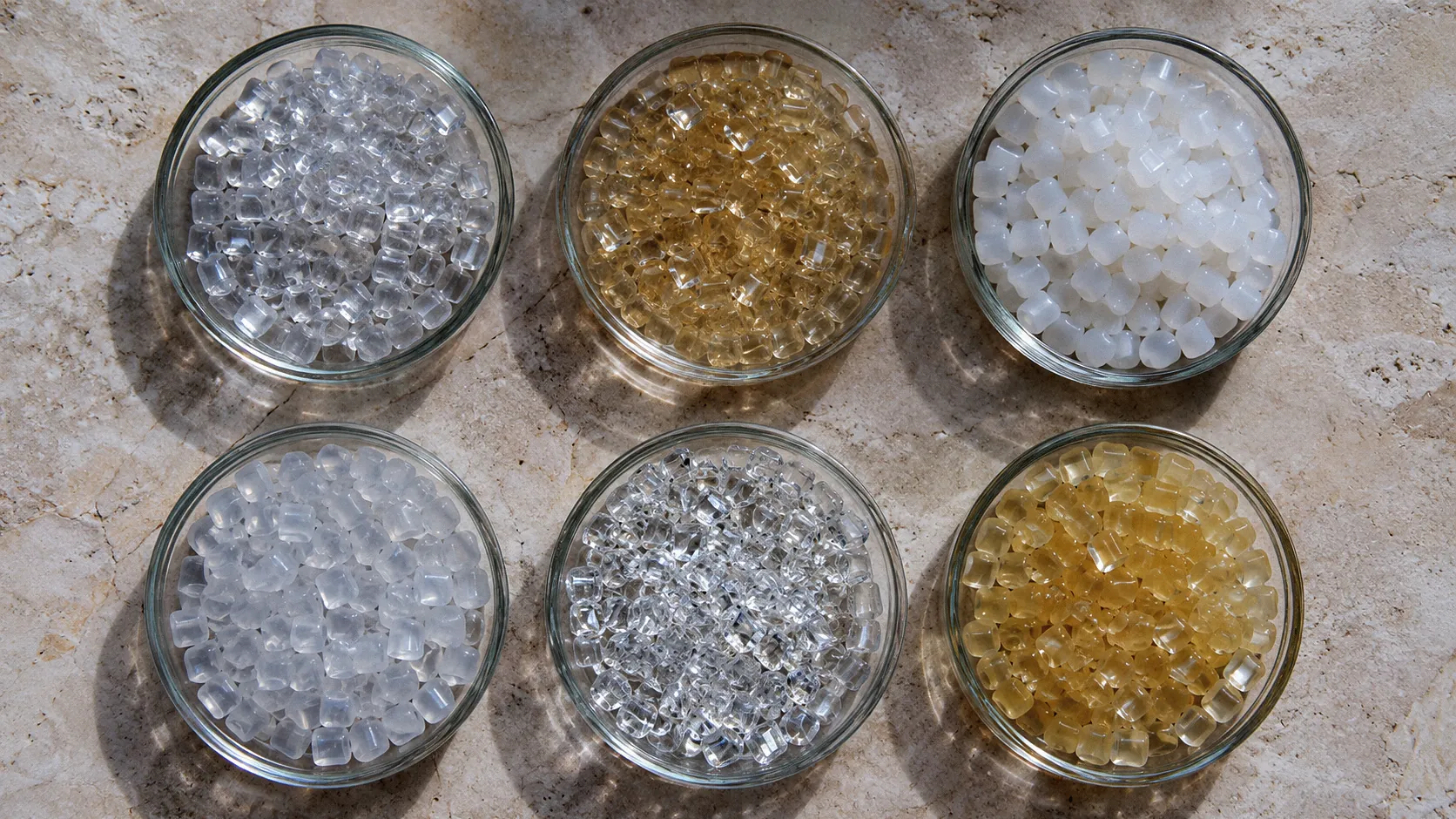
For ISBM materials, start from the container’s end use and target market rather than from the resin: whether it is single-use or reusable, how it will be washed or heated, how clear and tough it must be, and which food-contact or pharmaceutical rules apply. That narrows the choice to one or two candidates among PET, PETG, copolyesters such as Tritan and ECOZEN, PP, PC, PPSU, AS and PS, which a trial then confirms.
This guide compares the resins most often run on one-step injection stretch blow molding (also written moulding) machines and the processing points that change the project.
Start from the end use
Five questions settle most resin choices before any datasheet is opened:
- Single-use or reusable? Reusable drinkware needs toughness, dishwasher resistance and freedom from bisphenols in most markets.
- Heat? Hot filling, hot drinks, dishwashing, steam or autoclave sterilization each raise the temperature bar.
- Clarity and look? Glass-like clarity, a tint, a frosted finish or a gradient.
- Rules of the market? Food contact in the EU, China or the US; pharmaceutical packaging standards; children’s products.
- Cost and recycling? Resin price per container, recyclability and any recycled-content targets.
The resins compared
| Resin | Typical ISBM uses | Strengths | Points to plan for |
|---|---|---|---|
| PET | Bottles, jars, cosmetic and pharmaceutical packs | Clear, stiff, widely recycled; the mainstay of one-step ISBM | Must be dried; hazes if held too hot |
| PETG | Cosmetic packs, display containers | Clear, amorphous, easy to process | Check heat resistance for hot filling or dishwashing |
| Copolyesters (Tritan, ECOZEN) | Reusable sports bottles, jugs, cups | Clear and tough; made without BPA (check each supplier’s statement); heat-resistant grades | Drying and temperature windows follow each grade |
| PP | Cups, jars, infusion bottles, baby bottles | No pre-drying, low density, good chemical resistance | Less clear than polyesters unless clarified |
| PC | Light covers, technical parts, legacy drinkware | Very clear and impact resistant | BPA-based; EU food contact now restricted |
| PPSU | Baby bottles, medical and high-heat parts | High heat and repeated sterilization | Very high melt and mold temperatures |
| AS and PS | Cosmetic jars, display packaging | Clear and rigid | Lower impact resistance |
Paul Atkin of Nissei ASB describes PET as “still the mainstay” of one-step molding and lists PP, HDPE, LDPE, PC and Eastman Tritan among other resins used on one-step machines.[1]
Polyesters: PET, PETG and copolyesters
Polyesters give ISBM its characteristic clarity and stiffness, but they must be dried and handled within their temperature window.
- PET hazes when held too hot. Ottmar Brandau notes that haze forms when PET is heated above roughly 115 °C and then cools.[2]
- Tritan copolyester has published processing values. Eastman’s guide specifies drying for at least 4 hours at 88 °C with dry air at a dew point of -29 °C, to a moisture content of 0.03% or lower; a melt temperature around 282 °C; and mold surface temperatures of 38 to 66 °C.[3]
- ECOZEN is SK chemicals’ bio-copolyester in the PETG family, listed with high heat resistance and clarity for housewares, appliances and food and beverage packaging.[4]
Our article on sports bottles and wide-mouth jars covers how these resins are used in drinkware.
Polypropylene
PP is the low-cost, low-density option, and it does not need drying. A PETnology report on Milliken’s Millad NX8000 clarifier notes that PP “does not need to be pre-dried,” that most injection-blow equipment is built for polyolefins, and that the clarifier gave at least a 50% improvement in haze over the previous benchmark grade in plaque tests.[5] The report concerns injection blow molding, and its haze figures come from plaques, so confirm clarity on your own container.
Polycarbonate and the BPA question
PC is clear and tough, but conventional PC is made from bisphenol A, and that now decides its use in food contact. In the EU, Commission Regulation (EU) 2024/3190 bans BPA in food-contact materials; the Food Packaging Forum reports that the main transition period ended on 20 July 2026, after which most BPA-made single-use and reusable food-contact articles may no longer be placed on the EU market for the first time.[6] PC remains in use for non-food parts such as lamp covers and technical housings (for SanSong’s 24-cavity Christmas-light bulb cover case, the resin is confirmed per project; SanSong’s April 2026 brochures record PET).
Our article on the EU BPA ban explains the dates and what they mean for bottle makers.
PPSU: high heat, high processing demands
PPSU is chosen when containers must survive high heat or repeated sterilization, and it changes the equipment around the machine. Solvay’s sulfones guide recommends drying with pellet temperatures of at least 135 °C and an inlet dew point of -40 °C, to below 0.05% moisture for injection molding; a melt target around 375 °C; and mold temperatures of 138 to 160 °C, which require heat-transfer oil rather than electric cartridge heaters.[7] Our article on baby bottle making machines covers PPSU and PP baby bottles.
Confirm the choice in a trial
A datasheet narrows the choice; a trial confirms it. Run the candidate resin on the actual preform and mold, then test the containers for what matters in use: drop impact, top load, dishwasher cycles, hot filling, sterilization, clarity and migration testing where required. Our guide on bottle material data lists what to collect.
How SanSong can help
SanSong’s SS-400-60-03-01 three-station ISBM machine lists these published materials: PC, PCTG (Tritan TX1001 and TX2001, ECOZEN YF300, T110 and T110Pro), PET, PETG, AS, PPSU, PS and PP. Containers up to 4.6 L are made with 1 to 12 cavities, and the SS-400-110-04-02 four-station machine adds a conditioning station for temperature-sensitive resins and shapes. Resin grade and settings are confirmed for each container.
To discuss a resin for your container, see the ISBM machines or send us the container, end use and target markets.
Frequently asked questions
Which resin suits reusable water bottles?
No single resin suits every reusable bottle. Copolyesters such as Tritan and ECOZEN are widely chosen for clear, tough reusable drinkware, PP for lighter and lower-cost bottles, and PPSU where high heat or repeated sterilization is required. The target market’s food-contact rules and the user’s washing and heating habits decide.
Can ISBM process PP?
Yes. PP runs on one-step ISBM machines and is used for cups, jars and infusion bottles. Clarified PP grades improve transparency, and PP does not need pre-drying.
Is polycarbonate still allowed for drinking bottles?
It depends on the market. In the EU, Regulation (EU) 2024/3190 prohibits bisphenol A in food-contact materials, which covers PC made from BPA, with transition periods that are now ending. Check the rules of every market before choosing PC for food or drink.
Do all ISBM resins need drying?
Most do. PET, PETG, copolyesters, PC and PPSU absorb moisture and must be dried to the supplier’s limit before molding. PP is the main exception.
Sources
- Update on one step injection stretch blow molding, PETnology (Paul Atkin, Nissei ASB), .
- Solve Four Common Problems in PET Stretch-Blow Molding, Plastics Technology (Ottmar Brandau).
- Drying and processing guidelines for injection molding, Eastman Tritan copolyester (TRS-DUR-244), Eastman Chemical Company.
- ECOZEN T110 product data, UL Prospector (SK chemicals).
- Milliken’s new clarifying agent Millad NX8000 opens up a world of opportunity for highly transparent injection blow moulded PP containers, PETnology, .
- EU BPA ban reaches main transition deadline, Food Packaging Forum.
- Sulfones Processing Guide, Solvay Specialty Polymers.
Editorial note: written from the public sources listed above and SanSong’s published product information, checked on the dates shown. It is general guidance, not legal or compliance advice. Specifications not yet published by SanSong are confirmed during the project review.