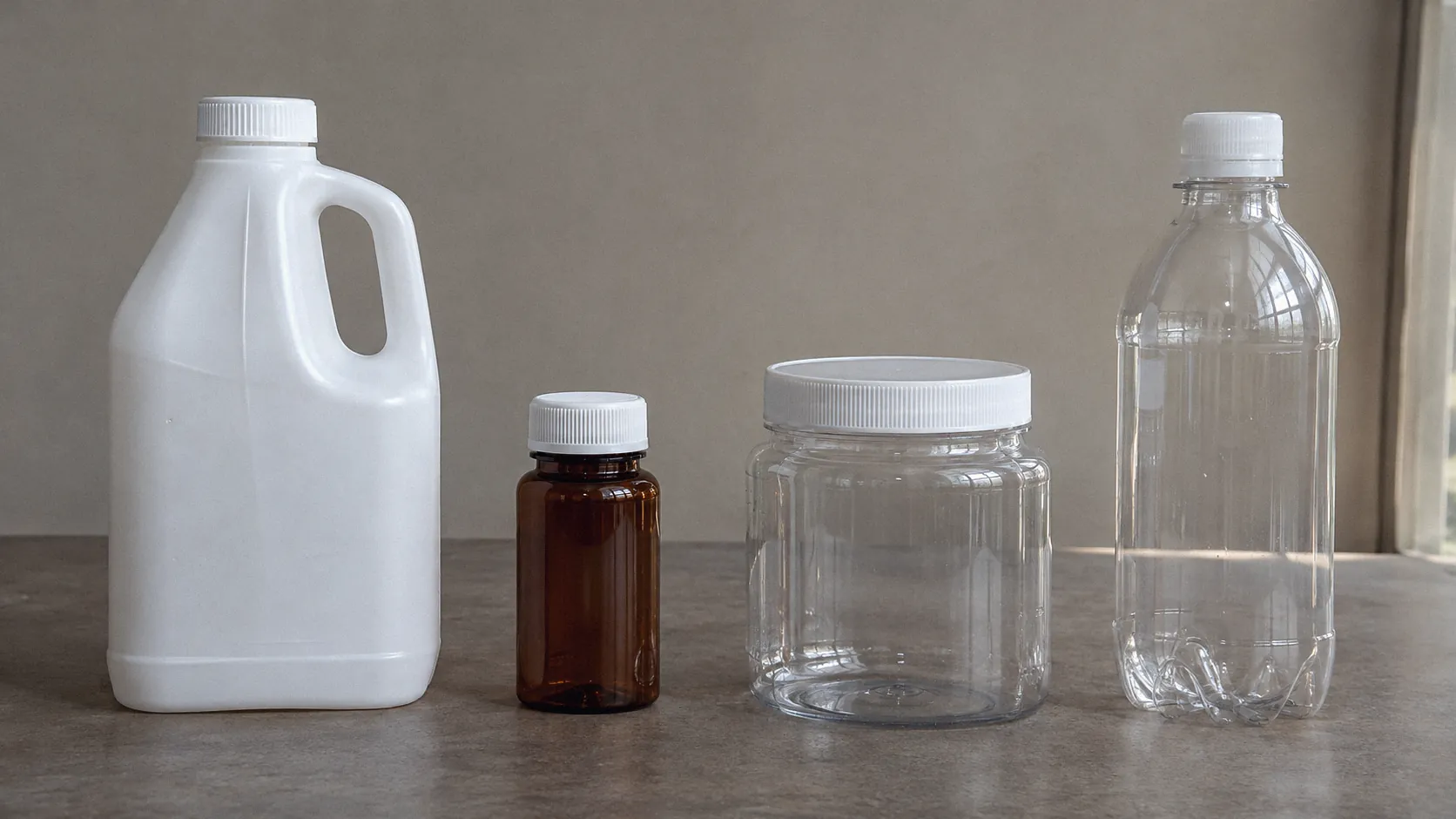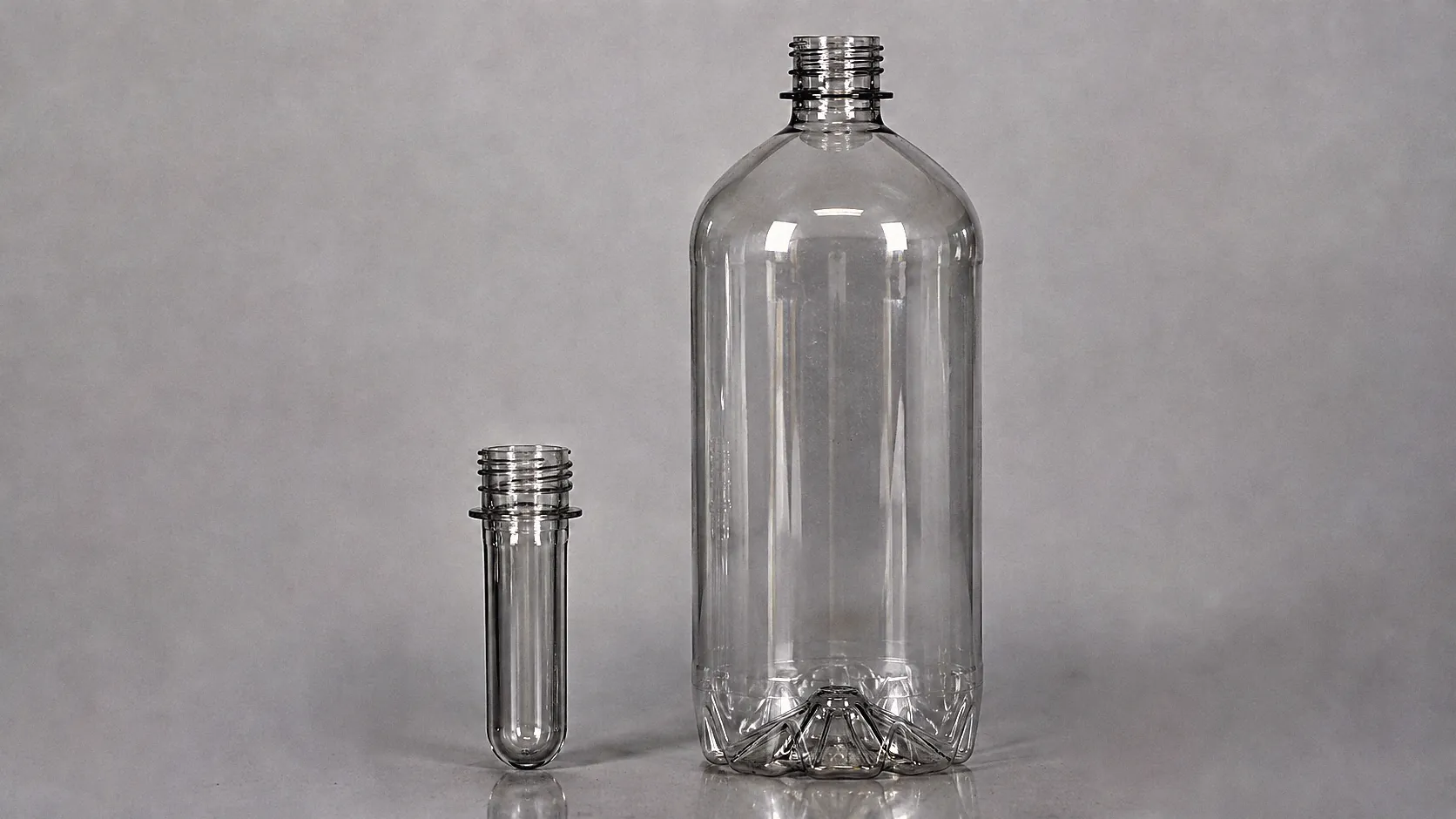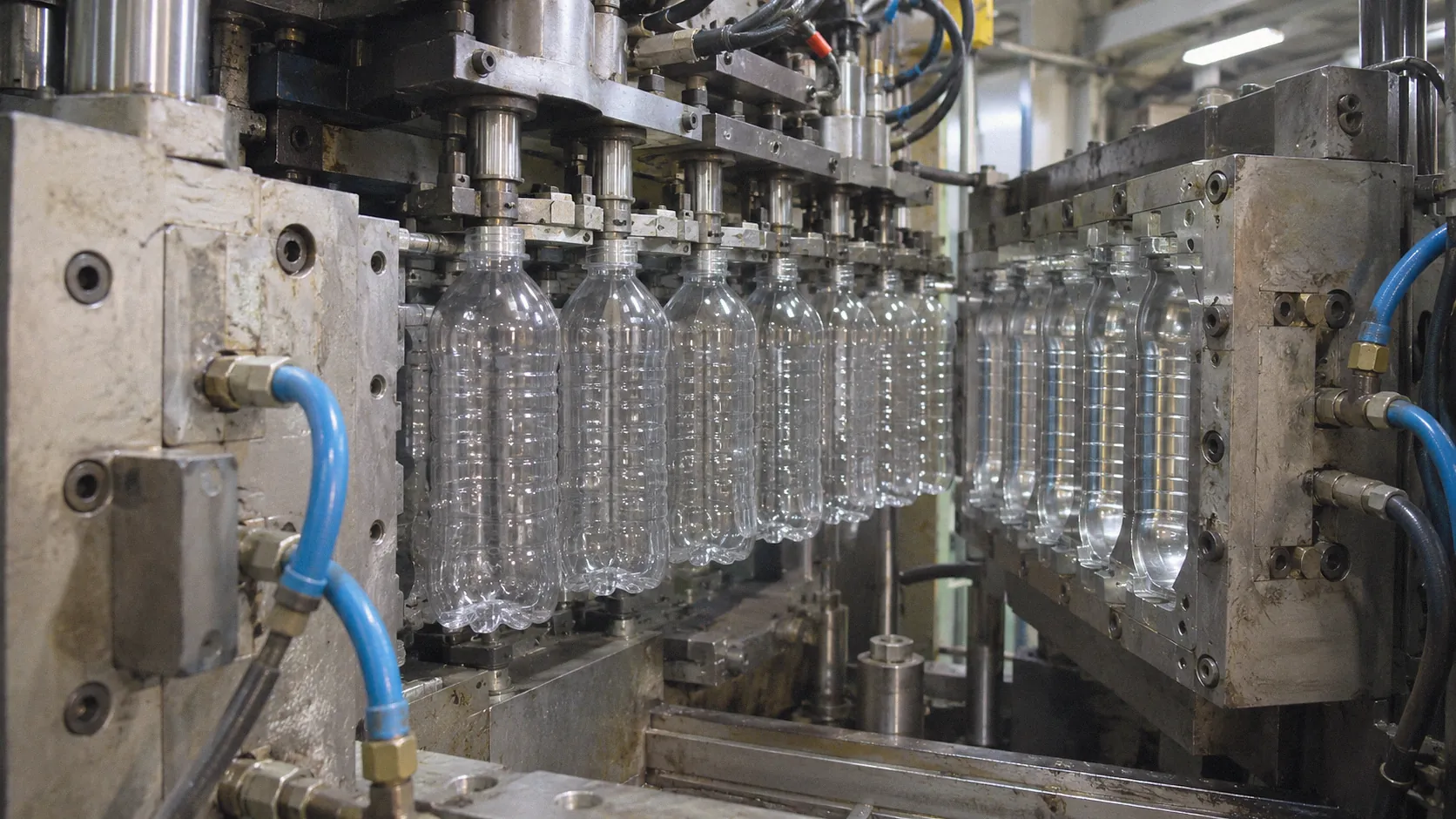
The injection stretch blow molding process (ISBM) makes a hollow container in two linked moves: a preform is injection molded, then stretched with a rod and blown with compressed air into the bottle shape. In the one-step version both moves happen on one machine while the preform is still warm, so resin goes in as pellets and comes out as a finished container with its final neck.
ISBM is also written injection stretch blow moulding in British English; the process is the same. The rest of this guide walks through the stations in the order the material sees them, explains what each one controls, and shows where three-station and four-station machines differ.
How does one-step ISBM work?
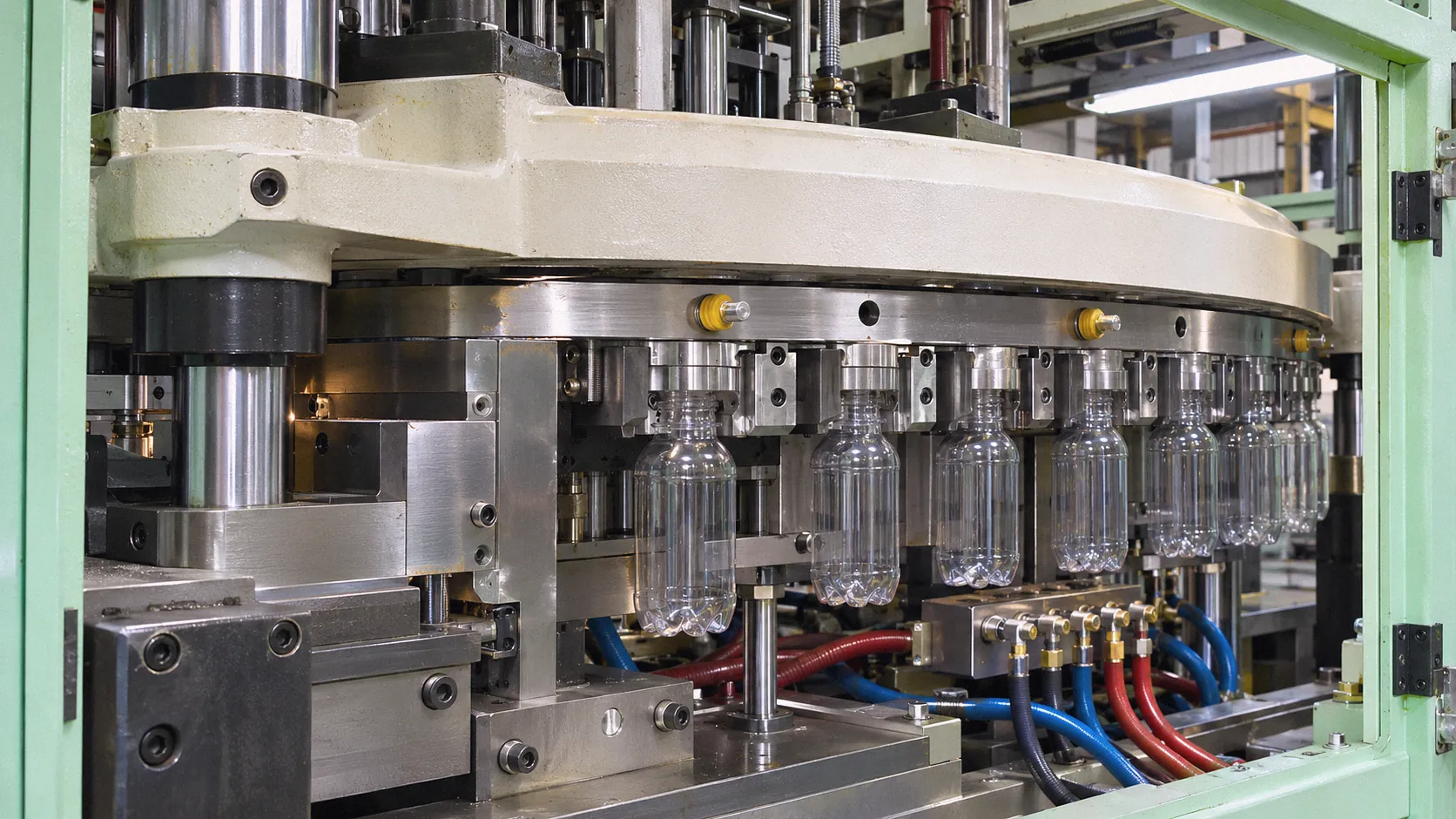
One-step ISBM is an indexing process: a rotary table carries each preform by its neck from station to station, and every station works on a different set of parts at the same time. Because the neck is held from the moment it is molded, the preform is never dropped, stored or reheated. Paul Atkin of Nissei ASB describes the key physical idea: the “residual energy stored within the injection molded preform provides the heat required for blow molding”.[1]
The two process routes compare like this:
| One-step ISBM | Two-step (reheat) stretch blow molding | |
|---|---|---|
| Preform | Molded and blown on the same machine | Molded on an injection machine, stored, reheated later |
| Heat for blowing | Heat left in the preform after injection | Infrared oven |
| Neck | Held throughout, never reheated | Reheated body, neck shielded |
| Typical fit | Wide mouths, oval shapes, cosmetics, pharma, reusable drinkware | High-volume round beverage bottles |
Ottmar Brandau, writing in Plastics Technology, lists blemish-free surfaces, no transfer ring and control over preform production among the strengths of the single-stage route, and long changeovers and uneven wall distribution as its typical weak points.[2]
Step 1: Drying and plasticizing the resin
The process starts before the machine: most ISBM resins must be dried to the supplier’s moisture limit. PET, PETG, copolyesters, PC and PPSU absorb moisture and degrade if molded wet, which shows up as haze, bubbles or brittle containers. Polypropylene needs little or no drying.
The dried pellets are melted by the screw and barrel of the injection unit. Melt temperature and residence time follow the resin datasheet. A two-color machine uses a second, smaller injection unit, so two melts can be combined into one preform.
Step 2: Injection molding the preform
The injection station decides most of what the finished container can be. Molten resin fills the cavity between the preform mold and the core rod through a hot runner. The preform’s neck, thread and any undercuts are formed here to their final size, because the neck is not stretched later.
Three things are set at this station:
- Weight and wall thickness. These fix the material per container and the cooling time.
- Neck finish. Threads, snap rings and tamper bands come straight from the preform mold.
- Gate quality. Brandau notes that an off-center gate is the most common cause of uneven wall thickness, because “wall thickness will go where the gate goes”.[3]
The preform must cool enough to hold its shape when the mold opens, yet stay hot enough to stretch. Holding that balance is the heart of one-step molding, and on most jobs it sets the cycle time.
Step 3: Conditioning the preform (four-station machines)
A conditioning station adjusts the preform temperature profile before blowing. Atkin lists overall, partial or spot heating and cooling at this station, and notes that the preform can be reshaped there.[1]
Conditioning helps when the container is far from a simple round bottle:
- Oval or flat containers, where the long sides must stretch more than the short sides.
- Thick-walled preforms that keep more heat in the core than on the surface.
- Resins with a narrow stretching window, such as some copolyesters.
On a three-station machine there is no separate conditioning step. The preform goes straight from injection to blowing, so its temperature profile is set by the preform design, the core and cavity cooling, and the transfer time. Our guide on three or four stations goes through that choice in more detail.
Step 4: Stretching and blowing
At the blow station the preform is enclosed in the blow mold, stretched lengthwise by a stretch rod and expanded by compressed air until it takes the shape of the cavity. OpenLearn explains why the stretch matters: stretching gives better control of crystallinity and molecular orientation, which improves mechanical properties, clarity and barrier resistance, and allows thinner walls.[4]
Most processes blow in two stages: a lower preblow pressure starts the expansion while the rod is still moving, and a high pressure then forces the wall against the cooled mold surface. The timing matters. Brandau warns that preblow that starts too early or too high can push the preform off center, and recommends triggering high pressure only after the rod has seated the preform.[3]
Stretch ratios guide the preform design. As a working rule, Brandau gives minimum ratios of about 2:1 axially and 4:1 in the hoop direction for even walls.[3] Our preform design guide explains how these ratios are calculated.
Step 5: Ejection and take-out
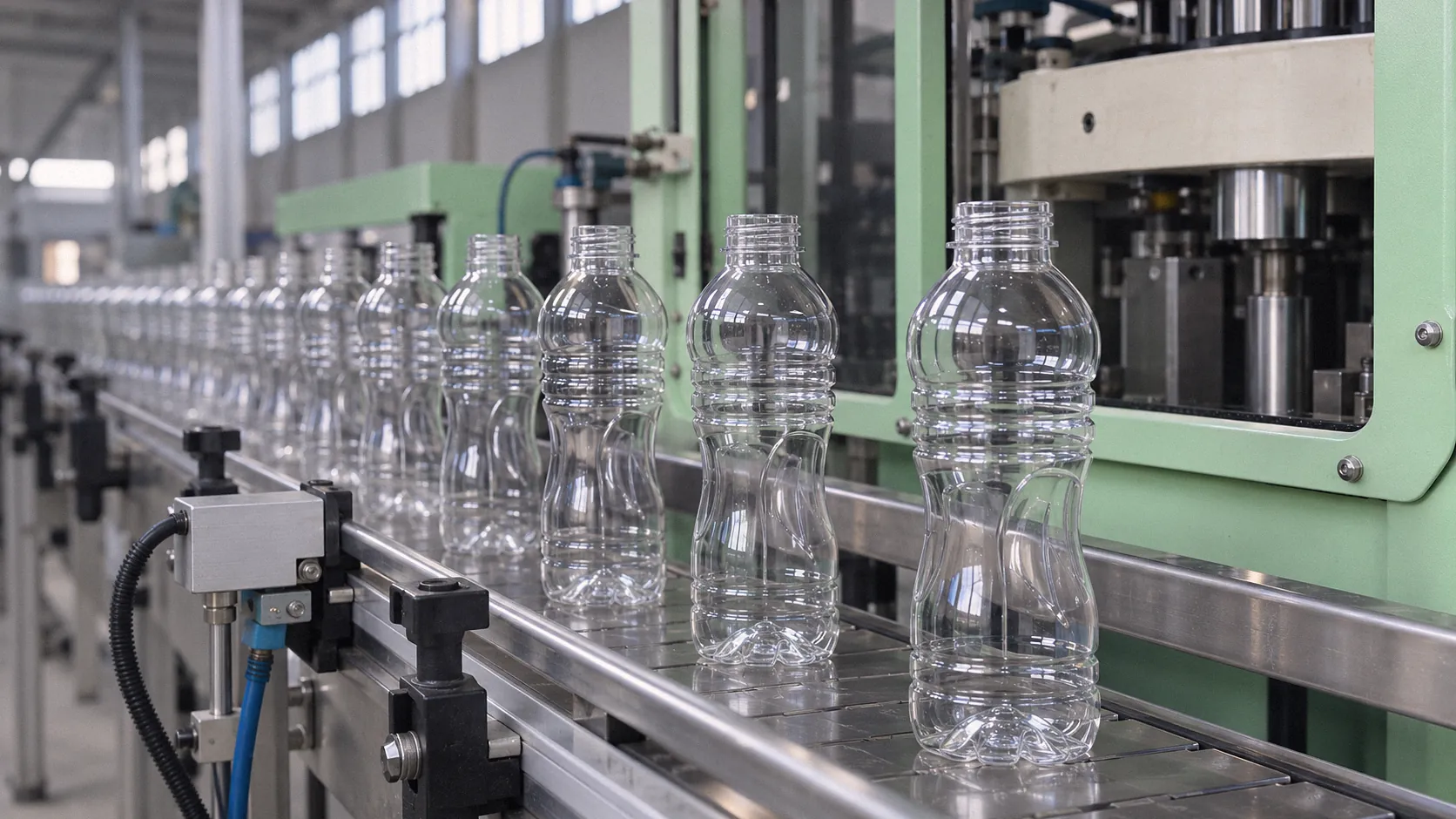
The ejection station releases the finished containers from the neck molds, and the table indexes back to injection. The containers are fully formed at this point, with a final neck, so they can go straight to inspection, leak testing, capping or packing.
Many plants add a take-out robot here to place containers on a conveyor in a fixed orientation. SanSong’s published cases include a three-cavity juicer cup and a four-cavity sports bottle, each with a take-out robot. Our article on take-out robots for ISBM covers the options.
What sets the cycle time?
In one-step ISBM the cycle time is usually set by the slowest station, which is nearly always preform cooling at injection. Because all stations work at the same time, a faster blow does not shorten the cycle unless the preform can leave injection sooner.
Thicker walls, larger containers and higher-heat resins all add cooling time. That is why preform weight and wall thickness are decided together with the output target, not after it. OpenLearn quotes about 1,200 bottles per hour for single-stage ISBM against about 15,000 for two-stage, as a general order of magnitude rather than a machine rating.[4] For a method to estimate your own output, see how to estimate ISBM output.
How SanSong can help
SanSong builds both machine layouts described here, with molds made for each container project:
| Model | Stations | Published specifications |
|---|---|---|
| SS-400-60-03-01 | 3: preform injection, stretch blow, ejection | Containers up to 4.6 L; 1 to 12 cavities; single injection unit |
| SS-400-60-03-02 | 3, two-color | Two-color gradient or single-color containers; main and side screws 65 mm and 45 mm |
| SS-400-110-04-02 | 4: preform injection, conditioning, stretch blow, ejection | Double-row molds; three Delta servo systems |
Published materials for the three-station standard machine are PC, PCTG (Tritan TX1001 and TX2001, ECOZEN YF300, T110 and T110Pro), PET, PETG, AS, PPSU, PS and PP.[5] Cycle time, clamping force and shot size depend on the container and are confirmed during the project review.
To check whether your container suits a three-station or four-station machine, see the ISBM machines or send us your bottle drawing with the material, volume and annual quantity.
Frequently asked questions
What is the difference between one-step and two-step stretch blow molding?
In one-step ISBM the same machine injects the preform and blows it while it is still warm. In two-step stretch blow molding the preforms are injection molded first, stored, then reheated in an oven and blown on a separate machine.
Why does a one-step machine need a conditioning station?
A conditioning station evens out or deliberately shapes the preform temperature before blowing. It helps with oval or flat containers, thick walls and resins that are sensitive to temperature, at the cost of an extra station and a more complex mold set.
Which materials can run on one-step ISBM?
PET is the most common. One-step machines also run PETG, copolyesters such as Tritan and ECOZEN, PP, PC, PPSU, AS and PS. The right grade and settings are confirmed for each container in a trial.
Does one-step ISBM produce scrap like extrusion blow molding?
No pinch-off flash is produced, because the preform is injection molded to its exact weight. Start-up, color change and rejects still create some waste, which most plants regrind where the specification allows.
Sources
- Update on one step injection stretch blow molding, PETnology (Paul Atkin, Nissei ASB), .
- Blow Molding: Single- or Two-Stage PET Bottle Making? Get to Know Your Options, Plastics Technology (Ottmar Brandau).
- How to Address Uneven Wall Thickness in Stretch Blow Molding, Plastics Technology (Ottmar Brandau).
- Blow moulding, The Open University, OpenLearn.
- SS-400-60-03-01 and SS-400-110-04-02 product pages, SanSong (lzsansong.com).
Editorial note: written from the public sources listed above and SanSong’s published product information, checked on the dates shown. It is general guidance, not legal or compliance advice. Specifications not yet published by SanSong are confirmed during the project review.