

Skip to content
One-step ISBM tooling

ISBM molds for one-step injection stretch blow molding

Injection stretch blow molds developed around the container design, material and selected machine.

One-step ISBM
Process
By project
Bottle design
By project
Cavities
By sample
Input
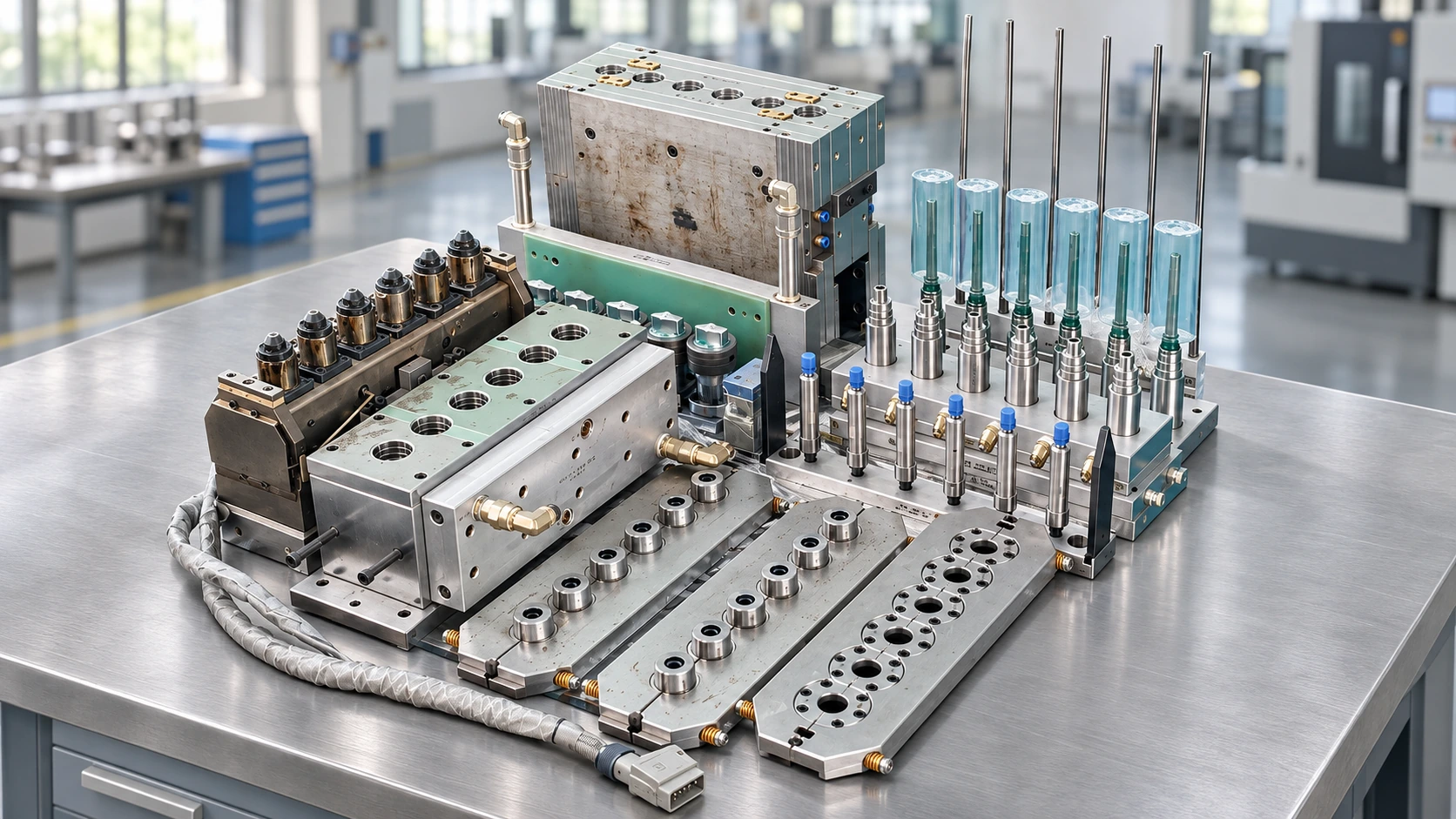
Illustrative visual: Multi-cavity bottle mold tooling with core rods and stainless cavity plates

The container defines the mold

SanSong offers molds for one-step injection stretch blow molding (moulding) alongside its three-station and four-station machine range.

Start with the finished container: its volume, shape, neck finish, material and intended use. A drawing or physical sample helps the team understand the requirement.

Mold and machine selection need to be considered together, including the cavity arrangement and the available processing stations.

Information for a mold enquiry

Provide the bottle drawing or sample, target volume and weight, neck dimensions, material grade and any appearance requirements.

If the mold is intended for an existing machine, include the manufacturer, model and tooling interface information. Compatibility requires a technical review.

Bring the design and the process together

Cavity count, mold dimensions and processing conditions are selected for the container and machine combination. Trial samples and acceptance requirements should be agreed in the project scope. Packaging compliance depends on the material, end use and destination market.

Designed as part of a system

One-step ISBM combines injection and stretch blow molding in the same production process. Tooling requirements follow the machine configuration.

SanSong lists standard, two-colour and double-row machine options. Ask the team to review the intended container against the suitable process.

For a new bottle family, discuss which dimensions and finishes are shared and which require a separate tooling design.

Prepare for production

Discuss mold trials, sample inspection and the required technical information before an order is finalised.

Cleaning, handling, storage and maintenance requirements should follow the documentation supplied for the selected tooling.

The quotation defines the tooling scope, trial arrangements, delivery schedule and commercial terms.

MOLD RANGE

From one cavity to twenty-four.

SanSong designs and machines ISBM molds for its three-station and four-station machines, and for machines from other makers.

Cavity options

Published examples include 1-, 3-, 6- and 24-cavity ISBM molds. Molds for the four-station double-row machine carry 8 to 24 cavities.

Molds for AOKI and ASB machines

SanSong also builds molds for AOKI and ASB machines. Send the machine model and the mold interface drawing so the engineers can check the fit.

Running an existing mold

The three-station standard machine is designed to run molds made for AOKI machines. A customer’s two-year-old Tritan mold from another maker runs on a SanSong machine at a 16-second cycle (see the production records).

Shown in public

CHINAPLAS 2025: a 4-cavity PET mold on a three-station machine. CHINAPLAS 2026: an 8-cavity PET syrup-bottle mold on a three-station machine and a 24-cavity PET syrup-bottle mold on a four-station machine.

MOLD DEVELOPMENT WORKFLOW

Four steps from container drawing to ISBM mold delivery.

SanSong designs and machines preform molds, core rods, neck splits, blow molds and hot runners in-house in Liuzhou. Pre-shipment sample inspection and trial scope are confirmed in the written project quotation.

  1. 01

    Drawing or sample evaluation

    Review 2D/3D drawings or scan a customer physical sample (3D scanning and shape optimization to 2D/3D drawings) to verify neck finish, gram weight, wall distribution, resin grade and closure fit.

  2. 02

    Mold, cavity & interface proposal

    Propose cavity layout (1-out-2 to 1-out-24 published examples), hot runner layout, two-tier mold-sharing options across bottle families, and machine interface checks (SanSong or existing AOKI/ASB drawings).

  3. 03

    Precision machining & CMM inspection

    Machine preform cavities, injection cores, neck molds and blow cavities in-house using CNC milling and coordinate measuring inspection (CMM) for dimensional consistency.

  4. 04

    Delivery & project handover

    Confirm pre-shipment sampling scope, inspection criteria, spare parts, drawings and handover schedule in the written quotation and contract.

Two-tier mold sharing & inner-thread non-forced stripping

Two-tier mold sharing (April 2026 brochure): (1) Bottles sharing the same resin, neck finish and cavity count can share the neck half plate, neck mold, hot runner and mold standard main plates. (2) Bottles sharing the same resin, gram weight, neck finish, cavity count and similar height can share the entire preform mold assembly (neck half plate, neck mold, injection core, cavity mold, blow core, ejection component, standard parts and hot runner).

Inner-thread containers without forced stripping: In October 2025 SanSong published a one-step ISBM molding technique for inner-thread cups (demonstrated on an inner-thread coffee cup and published in the April 2026 PC inner-thread cup case on SS-400-60-03-03) that releases internal mouth threads without forcing rigid resin over the core rod. Send your threaded-cup drawing and resin grade for engineering review.

What to send for an ISBM mold quotation (7-item brief)

ISBM mold quotation inputs
Input ItemDetails Needed for Engineering Review
1. Container drawing or physical sampleSTEP/IGES 3D file, 2D dimensional drawing, or a sample bottle for 3D scanning.
2. Capacity & target gram weightBrimful/nominal volume and target finished bottle weight.
3. Neck finish & closureThread standard, sealing surface, inner-thread details and closure drawing/sample.
4. Resin grade & colorExact polymer grade (PET, RPET, PETG, Tritan/PCTG, PC, PPSU, PP, PMMA, HDPE) and single vs two-color requirement.
5. Target output & cavity countHourly or annual volume so cavity count and single/double-row layout can be matched.
6. Target machine & interface drawingSanSong model or existing machine brand/model with platen and tie-bar interface drawing.
7. Surface finish & special featuresHigh-gloss polish, matte texture, embossed logo, handle geometry or inner-thread release.

Related engineering insights & guides

BLENDER 3D MECHANICAL ARCHITECTURE

3D Tooling-to-Cell Flow: Split Blow Mold, Gear Drive & FAT QC

Modeled and animated in Blender 4.2 with orthographic CAD contours to clarify clamping, gear-driven indexing, and closed-loop process telemetry alongside real factory documentation.

3D Engineering Process Schematic
Published Examples: 1-out-2 to 1-out-24 Cavities · ISO 9001:2015
SCENE 02 · TOOLING CAVITY TO AUTOMATION FAT FLOW

Split CNC Blow-Mold Cavities, Meshing Gear Drive & FAT QC

Three-stage engineering flow connecting CNC-milled split blow-mold plates and serpentine water circuits with a polycarbonate-guarded rotary indexing cell and dimensional FAT verification.

  • Split Mold & Leader Pins: Twin CNC tool-steel cavity blocks guide opening/closing strokes along four hardened leader pins.
  • Serpentine Cooling Channels: Rear manifold loops regulate cavity wall temperature for PC, PCTG (Tritan/ECOZEN), PET, and PPSU.
  • Guarded Gear-Driven Cell: Meshing spur gears index the 8-pocket dial inside framed transparent safety guarding panels.
  • Dimensional FAT Check: Neck finish, wall thickness, and cycle repeatability are verified prior to shipment.

Published SanSong mold configurations span 1-out-2, 1-out-3, 1-out-4, 1-out-6, and 1-out-24 cavity layouts.

Request mold evaluation
UNIT ECONOMICS FAT WORKSHEET & CONTAINER FMEA DIAGNOSTICS

Unit Economics FAT Verification Metrics & 5-Defect ISBM FMEA Matrix

Instead of generic industry benchmark claims, SanSong structures Factory Acceptance Testing (FAT) around three directly metered shop-floor economics indicators and a five-mode defect countermeasure matrix.

FAT · 01

Specific Energy (kWh / 1,000 Accepted Containers)

Logged across steady-state Liuzhou FAT cycles on your exact resin and cavity count (1–12 or 8–24 cavities across 74–90 kW 50 Hz rated platforms), metering press servo-hydraulics, hot-runner zones, resin dryer, mold chiller, and high-pressure air together rather than quoting generic nameplate fractions.

FAT · 02

First-Pass Yield & Zero Preform Tray Scrap

Calculated as dimensionally & visually accepted containers divided by total injected shots over continuous multi-hour FAT runs — capturing the elimination of two-stage preform cold-storage moisture regain, gaylord scuffing rejects, and reheat-oven drop-off scrap.

FAT · 03

Net Mold-Changeover Floor-to-Floor Minutes

Measured from the last accepted bottle of SKU A to the first QC-passed bottle of SKU B — separating mechanical hoist/clamp swap (standard SS-400-60-03-01 vs quick-change SS-400-60-03-03 / -03-06) from hot-runner thermal soak and barrel color-purge minutes.

5 Real One-Step ISBM Molding Defects, Root Causes, and SanSong Countermeasures
Container Defect ModeProcess / Tooling Root CauseSanSong 3/4-Station & Tooling CountermeasureAction
Body haze / spherulitic crystallizationPreform core/skin temperature sits too high entering stretch-blow or insufficient cooling rate on thick PET/PETG walls.Specify 4-station dedicated conditioning (SS-400-60-04-01 / SS-400-110-04-02) + optimize injection barrel & internal core-rod cooling zoning.4-Station Spec →
Pearlescence / stress whiteningPreform over-cooled below orientation window or stretch-rod advance mistimed relative to pre-blow pressure.Raise preform conditioning profile + synchronize servo stretch-rod curve and pre-blow delay (magnetic core-position sensing on -03-02).Preform Guide →
Circumferential wall eccentricityHot-runner manifold melt imbalance across cavities, core-rod circumferential temperature delta, or long-core deflection.Multi-zone independent hot-runner nozzle tuning + tapered neck-ring/core-rod concentricity lock machined in SanSong ISBM mold sets.Review Tooling →
Neck thread flash or sink marksClamping tonnage exceeded by wide-mouth multi-cavity projected area, or premature hold-pressure drop on thick neck rings.Step up to 80-ton clamping SS-400-80-03-05 for wide-neck containers + dedicated neck-ring chilled water circuit & multi-stage packing.Quote 80T Model →
Bottom gate vestige / pinholeHot-runner nozzle tip drooling/stringing or unconditioned crystalline gate slug resisting bottom center stretch.Match hot-runner gate land geometry to resin IV/MFR + optional automatic PET preform tail-cutting unit on 4-station -04-01 / -04-02.Defect Notes →
FAQ

Frequently asked questions

Useful details for your machine and mold enquiry.

What should I send for a bottle project?

Icon Close line

How do I choose three or four stations?

Icon Close line

Can you review an existing mold or machine?

Icon Close line

Which materials are listed by SanSong?

Icon Close line

Is a quoted cycle time valid for every bottle?

Icon Close line

How are trials and delivery arranged?

Icon Close line
Ready to automate your workflow?

Talk to our experts and discover the right solution for your production.
