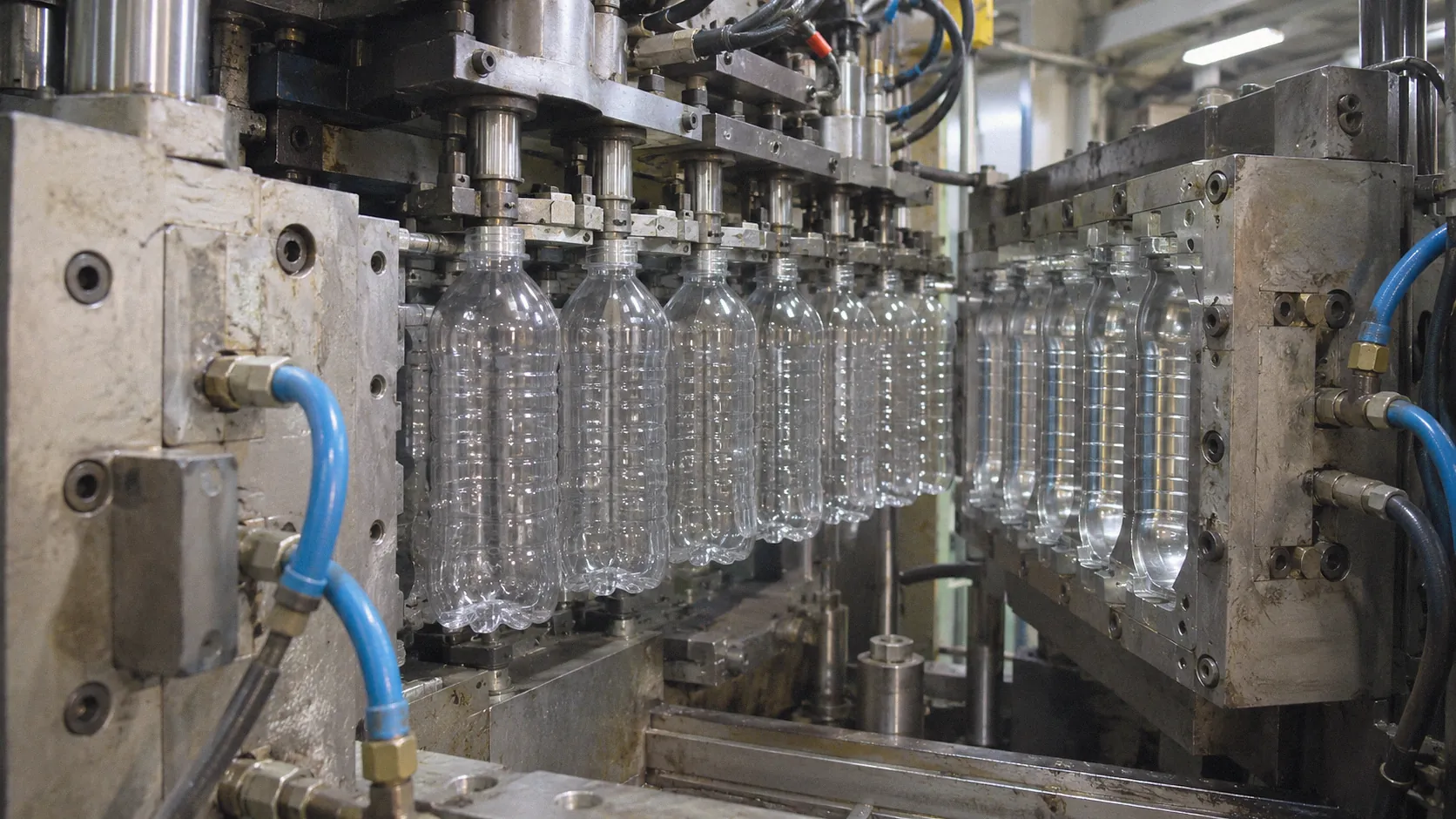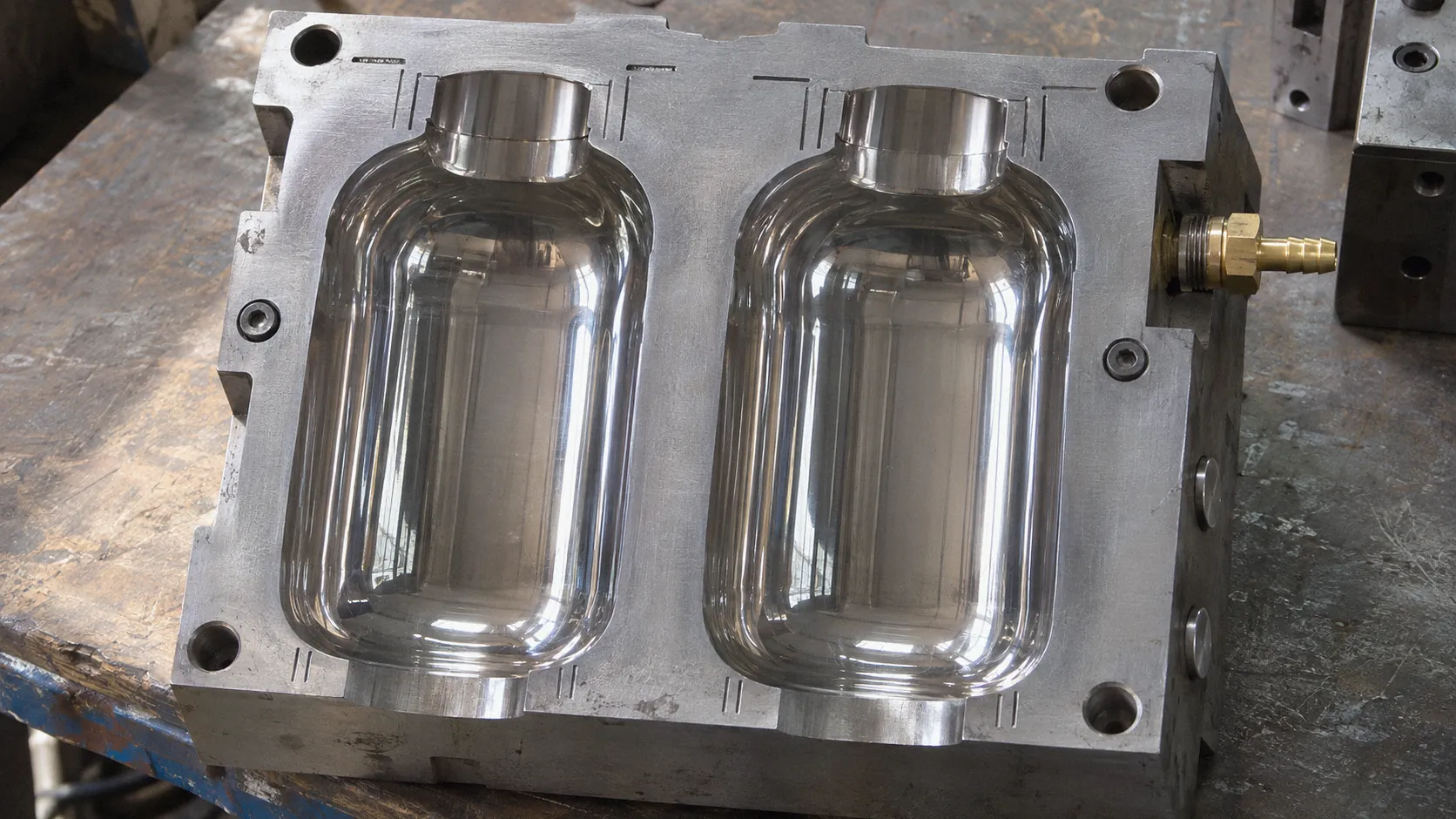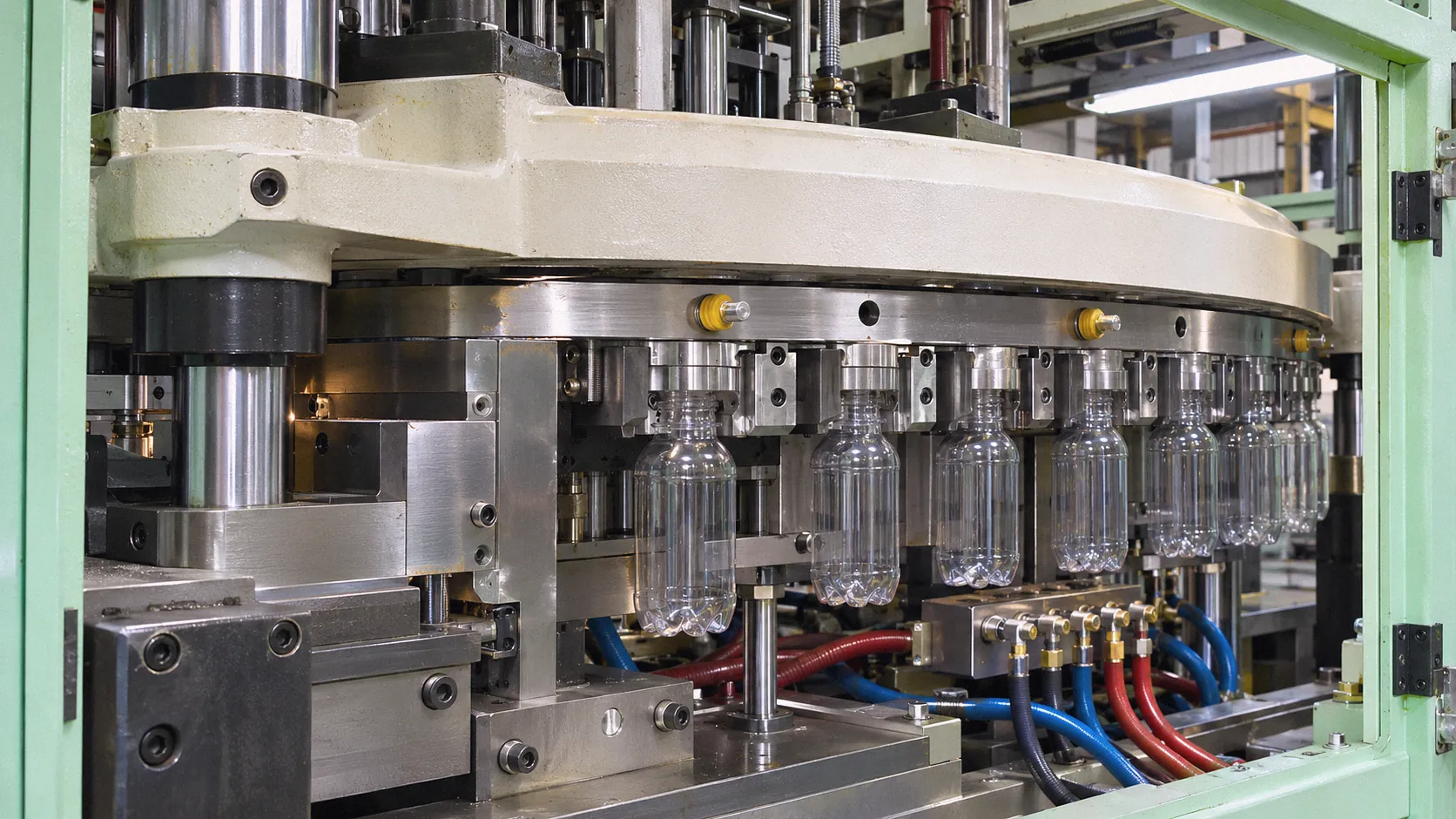
The main ISBM machine parts are an injection unit and hot runner that make the preform, a rotary table with neck molds that carries it, a stretch rod and blow unit that form the container, an ejection station, and the drives and controls that keep every cycle the same. On a four-station machine a conditioning station sits between injection and blowing.
This article follows the material through a one-step injection stretch blow molding (also written moulding) machine and explains what each part controls in the finished container.
How the parts fit together
A one-step ISBM machine is an injection molding machine and a stretch blow molding machine joined by a rotary table. Plastics Engineering describes the one-stage process as a preform that is “injection molded, conditioned (cooled and reheated if necessary), stretched, and blown into a bottle” in a single machine.[1] The table indexes after each cycle, so every station works on a different set of preforms at the same time.
| Part | Station | What it controls in the container |
|---|---|---|
| Injection unit (screw, barrel, nozzle) | Injection | Melt quality, shot weight, color |
| Hot runner and preform mold | Injection | Fill balance between cavities, gate quality, preform wall |
| Core rods | Injection | Inner preform shape and inner cooling |
| Neck molds on the rotary table | All | Neck finish, transfer without touching the body |
| Conditioning pots or cores | Conditioning (four-station) | Preform temperature profile |
| Stretch rod | Blow | Axial stretch and centering of the gate |
| Blow mold and blow valves | Blow | Final shape, wall distribution, surface |
| Stripper or ejector | Ejection | Clean release and placement |
| Servo drives, sensors, PLC and HMI | All | Repeatability, recipes, alarms |
Injection unit and hot runner
The injection unit melts the dried resin and pushes a measured shot into the hot runner, which distributes it to every preform cavity. Its screw size and stroke set the largest preform weight the machine can make. A two-color machine adds a second, smaller injection unit so that two melts can enter one preform.
The hot runner is part of the preform mold but is heated by the machine’s temperature zones. Ottmar Brandau, writing in Plastics Technology, lists hot-runner quality problems among the typical weak points of single-stage molding and recommends valve gates.[2] An uneven hot runner shows up as cavity-to-cavity weight differences and, later, as uneven walls.
Preform mold and core rods
The preform mold and the core rods form the preform: the cavity forms the outside, the core rod forms the inside, and both are water-cooled. Because the neck is molded here to its final size, any defect in a thread or tamper band starts at this station.
Cooling at this station usually sets the cycle time. The preform must be cool enough to hold its shape when the mold opens and warm enough to stretch at the blow station.
Rotary table and neck molds
The rotary table is what makes one-step molding one step. It carries the neck molds, which close around the preform’s neck at injection and do not release it until ejection. Paul Atkin of Nissei ASB notes that holding the neck throughout means no transfer is needed and avoids scuffing, which supports better visual quality.[3]
Indexing accuracy matters. A table that stops a fraction off position will load a preform off-center into the blow mold, and the wall will follow.
Conditioning station (four-station machines)
On a four-station machine the conditioning station adjusts the preform temperature before blowing. Atkin describes overall, partial or spot heating and cooling at this station, and notes that the preform can be reshaped there.[3] The station helps with oval or flat containers, thick walls and resins with a narrow stretching window. Three-station machines rely on the preform design and mold cooling instead; see our guide on three or four stations.
Stretch rod and blow unit
At the blow station the blow mold closes around the preform, the stretch rod pushes it down, and compressed air blows it out in two steps: a lower preblow, then high pressure. These three parts control wall distribution. Brandau’s checklist for uneven walls points to the gap between rod tip and mold bottom, preblow timing and pressure, high pressure that arrives before the rod has seated the preform, and bent stretch rods.[4]
Blow molds are water-cooled aluminum or steel, often with separate base inserts. Their venting and surface finish decide how sharp details and engravings come out.
Ejection station
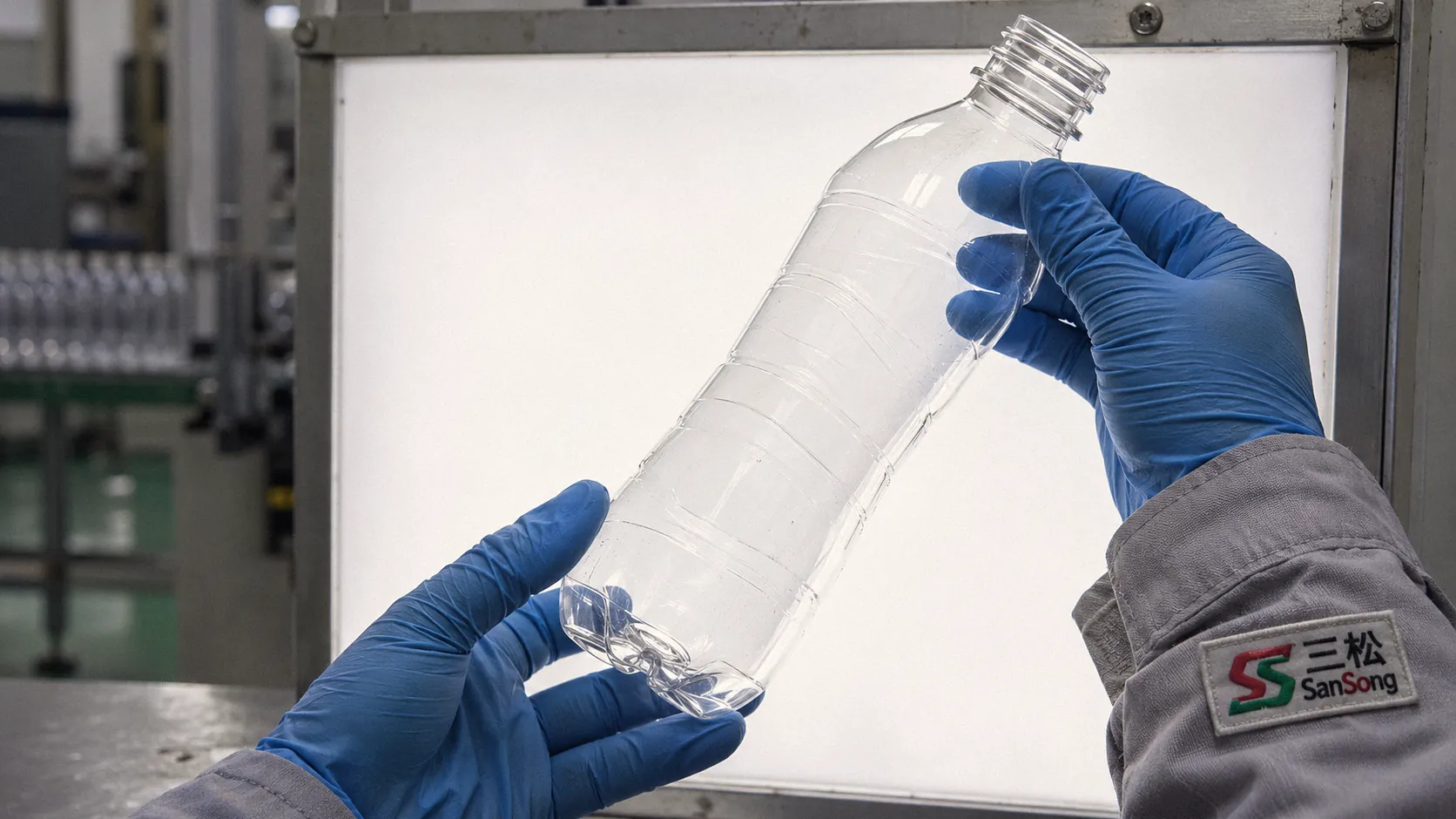
The ejection station opens the neck molds and releases the finished containers, which can drop onto a conveyor or be picked by a take-out robot. Because the neck is already finished, the container can go straight to inspection and packing. Our article on take-out robots covers this step.
Drives, sensors and controls
Drives and sensors decide how repeatable the machine is. Modern ISBM machines use servo-driven pumps or axes, position sensors on moving cores and rods, and a touch-screen operator panel that stores recipes for each mold.
SanSong publishes these details for two of its models:
- SS-400-60-03-02 two-color machine: main and side screws of 65 mm and 45 mm, an ECKERLE high-speed gear pump from Germany, three servo systems, a magnetic displacement sensor for injection-core position and injection-core lift speed up to 1 m/s.[5]
- SS-400-110-04-02 four-station machine: three Delta servo systems and a Delta touch-screen HMI, with double-row molds.
How SanSong can help
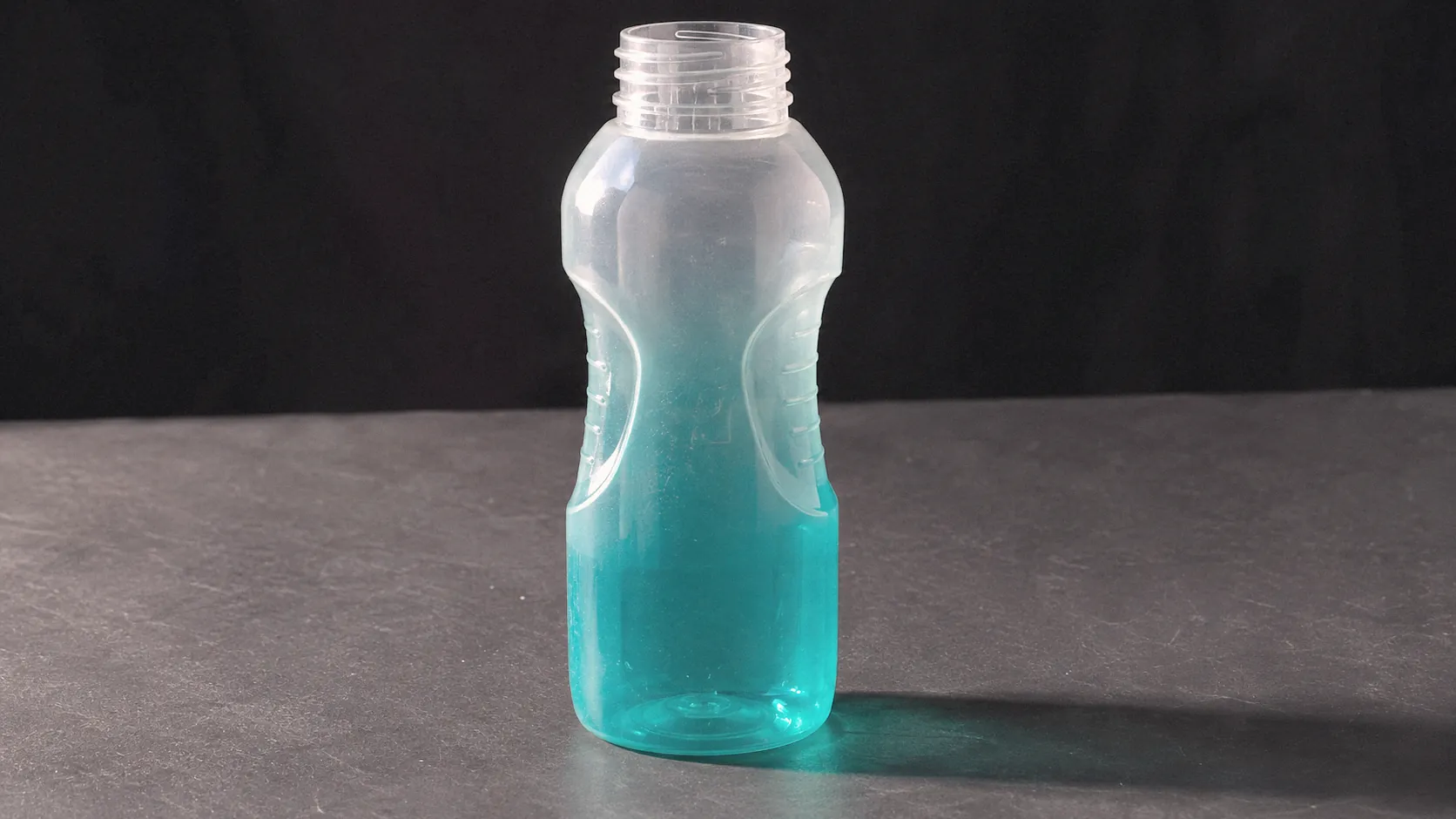
SanSong designs and builds one-step ISBM machines and the molds that run on them. The SS-400-60-03-01 three-station standard machine makes containers up to 4.6 L with 1 to 12 cavities on a single injection unit; the SS-400-60-03-02 adds a second injection unit for two-color gradient containers; and the SS-400-110-04-02 adds a conditioning station and double-row molds.
To see how these parts are configured for your container, compare the ISBM machines, read about mold components, or send us the container drawing for a configuration review.
Frequently asked questions
What does the rotary table do on an ISBM machine?
It carries the neck molds, and with them each preform, from station to station. Because the preform stays in its neck mold from injection to ejection, it is never dropped or reheated, which protects the neck and the surface.
Is the hot runner part of the machine or the mold?
The hot runner is built into the preform injection mold, but it is controlled by the machine’s temperature zones. Its condition affects gate quality, color changes and the even filling of every cavity.
Why do ISBM machines use servo drives?
Servo-driven pumps and axes deliver repeatable speeds and positions with less energy at idle than fixed-speed hydraulics. On SanSong’s machines, the two-color and four-station models each use three servo systems.
Which parts wear and need spares?
Typical wear parts are screw and check ring, nozzle tips and hot-runner heaters, stretch-rod tips, blow seals and valves, and neck-mold inserts. Ask the supplier for a recommended spare-parts list for your mold set.
Sources
- What Is Blow Molding? Main Types and Technologies Explained, Plastics Engineering (Society of Plastics Engineers), .
- Blow Molding: Single- or Two-Stage PET Bottle Making? Get to Know Your Options, Plastics Technology (Ottmar Brandau).
- Update on one step injection stretch blow molding, PETnology (Paul Atkin, Nissei ASB), .
- How to Address Uneven Wall Thickness in Stretch Blow Molding, Plastics Technology (Ottmar Brandau).
- SS-400-60-03-02 three-station two-color ISBM machine, SanSong (lzsansong.com).
Editorial note: written from the public sources listed above and SanSong’s published product information, checked on the dates shown. It is general guidance, not legal or compliance advice. Specifications not yet published by SanSong are confirmed during the project review.