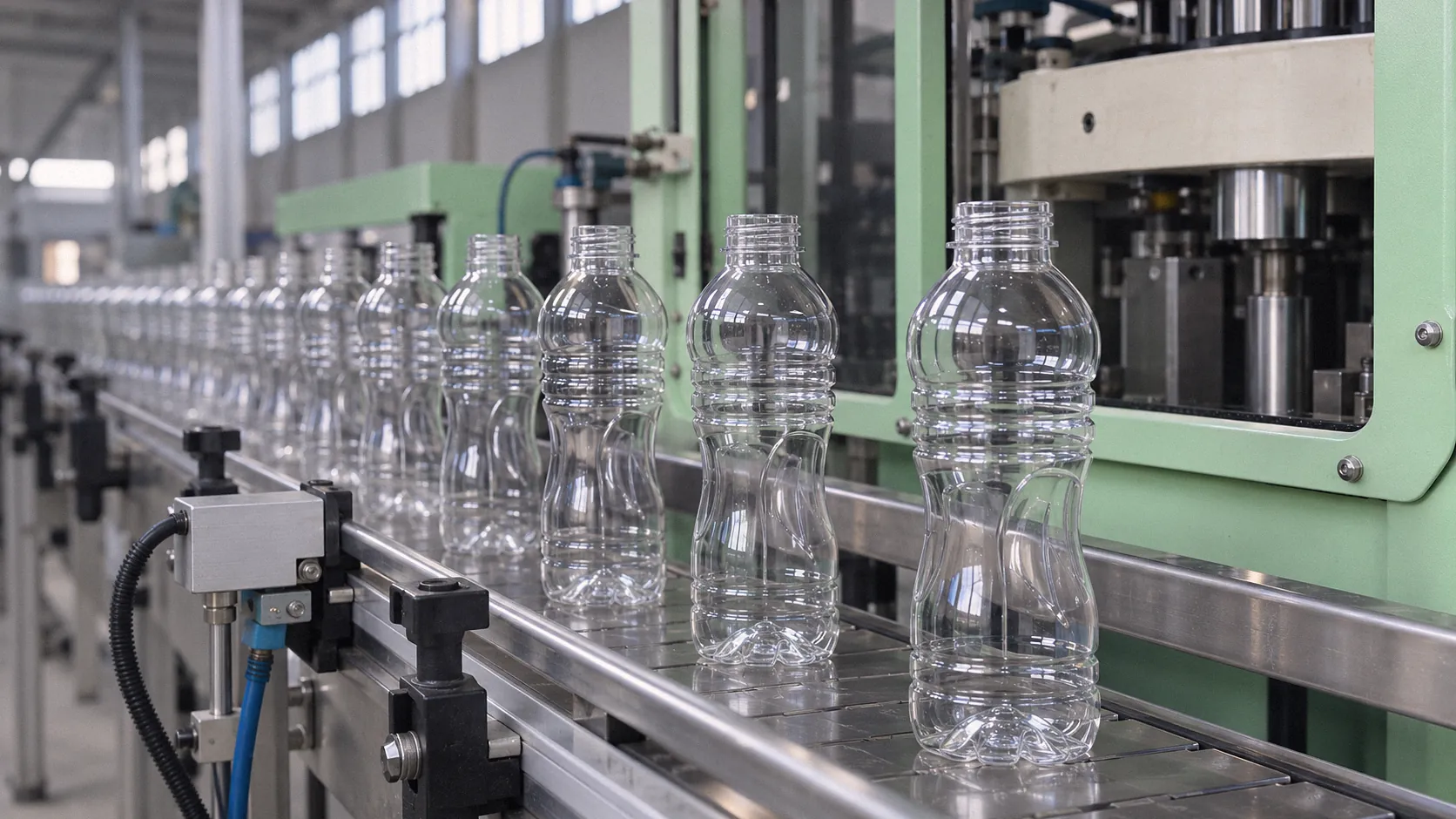
To estimate ISBM machine output, divide 3,600 by the cycle time in seconds, multiply by the number of cavities, and then multiply by your overall equipment effectiveness (OEE). The first two steps give the theoretical rate; OEE turns it into the number of good containers you can plan on. Cycle time and reject rate should come from a trial with your own resin and container.
This guide shows the method, a worked example with illustrative numbers, and what moves each input.
The basic formula
Output starts with two numbers the machine and mold decide: the cycle time and the number of cavities.
- Theoretical output per hour = 3,600 ÷ cycle time (s) × cavities
- Planned output per hour = theoretical output × OEE
- Annual output = planned output per hour × planned operating hours per year
The first line assumes the machine never stops and never makes a reject. The second corrects for the real world.
What OEE adds
Overall equipment effectiveness is the share of the theoretical output that turns into good parts. ISO 22400-2, the standard for key performance indicators in manufacturing operations management, defines it as availability × effectiveness × quality ratio; effectiveness is the factor most guides call performance.[1]
| Factor | What it measures in an ISBM plant | Typical losses |
|---|---|---|
| Availability | Running time against planned time | Mold changes, color changes, start-up, breakdowns, waiting for resin |
| Performance | Actual speed against the set cycle | Slow cycles while the process is unstable, micro-stops at take-out |
| Quality | Good containers against all containers | Start-up scrap, defects found at inspection |
Ottmar Brandau notes in Plastics Technology that single-stage machines need to run 24 hours a day to limit scrap, because every restart produces waste while the process stabilizes.[2] Plan shifts with that in mind.
A worked example
The numbers below are illustrative inputs to show the method, not a rating for any SanSong machine. Replace them with trial results.
| Input | Illustrative value |
|---|---|
| Cavities | 4 |
| Cycle time | 20 s |
| OEE | 85% |
| Operating time | 24 h × 300 days |
- Theoretical output: 3,600 ÷ 20 × 4 = 720 containers per hour.
- Planned output: 720 × 0.85 = 612 containers per hour.
- Annual output: 612 × 24 × 300 = 4,406,400 containers per year.
If the trial shows a 24 s cycle instead of 20 s, planned annual output falls to about 3,670,000 at the same OEE. A few seconds of cooling time can therefore decide whether one machine is enough.
For orientation only, OpenLearn quotes about 1,200 bottles per hour for single-stage ISBM and about 15,000 for two-stage, as general orders of magnitude.[3]
What sets the cycle time
In one-step ISBM all stations work at once, so the cycle equals the slowest station, which is nearly always preform cooling at injection. The preform has to be stiff enough to leave the mold and warm enough to stretch.
The main drivers are:
- Preform wall thickness. Cooling time rises steeply with wall thickness, so a heavier preform costs cycle time.
- Resin. Each resin has its own processing window; high-temperature resins and thick copolyester walls need more time.
- Container quality. Brandau recommends more cooling or hold time in single-stage molding to cure haze or drop-impact failures, which lengthens the cycle.[4]
- Conditioning. On a four-station machine the conditioning step can take part of the thermal work away from the injection station for some containers.
Our preform design guide explains how wall thickness and stretch ratios are balanced.
Cavities, changeovers and the annual number
More cavities raise the output per cycle but change the rest of the equation. A larger mold needs a bigger shot, may need a longer cycle and takes longer to change. If you run many container variants, changeover time can cut availability more than an extra cavity adds.
Brandau notes that single-stage tooling is hard to justify below about 2,000,000 bottles a year.[2] Compare your annual forecast with the planned output before you choose the cavity count. Our guide to mold changeovers covers how to keep that time short.
Turn the estimate into a plan
Use the estimate to ask better questions, then replace it with measured data:
- State the container, resin, target weight and annual quantity.
- Ask the supplier for a trial cycle time and the cavity count it is based on.
- Agree how the cycle will be measured in the acceptance test: steady state, how many cycles, which reject criteria.
- Recalculate with your own OEE assumptions at two or three levels.
How SanSong can help
SanSong’s SS-400-60-03-01 three-station machine makes containers up to 4.6 L with 1 to 12 cavities, and the SS-400-110-04-02 adds a conditioning station with double-row molds. Cycle time is confirmed for each container in the project review rather than published as a single figure, because it depends on the preform and resin.
To get a cycle-time estimate for your container, send us the drawing, resin and annual quantity, or compare the ISBM machines first.
Frequently asked questions
What cycle time should I assume for an ISBM machine?
It depends on preform wall thickness, resin, container size and cavities, so no single figure is reliable. Use the supplier’s trial result on your container; until then, treat any cycle time as an assumption and say so in your plan.
Does a four-station machine produce more than a three-station one?
Not automatically. The extra conditioning station lets the preform leave injection at a different temperature, which can shorten the injection step for some containers, but the cycle is still set by the slowest station. Compare trial cycle times on your container.
What OEE should I use in a business case?
Use your own plant’s history if you have it. If not, calculate the result at two or three OEE levels and plan for the lower one until the line has run for several weeks.
Do more cavities always mean more output?
More cavities raise output per cycle, but a larger mold can need a longer cycle, a bigger shot and more time for changeovers and maintenance. The right cavity count balances output, mold cost and how often you change products.
Sources
- OEE according to ISO 22400, Fabrico (summary of ISO 22400-2).
- Blow Molding: Single- or Two-Stage PET Bottle Making? Get to Know Your Options, Plastics Technology (Ottmar Brandau).
- Blow moulding, The Open University, OpenLearn.
- Solve Four Common Problems in PET Stretch-Blow Molding, Plastics Technology (Ottmar Brandau).
Editorial note: written from the public sources listed above and SanSong’s published product information, checked on the dates shown. It is general guidance, not legal or compliance advice. Specifications not yet published by SanSong are confirmed during the project review.