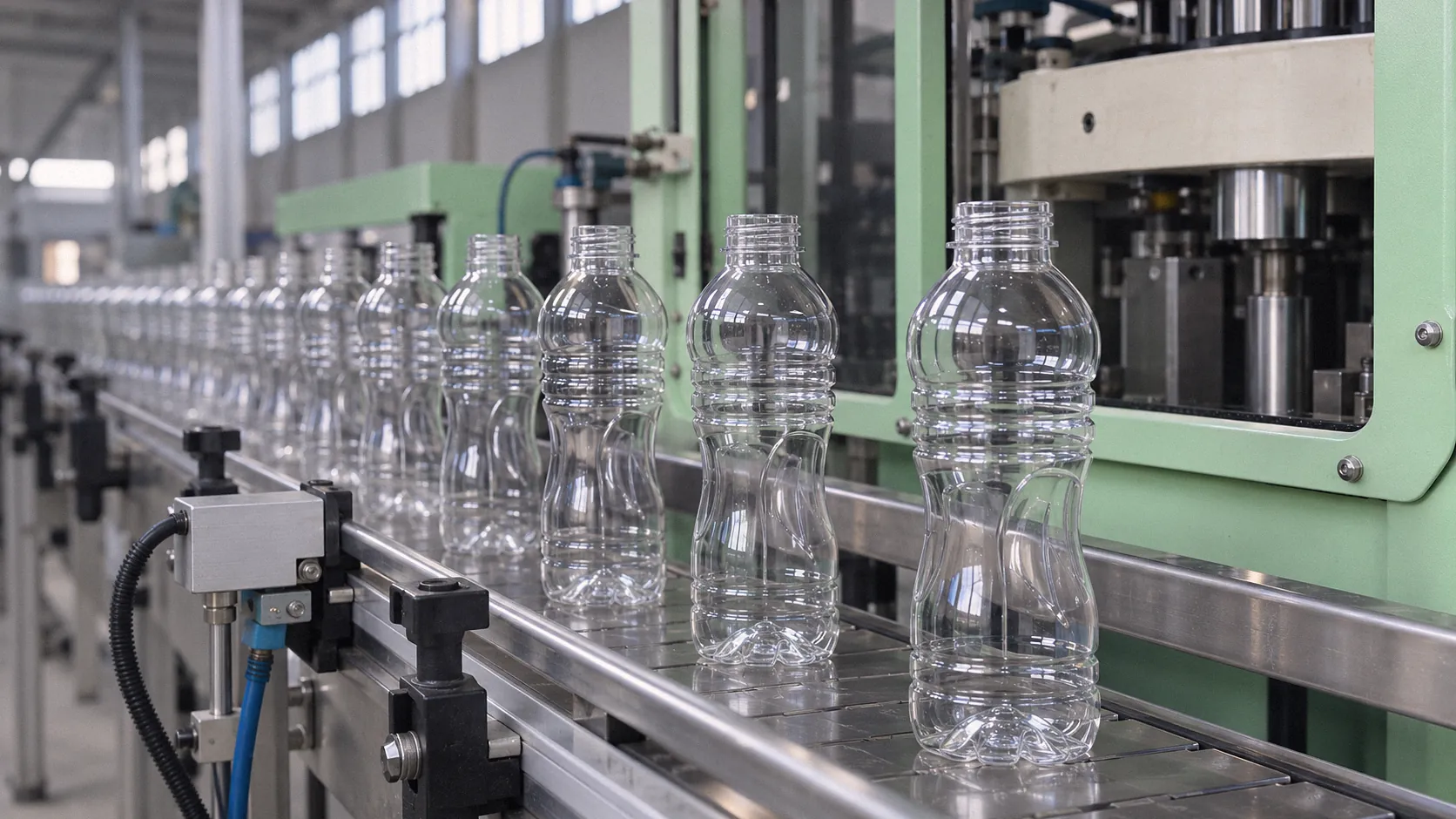
ISBM machine price is set by what the machine has to make: the station layout, the number of cavities, the container size and the resin decide the frame, the injection unit and the mold set, and the mold set plus auxiliaries can change a project budget as much as the machine itself. Two quotations for the “same” injection stretch blow molding machine can differ widely because they describe different projects.
This guide lists the factors in the order they usually move the price, so you can compare offers on equal terms. It gives no figures: SanSong quotes each configuration, and published price lists rarely match a real project.
1. Station layout: three or four stations
The station layout is the first price driver because it fixes the machine’s structure. A three-station machine runs preform injection, stretch blow and ejection. A four-station machine adds a conditioning station that adjusts the preform temperature before blowing, which means an extra station on the rotary table and an extra set of conditioning tooling in every mold set.
Choose four stations because the container needs them, not by default. Oval or flat containers, thick walls and temperature-sensitive resins are the usual reasons. Our guide on three or four stations explains the choice.
2. Cavities and container size
Cavity count and container size together set the clamping force, the shot size and the size of the mold set. More cavities raise output per cycle, but they also need a larger injection unit, a larger hot runner and more steel in each mold.
Two buyers can ask for the same model and receive different prices because one needs 2 cavities of a 1.5 L jug and the other needs 8 cavities of a 100 mL cosmetic bottle. Always quote the container, not just the model number.
3. Resin and temperature control
The resin decides the drying, heating and cooling equipment around the machine. Most ISBM resins must be dried. Eastman’s guide for Tritan copolyester, for example, specifies at least 4 hours at 88 °C with dry air at a dew point of -29 °C or lower, down to a moisture content of 0.03% or less.[1]
High-temperature resins raise the bar further. Solvay’s sulfones guide gives mold temperatures of 138 to 160 °C for Radel PPSU injection molding and notes that this calls for heat-transfer oil rather than electric cartridge heaters.[2] A PPSU baby-bottle project therefore needs different temperature control from a PP cup project, even on a similar machine.
4. The mold set
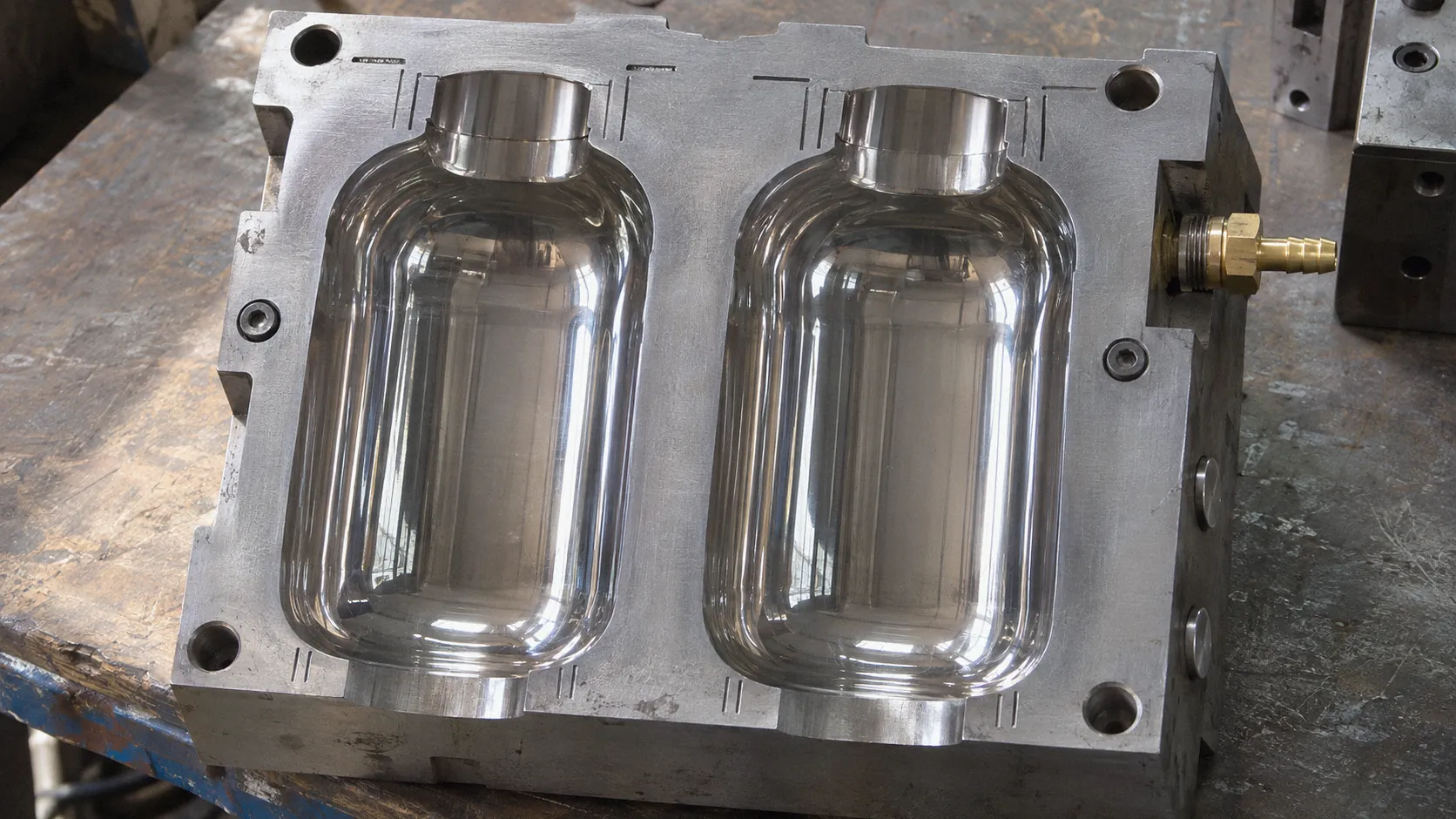
The mold set is a separate and often large line in an ISBM budget. A one-step mold set includes the preform injection mold and core rods, the neck molds that carry the preform, the blow molds, and, on four-station machines, conditioning tooling. The cost depends on:
- Cavity count and container size.
- Hot runner type and gate quality. Ottmar Brandau notes that hot-runner quality is a common weak point of single-stage molding and recommends valve gates.[3]
- Neck complexity: threads, undercuts, tamper bands and very thin necks.
- Surface finish, textures and engraving.
- The number of container variants that share one preform.
Brandau also notes that single-stage tooling is hard to justify below roughly 2,000,000 bottles a year.[3] If your volume is lower, ask whether fewer cavities or a shared preform can serve several containers. Our article on ISBM mold components explains each part of the set.
5. Two-color and special functions
Options add hardware. A two-color machine needs a second injection unit and the controls to combine two melts in one preform. SanSong’s SS-400-60-03-02, for example, uses main and side screws of 65 mm and 45 mm, an ECKERLE high-speed gear pump, three servo systems and a magnetic displacement sensor for core position.
Other options that change the price include in-mold labeling, extra servo axes, energy monitoring and data interfaces to a plant system. List the ones you need in the enquiry.
6. Auxiliaries and automation
A machine on its own does not make bottles. A complete one-step line usually needs:
| Item | Why it is needed | Check in the quotation |
|---|---|---|
| Resin dryer | Removes moisture from PET, copolyesters, PC and PPSU | Capacity per hour, dew point |
| Chiller | Cools the preform and blow molds | Cooling capacity for your cycle |
| Mold temperature controllers | Hold hot-runner and mold temperatures | Water or oil, number of zones |
| Compressed air | Preblow and high-pressure blowing | Pressure, flow, air quality |
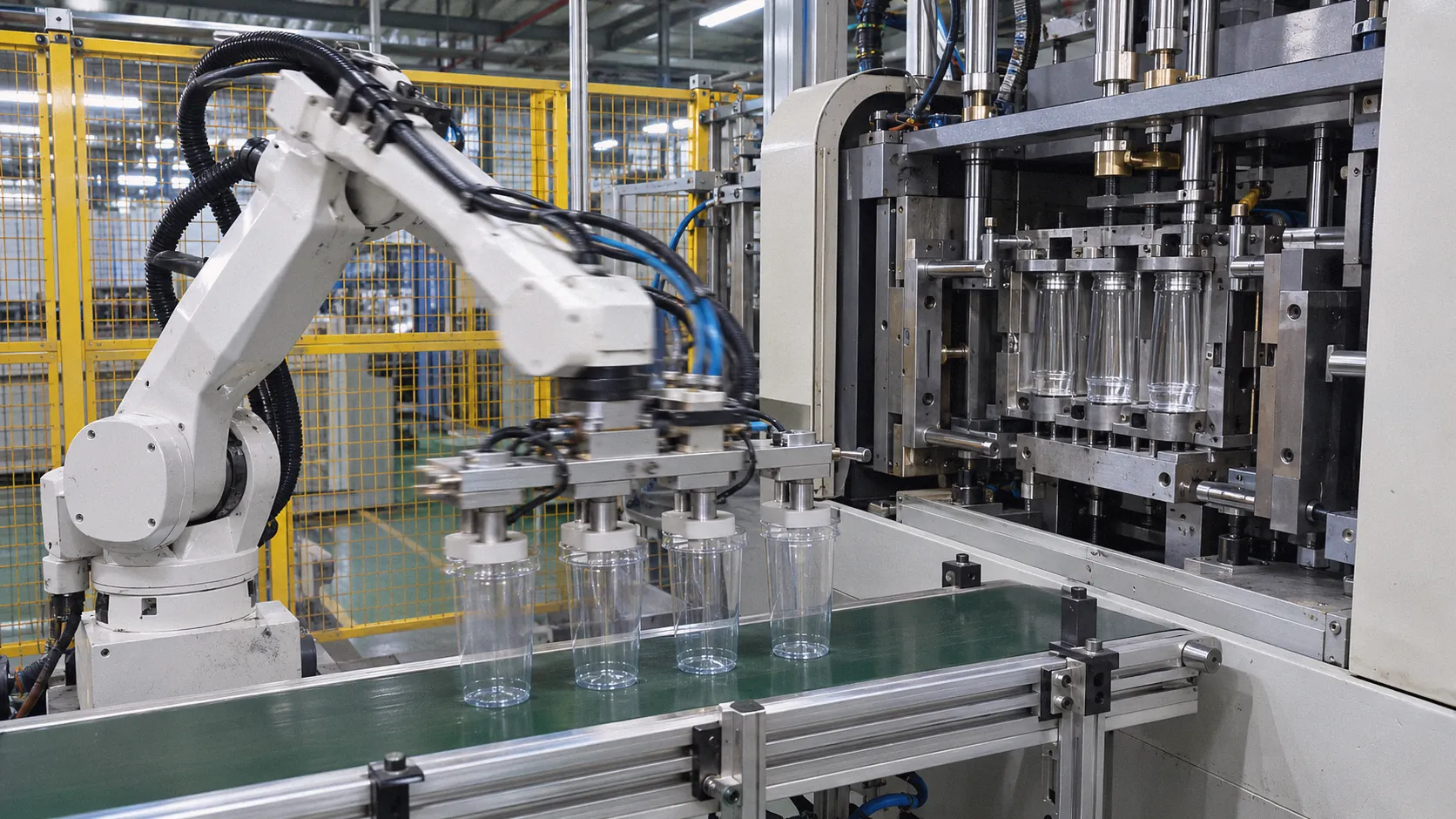
| Take-out robot or conveyor | Places containers for inspection and packing | Gripper per cavity layout |
Leaving any of these out of one quotation and in another is the most common reason offers look further apart than they are. Our article on take-out robots for ISBM covers the downstream options.
7. Service, trial and delivery scope
The commercial scope matters as much as the hardware. Check whether each offer includes a mold trial with your resin, sample containers, installation and commissioning, operator training, a spare-parts kit, documentation in your language and the applicable conformity marking for your market. Ask what remote support and on-site service look like after start-up.
How to compare quotations fairly
Compare offers on cost per good container over the life of the project. Two numbers drive that comparison: output of good containers per hour and the total investment. A cheaper machine that needs a longer cycle, makes more rejects or takes longer to change molds can cost more per container. Our guide to estimating ISBM output shows how to compare cycle times and efficiency.
Sources even differ on which route needs more capital: OpenLearn describes two-stage ISBM as the larger investment, while Brandau notes that a two-stage blow molder needs less capital than single-stage, because it can buy preforms instead of making them.[4][3] The difference is what each counts in the line, which is exactly why a quotation should list every item.
How SanSong can help
SanSong quotes each ISBM project on its container. Published models are the SS-400-60-03-01 three-station machine (containers up to 4.6 L, 1 to 12 cavities, single injection unit), the SS-400-60-03-02 three-station two-color machine and the SS-400-110-04-02 four-station double-row machine. Molds are made for each container; published examples range from 2-cavity to 24-cavity sets.
For a quotation that can be compared line by line, send us the container drawing, resin and annual quantity. Our guide on what to send with an equipment enquiry lists the details that speed up the review, and the ISBM machines page summarizes each model.
Frequently asked questions
Can you publish a price list for ISBM machines?
SanSong does not publish fixed prices, because the same model is quoted differently depending on cavities, container size, resin, molds and automation. Send the container drawing, resin and annual quantity and the team will quote the configuration that fits.
Is a four-station machine always more expensive than a three-station one?
A four-station machine has an extra station and a more complex mold set, so it usually costs more for the same container. It can still be the cheaper choice per good container if conditioning lets you run a shape or resin that a three-station machine would reject.
Does the machine price include the mold?
Quotations differ. Ask every supplier to list the mold set as its own line, with the number of cavities, hot runner type and what the trial includes, so the offers can be compared.
What auxiliary equipment does an ISBM line need?
Typically a resin dryer (for PET, copolyesters, PC and PPSU), a chiller, mold temperature controllers, a compressed-air supply for blowing and, often, a take-out robot or conveyor. Check which of these each quotation includes.
Sources
- Drying and processing guidelines for injection molding, Eastman Tritan copolyester (TRS-DUR-244), Eastman Chemical Company.
- Sulfones Processing Guide, Solvay Specialty Polymers.
- Blow Molding: Single- or Two-Stage PET Bottle Making? Get to Know Your Options, Plastics Technology (Ottmar Brandau).
- Blow moulding, The Open University, OpenLearn.
Editorial note: written from the public sources listed above and SanSong’s published product information, checked on the dates shown. It is general guidance, not legal or compliance advice. Specifications not yet published by SanSong are confirmed during the project review.