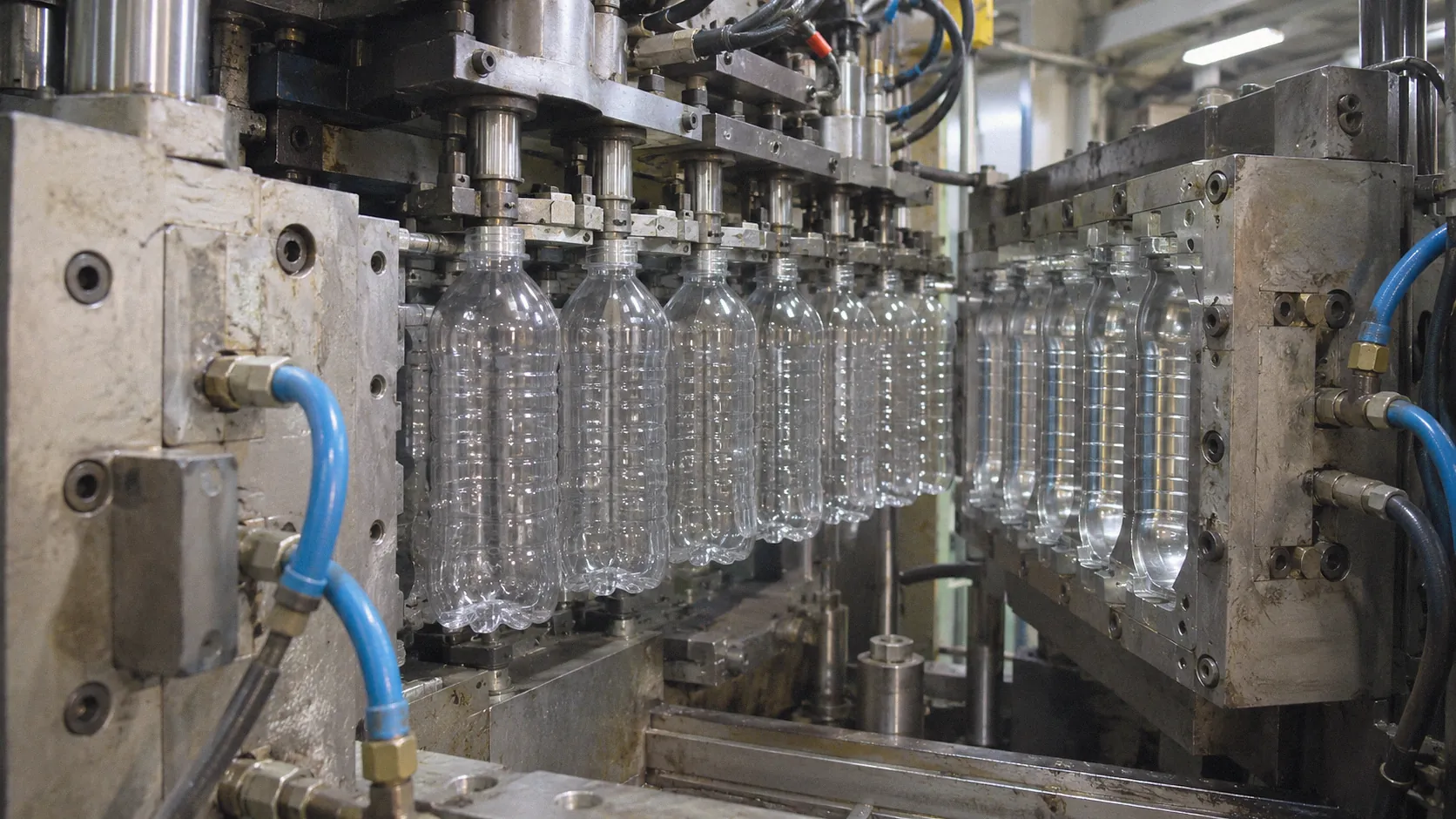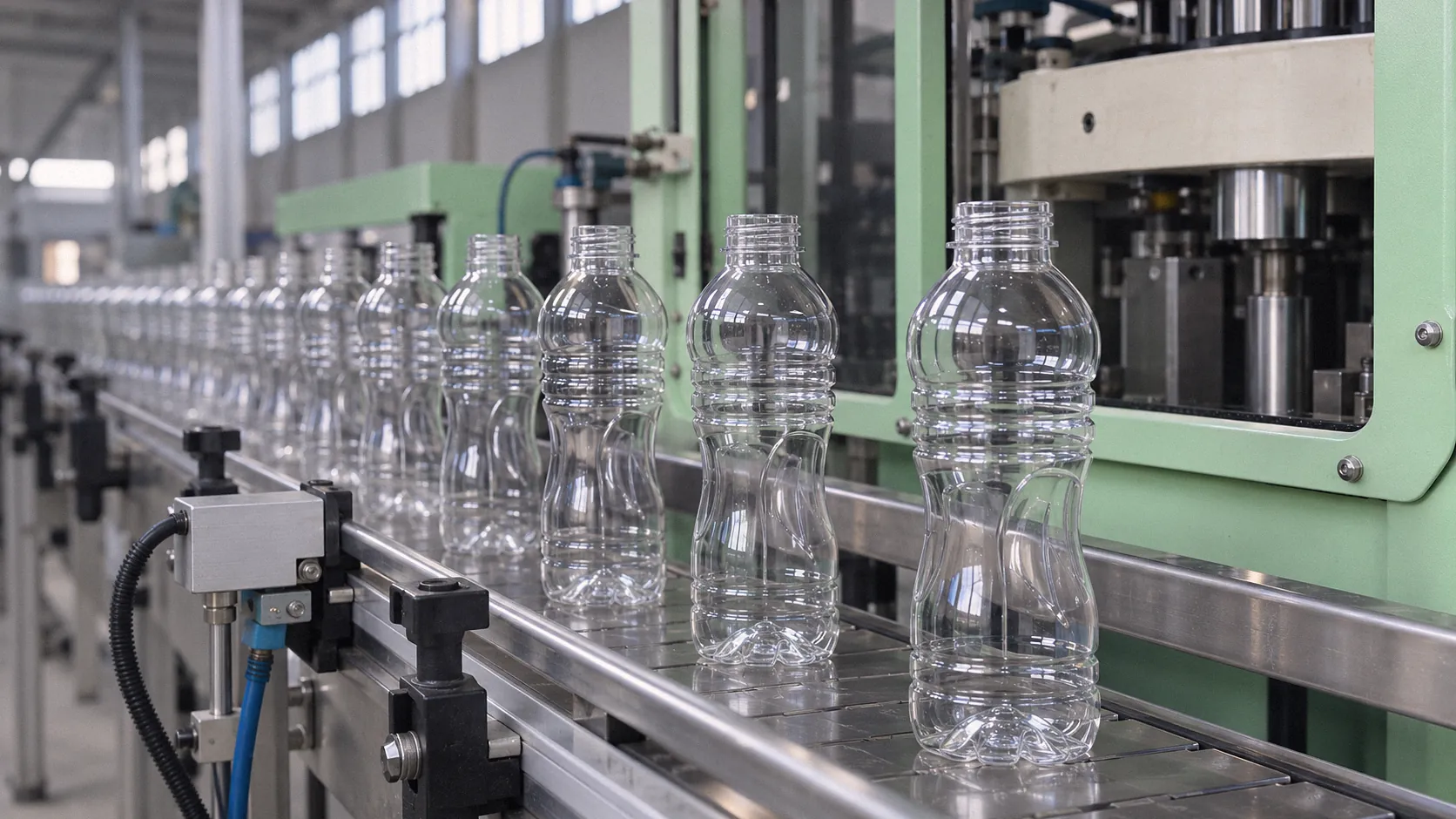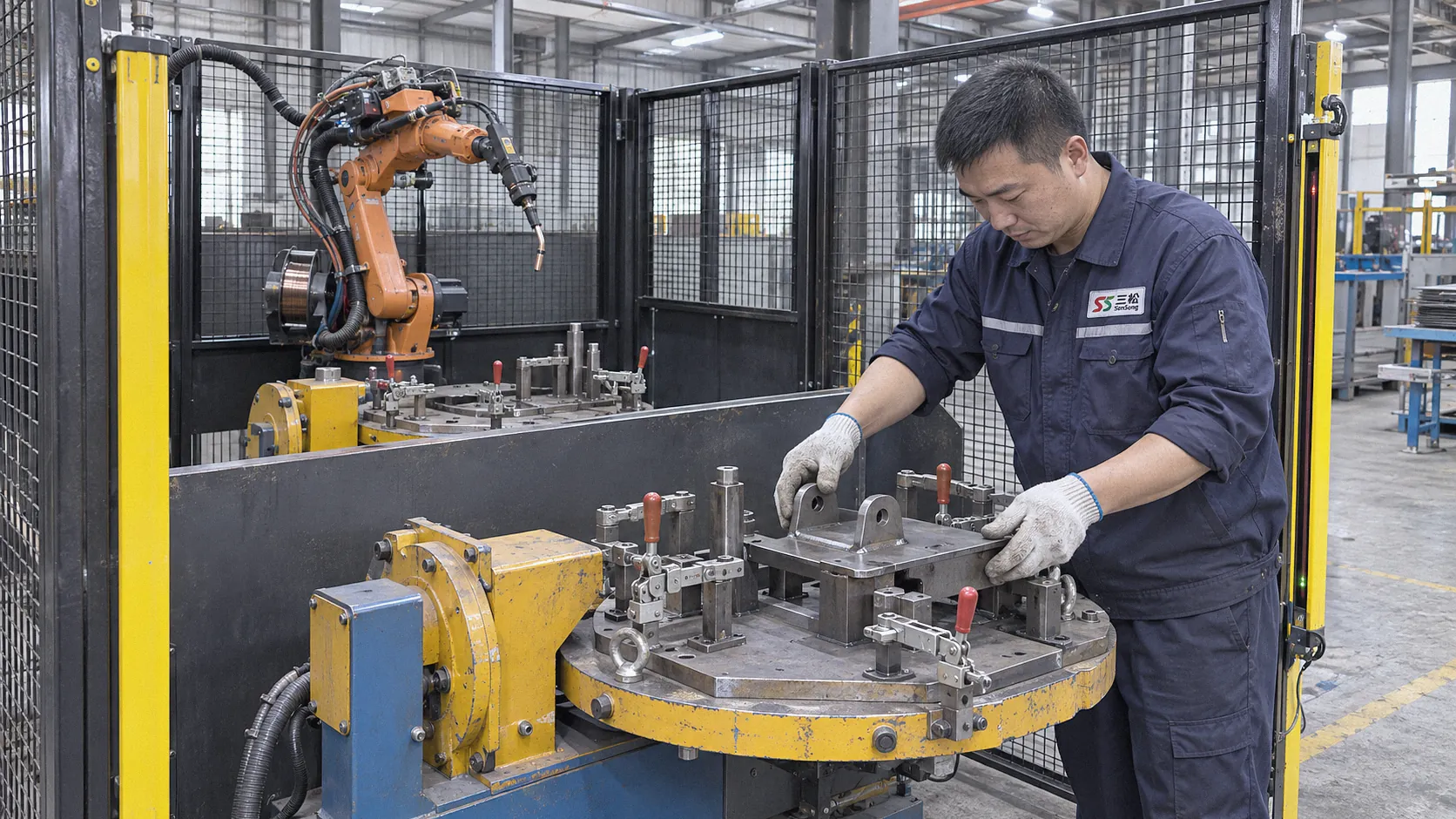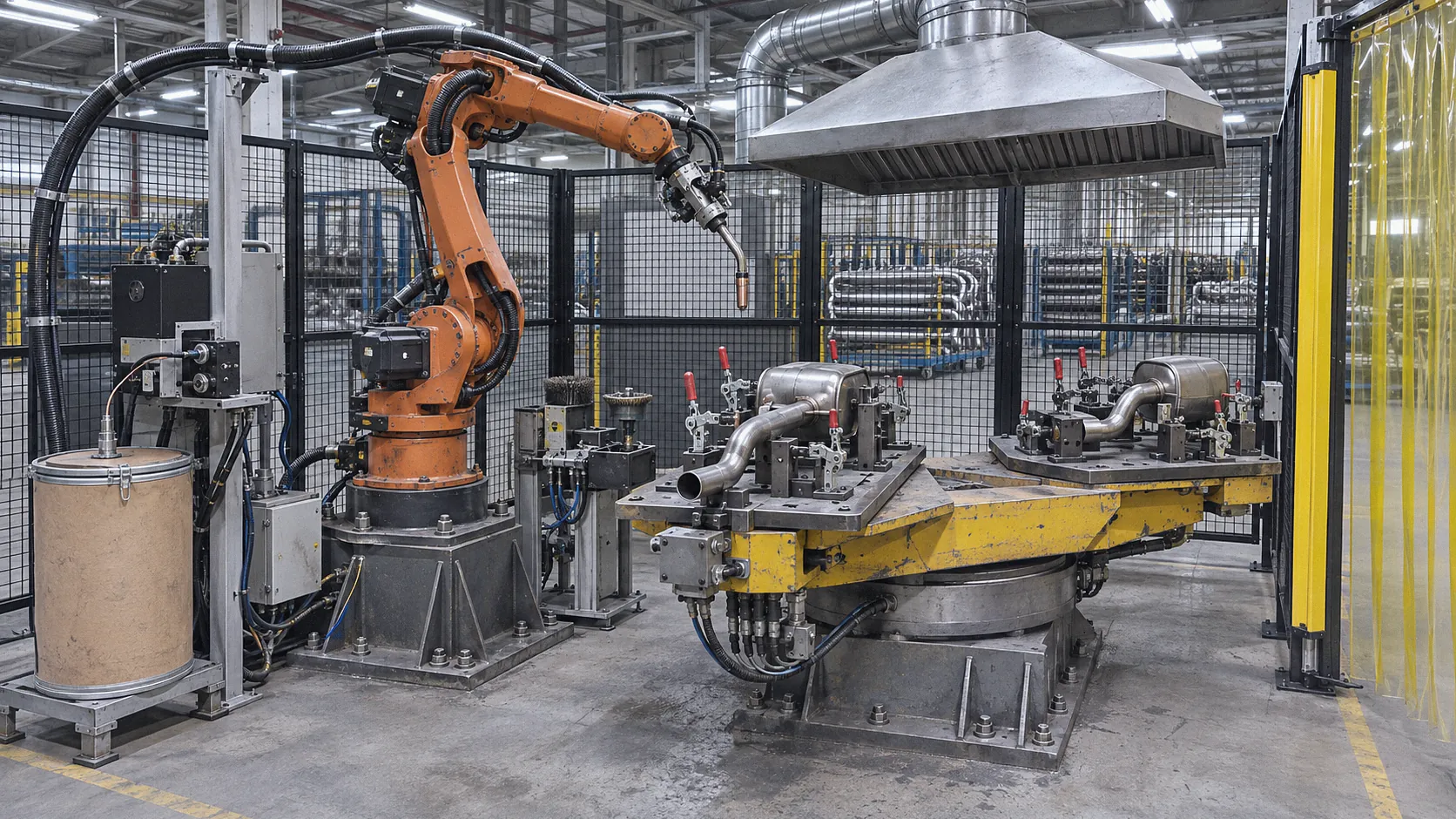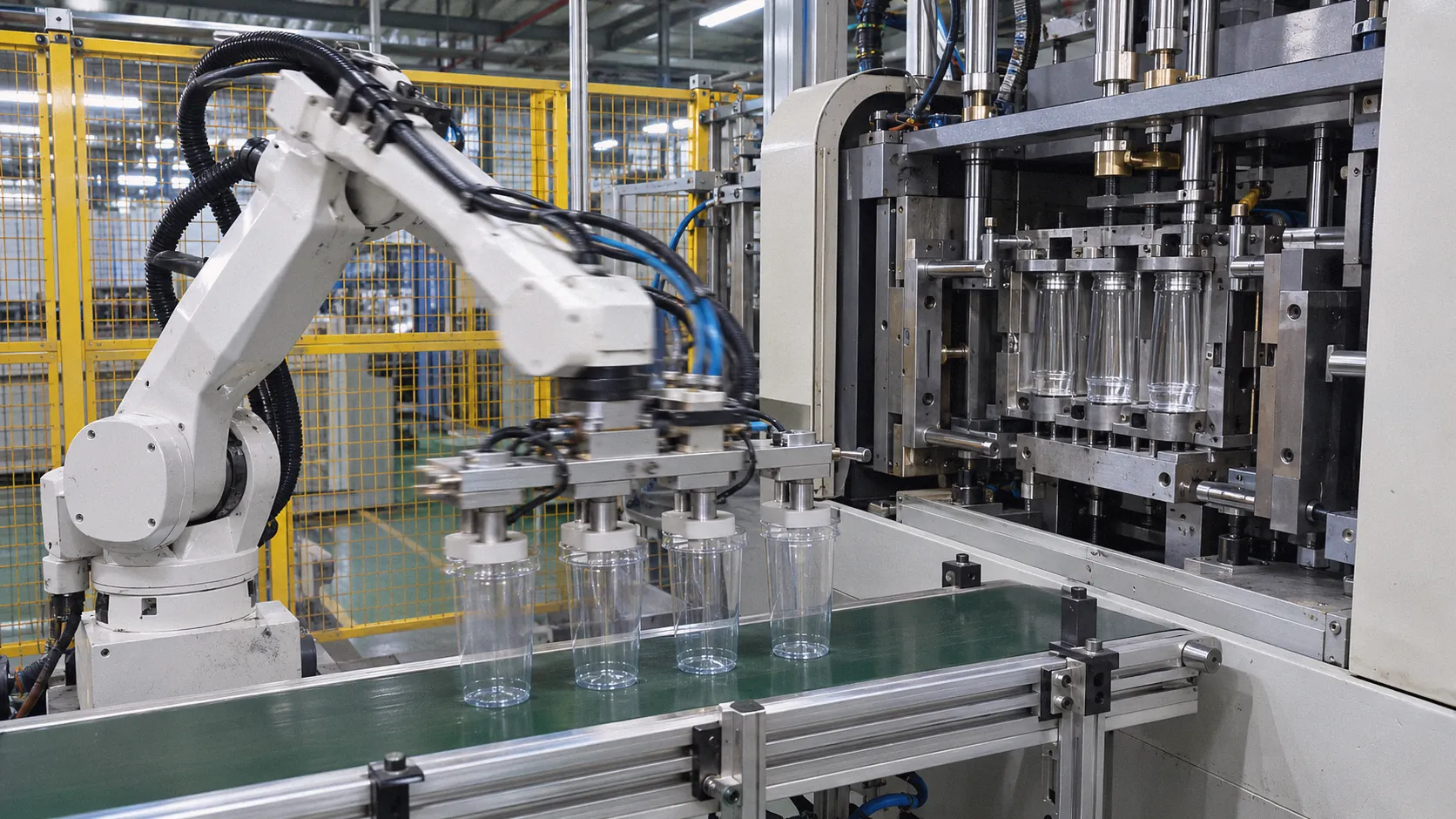
An ISBM take-out robot lifts the finished containers from the ejection station and places them, oriented and spaced, on a conveyor or straight into inspection and packing. Because a one-step machine delivers containers with a finished neck, the robot can grip them by the neck at once, and the line can run from resin to packed carton without manual handling.
This guide covers the options after the machine, how to size a take-out robot, and the interface and safety points to agree before the order.
Why automate the end of an ISBM line
The end of the line is where one-step quality is easiest to lose. Paul Atkin of Nissei ASB notes that holding the preform by the neck throughout the one-step process avoids scuffing and supports better visual quality.[1] Dropping containers into a bin afterwards can undo that.
Automation after the machine helps in four ways:
- Surface protection. Containers do not rub against each other or fall onto hard surfaces.
- Orientation. Containers arrive upright and spaced for inspection, capping or packing.
- Hygiene. Fewer hands touch containers for food, baby or medical use.
- Counting. Every cycle’s output is recorded at the same point.
Options after the ejection station
The right option depends on the container and the next step.
| Option | Suits | Watch out for |
|---|---|---|
| Chute and conveyor | Robust containers, bulk packing | Scuffing, random orientation |
| Pick-and-place robot | Oriented placement, inspection, packing | Gripper change per mold |
| Collaborative robot | Low-speed take-out next to operators | Cell risk assessment, cycle speed |
| Robot plus inspection and counting | Food, baby and pharmaceutical containers | Reject handling, data interface |
Grippers and the cavity layout
The gripper has to match the cavity layout of the mold: the number of containers, their pitch and, on double-row machines, both rows. Neck grippers suit most ISBM containers, because the neck is rigid and finished, and they keep fingers off the visible body. Vacuum cups can work on flat or wide containers but must not mark the surface.
Plan one gripper per mold or a gripper with adjustable pitch. Gripper change time then becomes part of the mold changeover; our guide on mold changeovers covers that time.
Sizing the robot to the cycle
The robot has to finish its move and leave the mold area before the next ejection. Size it for the shortest cycle the machine may run, not the first trial cycle, since cycles usually get shorter as the process is optimized. Check:
- Reach to the ejection station and to the placement point.
- Payload: gripper plus all containers in one cycle.
- Move time inside the ejection window, with a margin.
- Space for the gripper to enter without touching the neck molds.
Our guide to estimating ISBM output explains how the cycle is set.
Inspection, counting and packing
Downstream steps depend on the product. Food and drinkware lines often add a visual check for defects and contamination; medical and baby products may add more inspections and lot tracing. Agree what happens to a reject: diverted automatically, flagged, or stopped. Counting at the robot gives an exact production record per cavity.
Interfaces and safety
A take-out robot turns a machine into a robot cell, and the cell is assessed as a whole. ISO 10218-2:2025, published in February 2025, sets the safety requirements for integrating industrial robot applications and robot cells, from design and commissioning through operation and maintenance.[2]
IBF Solutions summarizes changes that matter for take-out cells:[3]
- Collaborative operation, previously in ISO/TS 15066, is now part of ISO 10218-2, including hand guiding, speed and separation monitoring, and power and force limiting.
- A normal-stop safety function is now required, separate from emergency stop.
- Guidance on manual load and unload stations and on gripper systems has been integrated.
- The blanket performance level requirement has been replaced by default levels per safety function in an informative annex, such as PL d for protective stop.
For the EU market, the Machinery Regulation (EU) 2023/1230 applies from 20 January 2027. Pilz notes that it defines substantial modification and that “If a substantial modification has taken place, the operator becomes the manufacturer”.[4] Adding a robot to an installed machine should therefore be planned with the conformity documentation in mind. Our article on ISO 10218:2025 explains the standard in more detail.
Agree the signal interface between machine and robot in writing: ejection ready, robot clear, cycle start inhibit, fault and emergency-stop links.
How SanSong can help
SanSong builds both sides of this interface: one-step ISBM machines and industrial robot automation. Its published blow-molding cases include a three-cavity juicer cup and a four-cavity sports bottle, each produced with a take-out robot. Its automation team designs non-standard production lines, installs and commissions robots, and provides maintenance.
To plan automation for a new or existing ISBM line, see the ISBM machines, see robotic automation systems or send us the container, cavity layout and downstream steps. Our guides on robot retrofits and automation acceptance list what to prepare.
Frequently asked questions
Do I need a take-out robot on a one-step ISBM machine?
Not always. Containers can drop onto a chute or conveyor. A robot pays off when containers must stay oriented, must not touch each other, go straight into inspection or packing, or when labor for manual handling is scarce.
Can a collaborative robot be used for take-out?
Sometimes. ISO 10218-2:2025 now covers collaborative applications, including power and force limiting. Whether a collaborative layout is acceptable depends on the risk assessment of the whole cell, including the machine’s ejection area.
Who is responsible for safety when a robot is added to an existing machine?
The party that integrates the robot and the machine into one cell is responsible for the cell’s risk assessment and conformity. Under the EU Machinery Regulation, a substantial modification can make the operator the manufacturer of the modified machine.
Has SanSong supplied ISBM machines with take-out robots?
Yes. SanSong’s published cases include a three-cavity juicer cup and a four-cavity sports bottle, each produced with a take-out robot.
Sources
- Update on one step injection stretch blow molding, PETnology (Paul Atkin, Nissei ASB), .
- ISO 10218-2:2025 Robotics: Safety requirements, Part 2: Industrial robot applications and robot cells, International Organization for Standardization, .
- New standards for industrial robots: EN ISO 10218-1 and -2, IBF Solutions.
- EU Machinery Regulation from 20 January 2027, Pilz.
Editorial note: written from the public sources listed above and SanSong’s published product information, checked on the dates shown. It is general guidance, not legal or compliance advice. Specifications not yet published by SanSong are confirmed during the project review.