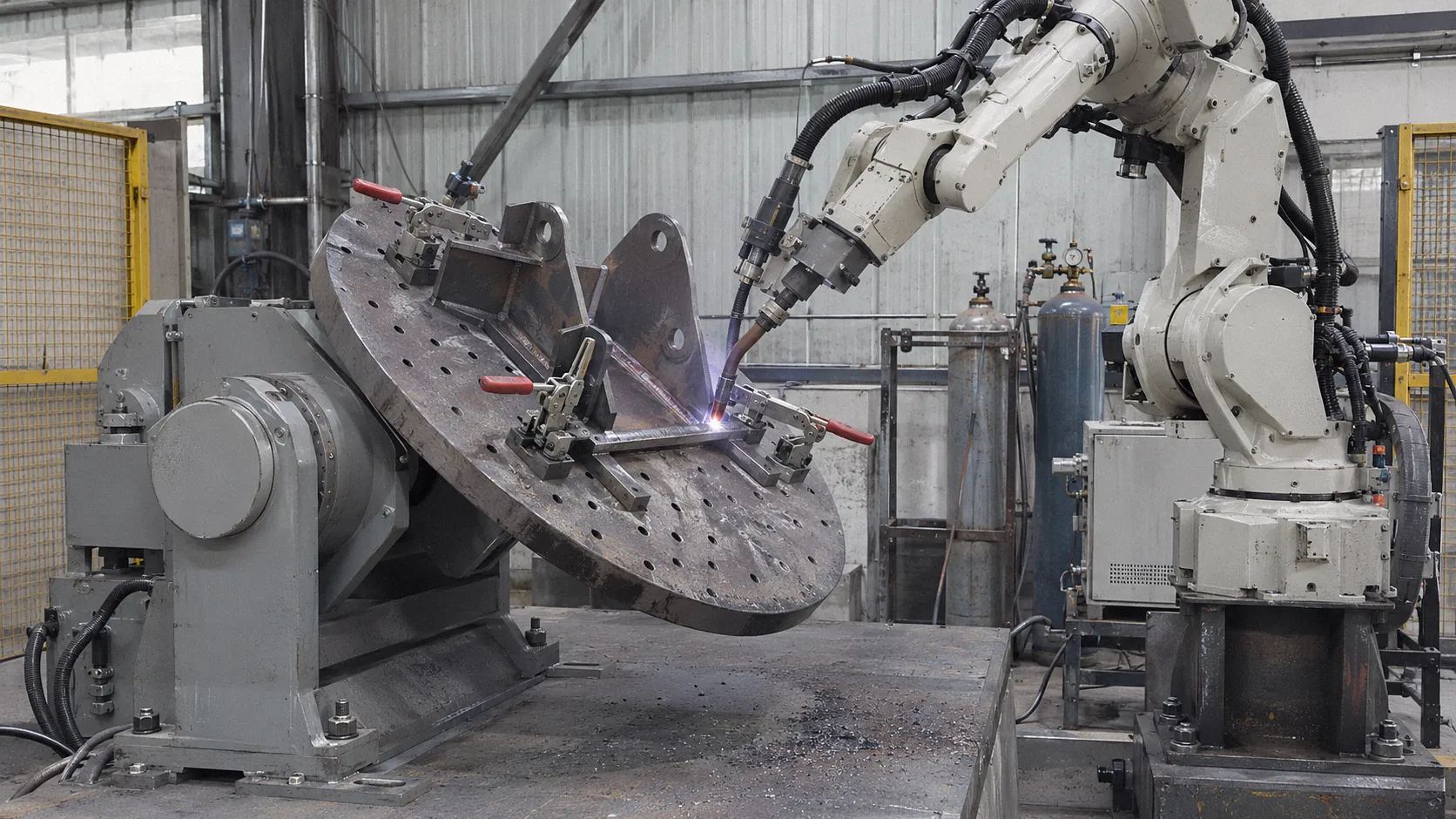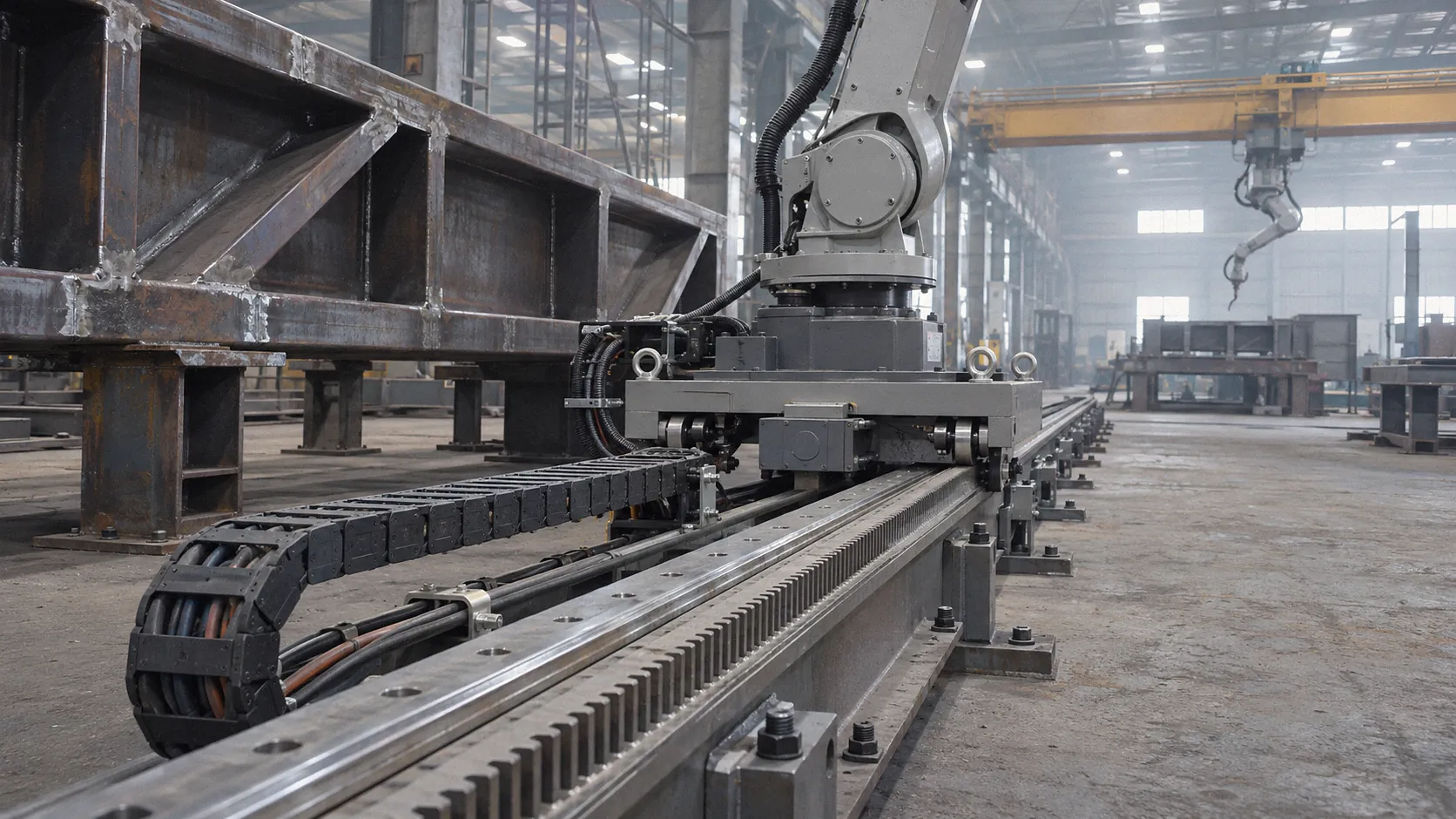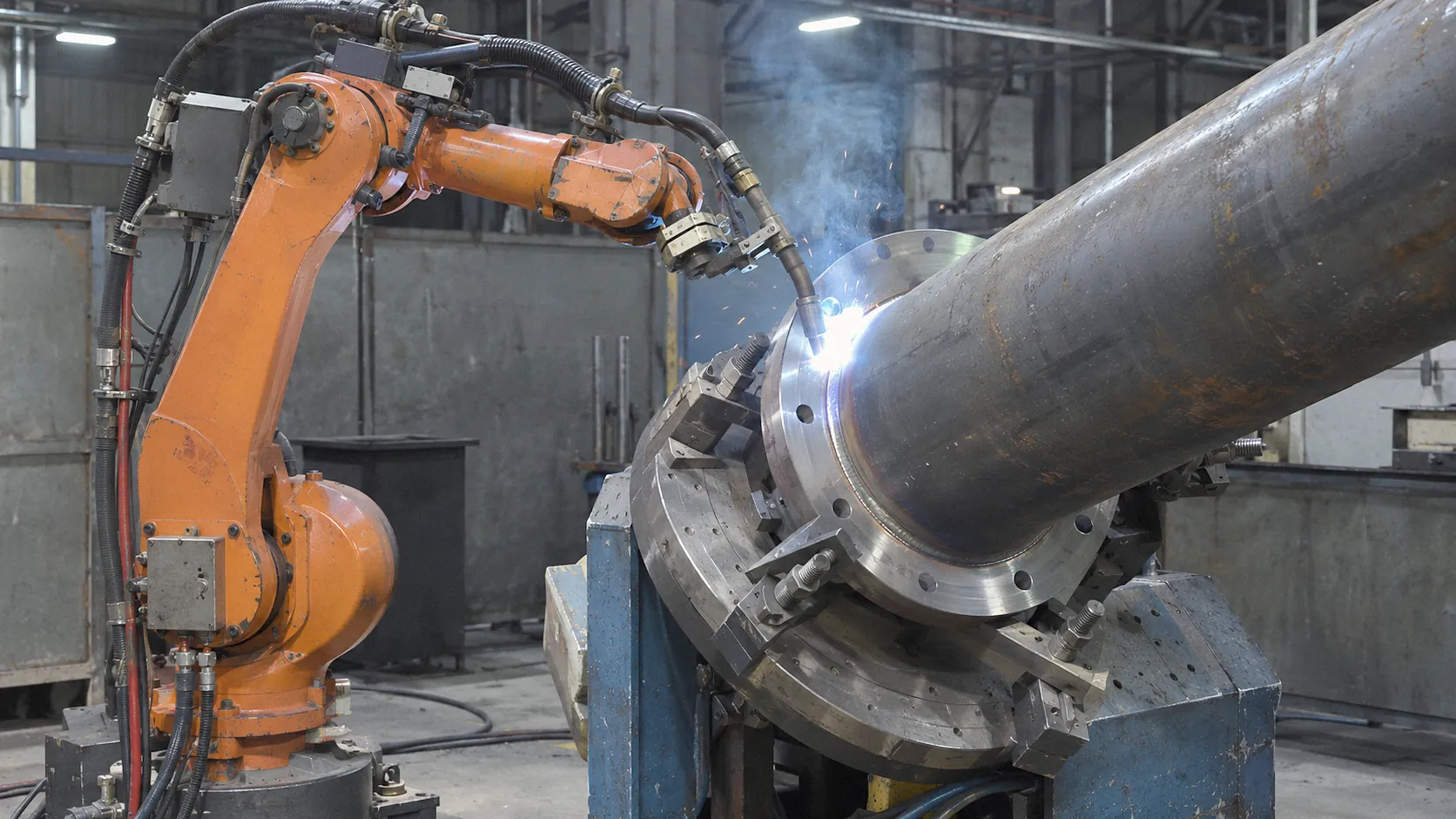
Coordinated motion is a robot controller function that moves the robot and its external axes, such as a welding positioner or a track, together along one path. The torch path is defined relative to the moving part, so the robot keeps the same torch angle and travel speed while the positioner turns the joint into a good welding position. It makes single-pass welds on circular and curved seams possible, but it needs servo-driven external axes on the robot controller and a careful robot-to-station calibration.
This guide explains how it works, when it is worth having, and what a cell needs for it.
Indexing or coordinated motion
A positioner in a robot cell works in one of two ways.
| Mode | How it works | Suits |
|---|---|---|
| Indexing | The positioner turns the part to a set orientation and stops; the robot welds; the positioner turns to the next orientation | Short, straight welds on several faces |
| Coordinated motion | Robot and positioner move together during the weld, on one path relative to the part | Circular seams, long curved seams, welds that should stay flat or horizontal |
FANUC describes its coordinated motion software as synchronizing robots and external axes “so they follow a shared path or timing relationship,” with the robot and external axes programmed as one motion group, which it says reduces programming complexity.[1] Yaskawa’s setup guide describes the robot and station being “coordinated throughout the path.”[2]
What it achieves at the torch
The quality of a robotic weld depends on keeping the torch angles and travel speed right along the whole seam. Yaskawa defines the work angle as the angle of the torch relative to the axis perpendicular to the joint, and the travel angle as the angle relative to the direction of welding. It gives recommended work angles of 45° for fillet joints, 60° for lap joints and 90° for butt joints, with travel angles of up to about 10° to 15°.[3]
On a circular seam, an indexing positioner would force the robot to weld around the part with constantly changing arm poses. With coordinated motion, the positioner turns the part under the torch, and the robot holds the angles. FANUC’s example is a robot and a rotating positioner moving together so the torch stays “perfectly aligned with the joint,” with “consistent speed and orientation between all coordinated axes.”[1]
The same idea avoids refixturing. In a Control Engineering report from Fabtech 2023, Universal Robots’ Bryan Bird describes welding a part in a single pass by moving the part and the robot at the same time, rather than taking it off the table to refixture it.[4]
What the cell needs
Coordinated motion is a combination of hardware, software and setup.
- Servo-driven external axes on the robot controller. The positioner or track must be driven as external axes of the robot controller, not by a separate control.
- The software option. Controllers need the coordinated motion function enabled. Yaskawa’s guide notes that, on a real controller, the parameter file must be updated with Yaskawa’s help and the positioner options enabled before use.[2]
- An accurate tool center point. Yaskawa requires accurate tool data first, taught from five reference positions in varied orientations.[5]
- Robot-to-station calibration. “For coordinated motion between a robot and a station axis, positioning calibration must be performed,” says Yaskawa. For a single-motor station, three points are taught with the station in three rotational positions; for a two-motor station, five points.[5] Keep axes away from their limits while teaching, since near-limit positions reduce accuracy.[5]
- Programming and simulation. Coordinated paths are easier to plan with offline simulation, which shows reach, cable wrap and collisions before the cell is built.
Multi-robot cells and seam tracking
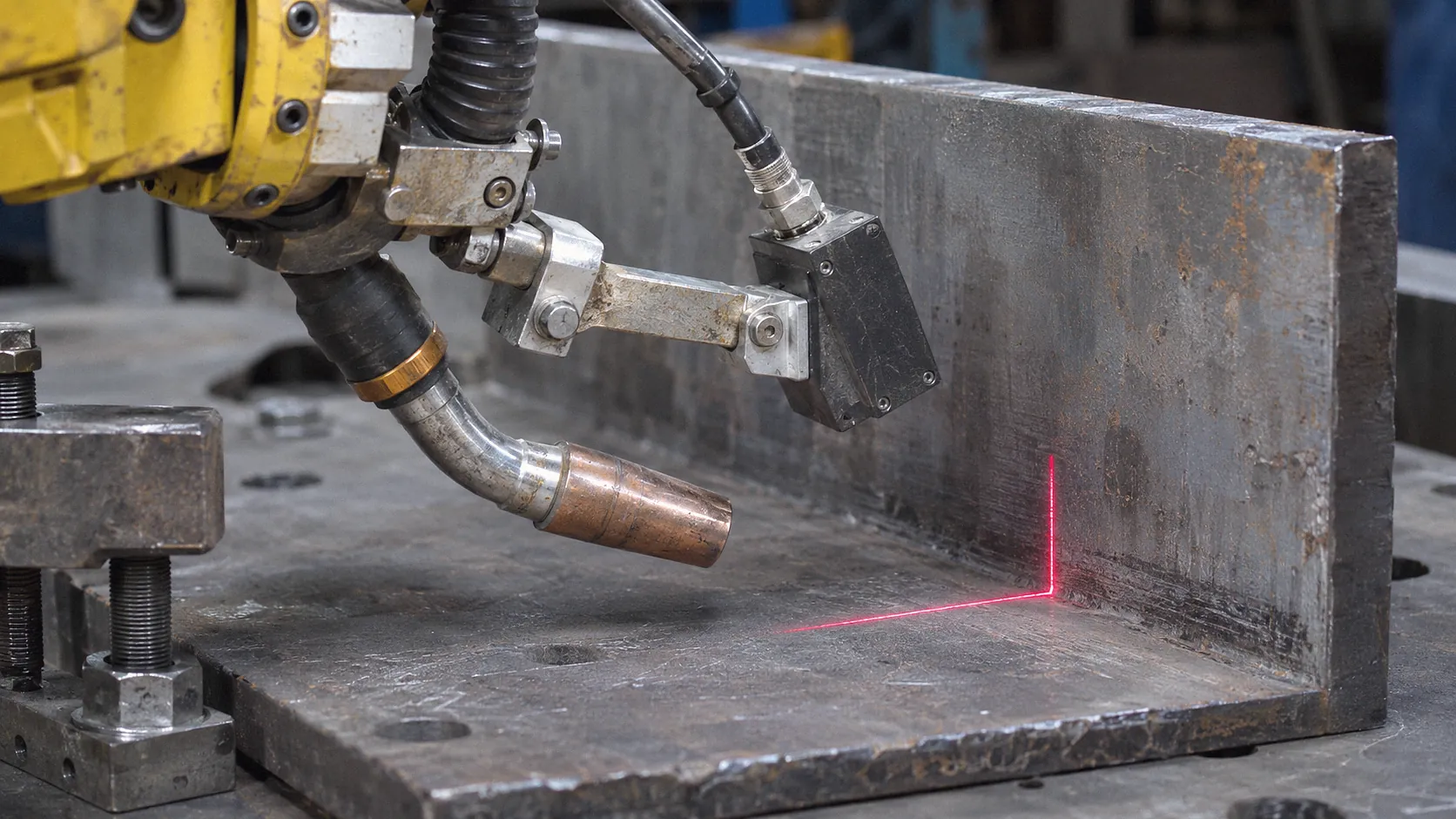
Coordinated motion extends to cells with more than one robot. FANUC describes multiple robots on the same part with movements timed and spaced to avoid collisions.[1] Seam tracking can be combined with it: Yaskawa Motoman lists support for dual robots and coordinated motion among the advantages of through-arc seam tracking.[6] Our article on seam finding and seam tracking compares the sensing methods.
When it is worth having
Coordinated motion is usually worth specifying when:
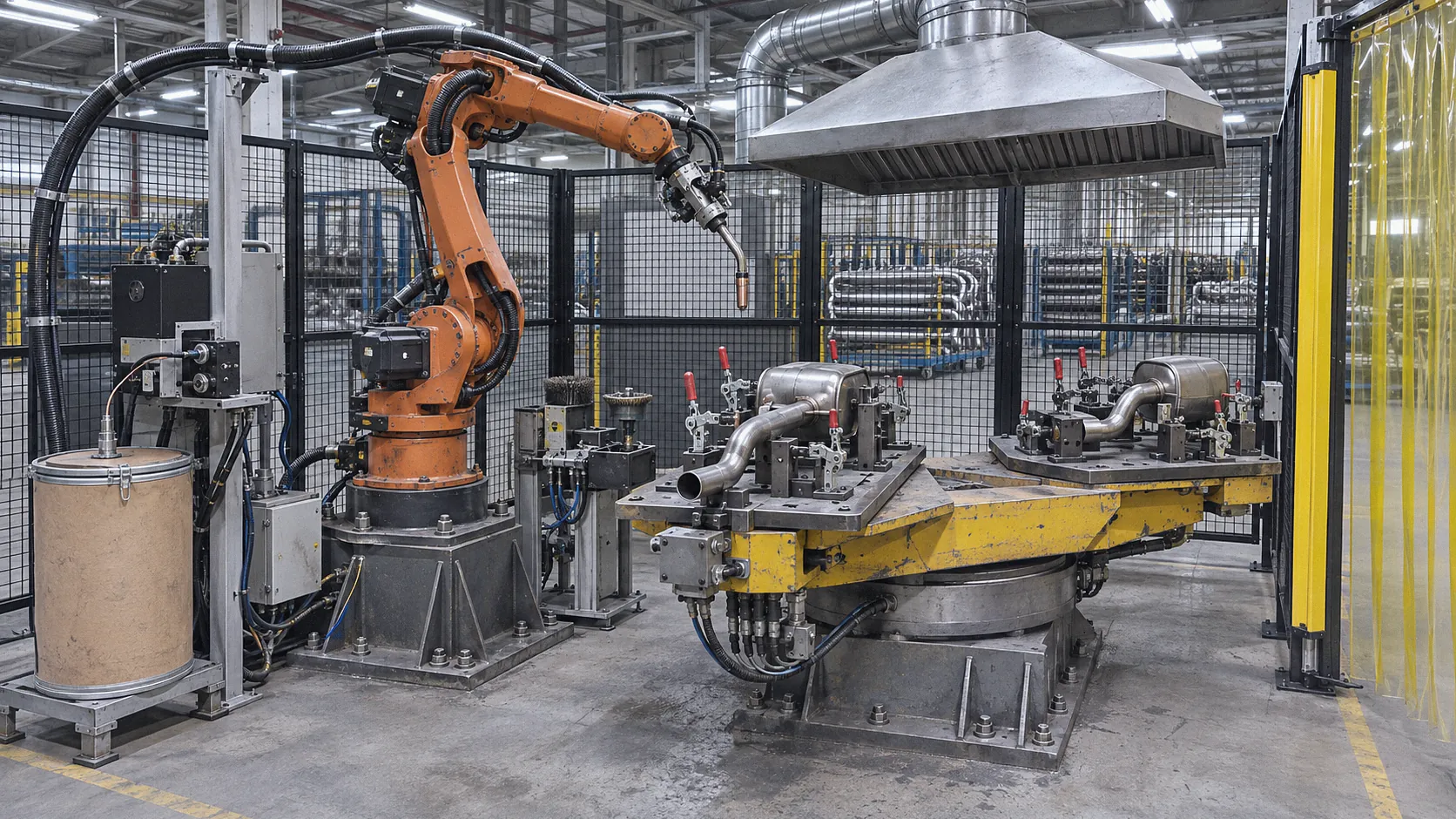
- parts have circular or long curved seams, such as flanges, tanks, axles and exhaust parts;
- welds must stay in the flat or horizontal position along a changing joint;
- large parts need welding on several sides without stopping;
- two robots must work on one part.
For simple parts with short, straight welds, indexing keeps the cell simpler. Our guide on how a welding positioner works covers positioner types and sizing, and robot 7th axis tracks can be coordinated in the same way.
How SanSong can help
SanSong builds welding positioners, floor and overhead tracks and walking axes, and integrates them with robots into welding workstations and welding lines. Its published robotics cases include aluminum battery frame welding and laser seam-finding welding of construction-machinery fenders and steel structures.
To plan a coordinated cell, see welding positioners, see robotic automation systems or send us the part, weld positions and robot controller.
Frequently asked questions
What is coordinated motion in robotic welding?
It is a controller function that moves the robot and external axes, such as a positioner or track, together along one path. The robot keeps its torch angle and speed relative to the part while the part moves.
Do I need coordinated motion for every welding cell?
No. If welds are short and straight and the positioner only needs to present each side to the robot, indexing between welds is simpler. Coordinated motion pays off on circular or long curved seams and on parts where flat-position welding matters.
Why does a positioner need calibrating to the robot?
The controller must know exactly where the positioner’s axes are relative to the robot to keep the torch on the joint while the part moves. Yaskawa states that positioning calibration must be performed for coordinated motion between a robot and a station axis.
Can two robots weld one part with coordinated motion?
Yes, on controllers that support it. FANUC describes multiple robots working on the same part with movements timed and spaced to avoid collisions.
Sources
- Coordinated Motion Plus, FANUC America.
- Coordinated Motion Setup and Operation, Yaskawa Knowledge Center, .
- Robotic Welding Concepts, Yaskawa Knowledge Center, .
- Coordinated external axis control for welding applications, Control Engineering.
- Robot to Station Calibration, Yaskawa Knowledge Center, .
- Pros and Cons of Robotic Seam Finding and Seam Tracking, Yaskawa Motoman (Josh Leath), .
Editorial note: written from the public sources listed above and SanSong’s published product information, checked on the dates shown. It is general guidance, not legal or compliance advice. Specifications not yet published by SanSong are confirmed during the project review.