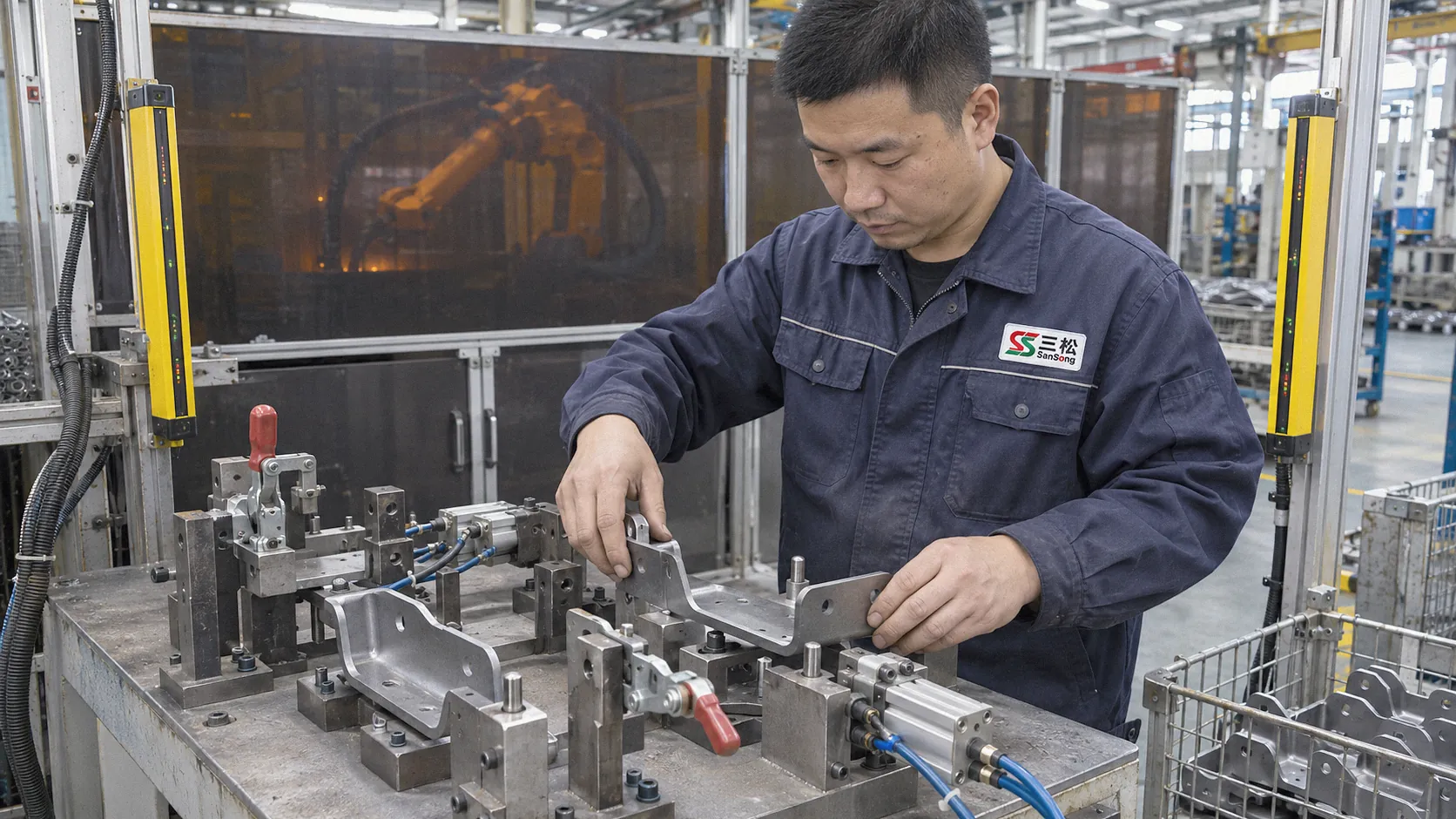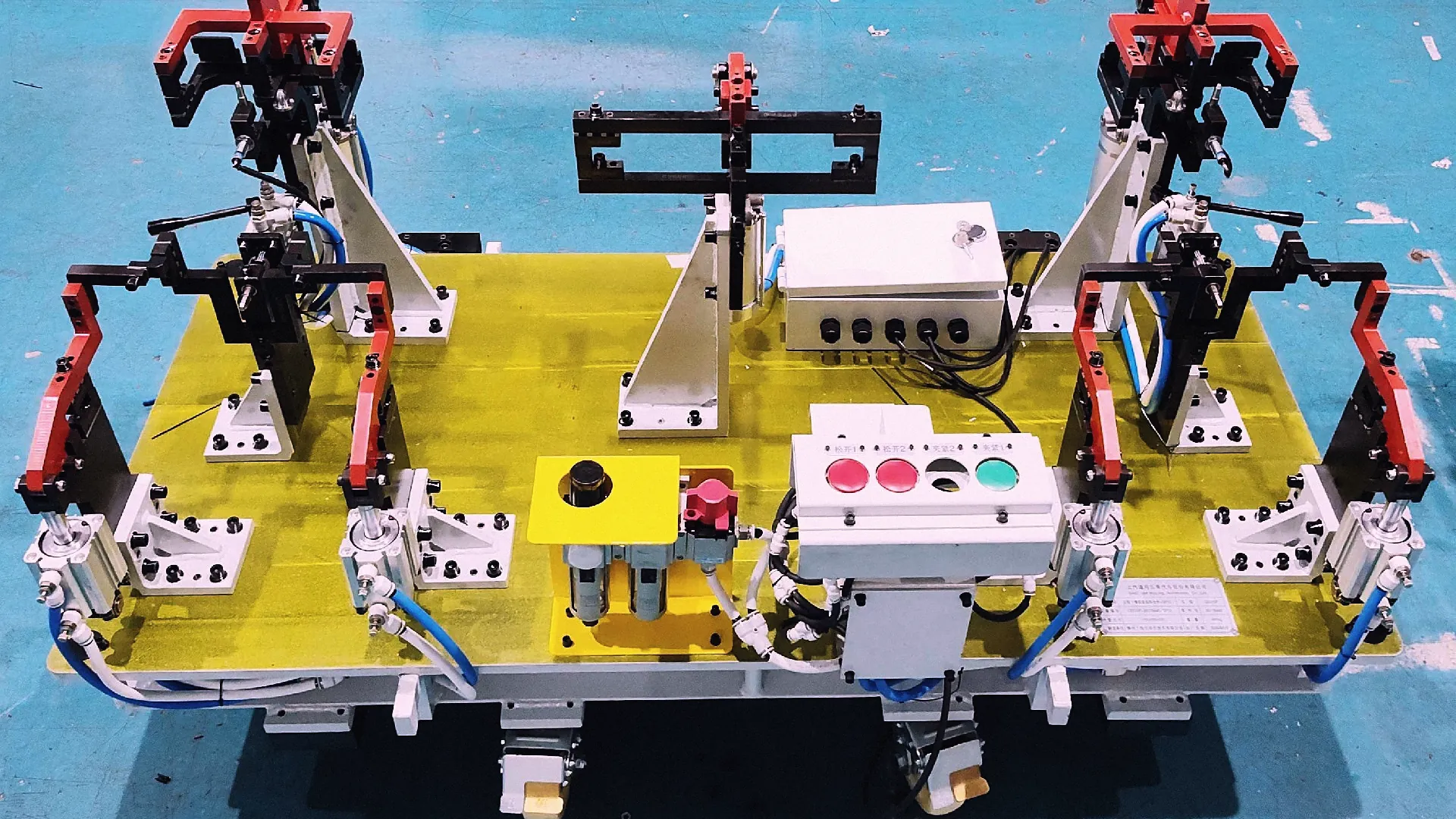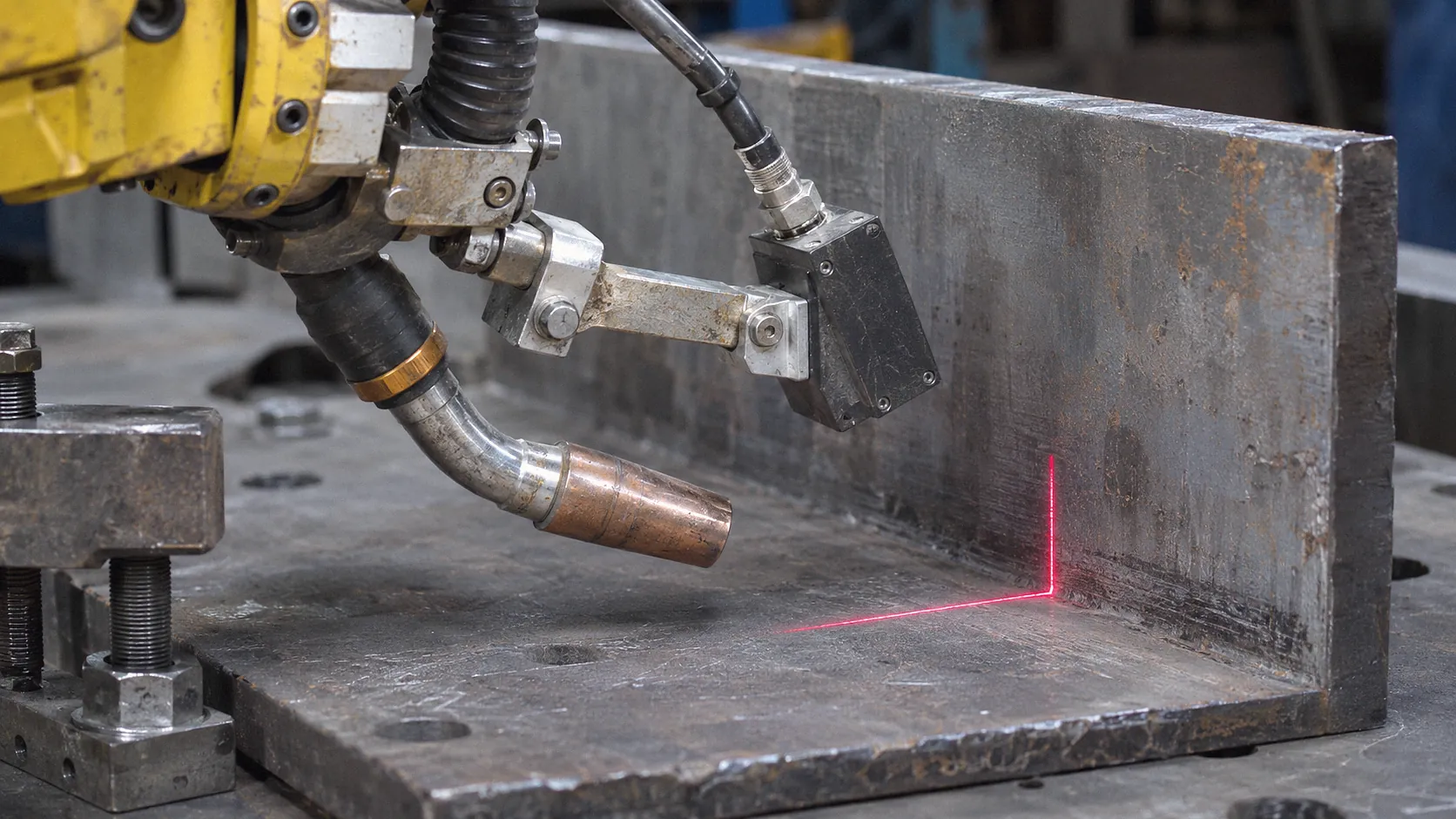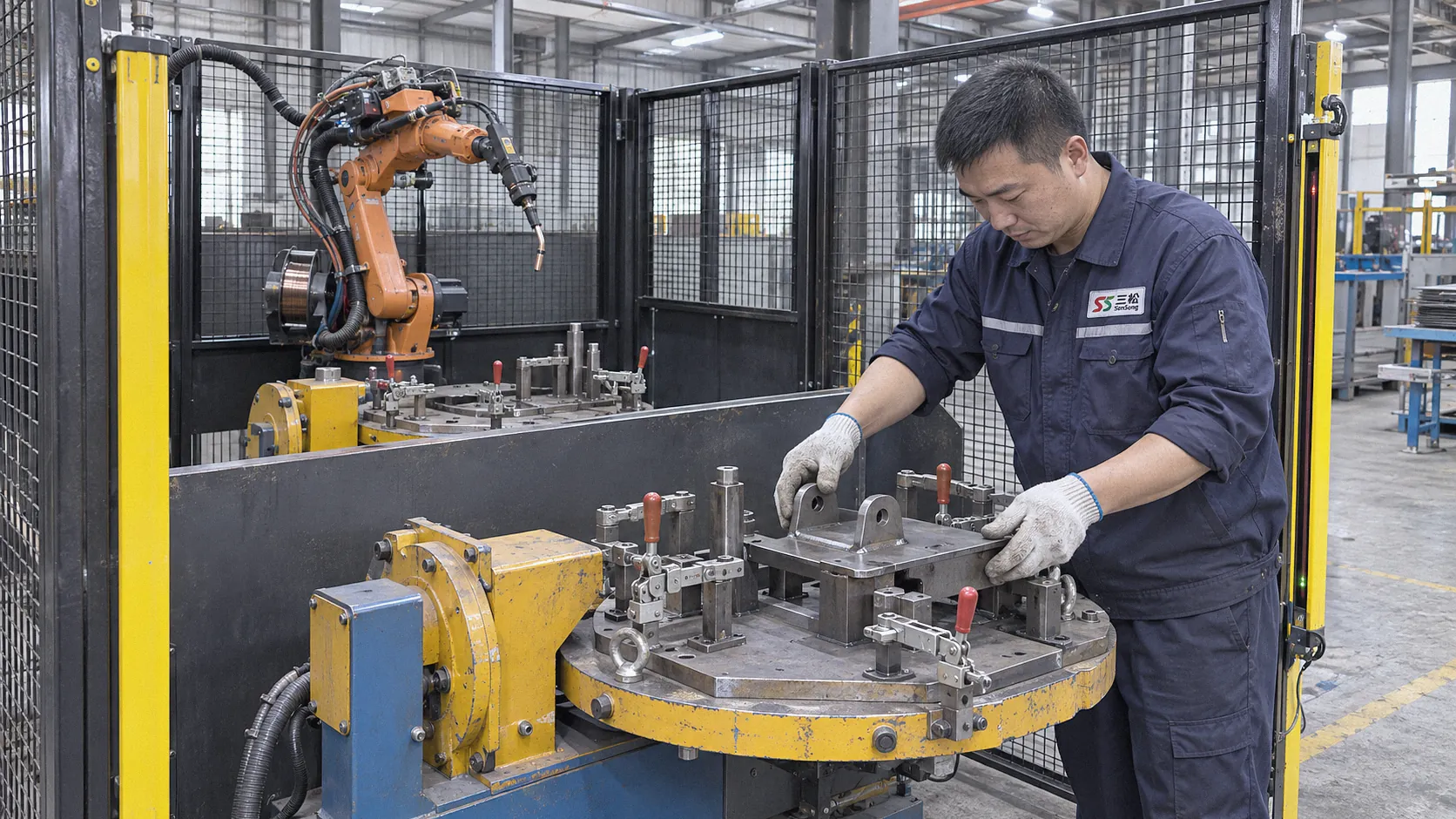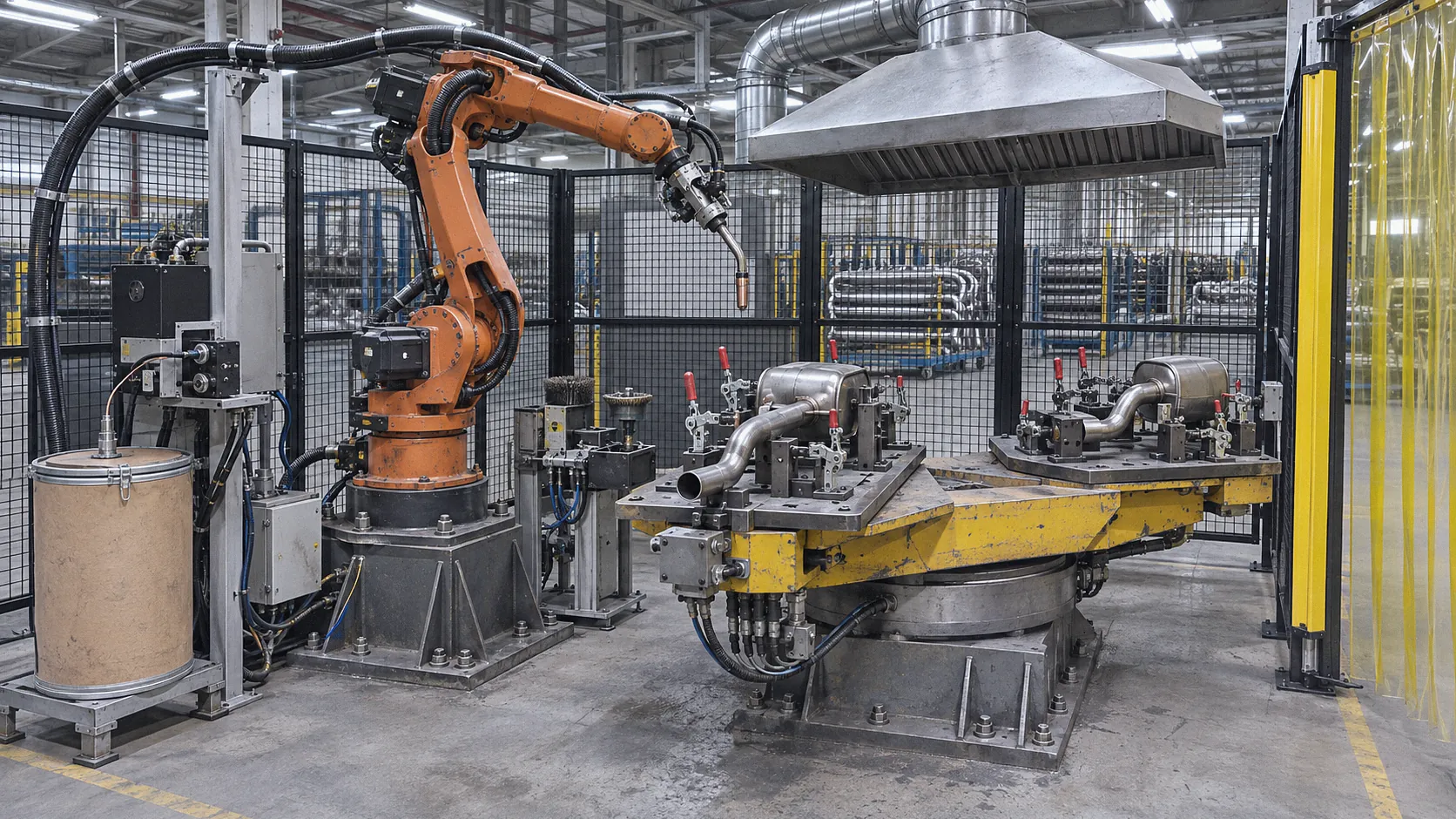
A robotic welding cell is a complete machine built around a welding robot: the robot and controller, a welding package with torch service, a positioner or table, fixtures that hold the parts, sensing that finds the joint, guarding and safety devices, fume extraction and the controls that link them. The layout, from a single station to dual-station or multi-robot lines, and the way fixtures change over, decide how much of the shift the robot actually welds.
This guide lists the components and what to specify for each, then covers layouts and changeover options.
The components and what to specify
| Component | What it does | What to specify |
|---|---|---|
| Robot and controller | Moves the torch along the seams | Reach, payload incl. torch and cables, external axes the controller can drive |
| Welding package | Power source, wire feeder, torch, cables and wire supply | Process (MIG/MAG, pulse, TIG), current, air- or water-cooled torch, wire drum or spool |
| Torch service station | Cleans the nozzle, sprays anti-spatter, cuts the wire | Cleaning interval, wire cutting if touch sensing is used |
| Positioner or table | Holds the part and turns it into a good welding position | Load, center of gravity, torque, number of stations, indexing or coordinated |
| Fixtures | Locate and clamp the parts in a repeatable position | Locating scheme, clamps, access for the torch, changeover |
| Sensing | Finds the seam before welding or tracks it during welding | Touch, laser or through-arc sensing, joint types, cycle impact |
| Safety | Separates people from robot and arc | Fencing, light curtains, interlocked doors, arc screens, safety functions and levels |
| Fume extraction | Removes welding fume at the source or from the cell | Hood or torch extraction, airflow, filter type |
| Gas supply | Delivers clean shielding gas | Piping, leak checks, dew point at the torch |
| Cell controls | Links all of the above to the plant | HMI, part identification, program selection, data and alarms |
AWS publishes a guide on exactly this subject, D16.2, Guide for Components of Robotic and Automatic Arc Welding Installations, covering design, integration, installation and use for GMAW, GTAW, PAW and FCAW.[1]
A few components deserve more attention than they usually get.
Positioner and fixtures
The positioner and fixtures decide fit-up, access and loading time, so they shape both weld quality and cycle. The Fabricator’s positioner guide stresses that part weight also determines the fixtures and mounting plates, that the center of gravity must be recalculated when parts are added, and that swing clearance must be checked across the full tilt range.[2] See our guides on how a welding positioner works and welding fixture design.
Sensing
Parts and fixtures always vary a little. Seam finding locates the joint before welding; seam tracking corrects the path during welding. The right method depends on joint type, material thickness and cycle time: Yaskawa Motoman notes, for example, that touch sensing is slower than laser or camera methods and needs a wire cutter.[3] Our article on seam finding and seam tracking compares them.
Gas and torch service
Shielding gas quality matters most for aluminum. TWI recommends minimizing gas travel distance, using low-permeation piping, checking for leaks and aiming for a dew point “preferably below -50degC” at the torch.[4] Torch cleaning keeps spatter from changing gas coverage over the shift.
Safety
The cell is assessed as a whole. ISO 10218-2:2025 sets requirements for robot cells from design to decommissioning.[5] In the United States, AWS D16.1:2026 is the Specification for Robotic Arc Welding Safety and D16.3:2026 the Risk Assessment Guide for Robotic Arc Welding.[1] Our article on ISO 10218:2025 explains what changed.
Layouts
| Layout | How it works | Suits |
|---|---|---|
| Single station | The operator loads; the robot welds; the operator unloads | Low volume, large parts, long welds |
| Dual station, side by side | The operator loads one station while the robot welds the other | Small to medium parts, medium volumes |
| Turnover or turntable | A rotating frame swaps the loaded side into the robot zone | Shorter load swap, compact footprint |
| Track-mounted robot | One robot on a 7th axis serves several stations or a long part | Long parts, several fixtures |
| Multi-robot line | Several cells or robots in sequence, linked by conveyors or handling robots | High volume, multi-step assemblies |
Yaskawa’s ArcWorld 200, reported by Fabricating & Metalworking, is a typical dual-station example: one robot serves two stations, each with a table or positioner, and the operator “load[s] one workstation while the robot is servicing the other.” An electrically driven barrier door separates the stations, and positioner axes are monitored at standstill while the operator interrupts the light curtain.[6] Our article on dual-station welding cells covers the layout in detail, and our article on robot 7th axis tracks covers track-mounted robots.
Changeover options
When a cell welds several part numbers, changeover time is lost welding time. The usual options, from simplest to most automated:
- Dedicated stations. Each station keeps its fixture; changing parts means switching station and program. Fixtures can also be tooled for different parts or sequential operations.[6]
- Quick-change fixture plates. Fixtures mount on locating pins or zero-point clamping, so they return to the same position without re-teaching.
- Program selection by part. The cell reads a part number, barcode or fixture code and loads the matching program and weld settings.
- Flexible fixtures. Adjustable or modular locators cover a family of similar parts.
- Seam finding. Sensing corrects small differences between fixtures and parts, reducing touch-up after a change.
Record the changeover time as part of acceptance, so it can be checked later. Our guide on automation acceptance lists items to agree.
How SanSong can help
SanSong designs and builds welding fixtures, robot welding workstations, welding lines and handling lines, and supplies its own welding positioners, floor and overhead tracks and walking axes. Its published product pages include a muffler and exhaust welding station, a battery frame welding line with flexible fixtures and seam finding and tracking, a truck floor double-slide welding line and a robot spot welding line. Its engineers also install and commission robots and provide maintenance.
To plan a cell, see robotic automation systems, see robotic production lines or send us the parts, welds and volumes.
Frequently asked questions
What are the main components of a robotic welding cell?
The robot and controller; the welding package of power source, wire feeder, torch, cables and wire supply; a torch cleaning station; a positioner or table with fixtures; sensing such as seam finding; guarding and safety devices; fume extraction; and the cell controls that link them.
What is the most important part of a welding cell?
There is no single one, but the fixture and the positioner often matter as much as the robot, because they decide part fit-up, repeatability, access and loading time.
How can a welding cell change over quickly between parts?
Use fixtures that mount in repeatable positions with quick-change plates, select the robot program by part, keep common welding settings, and design stations so one part can be prepared while another is welded.
Which standards cover robotic arc welding installations?
ISO 10218-2:2025 covers robot cells in general. In the United States, AWS D16.2 is a guide to components of robotic and automatic arc welding installations, and AWS D16.1 covers robotic arc welding safety.
Sources
- D16 Committee on Robotic and Automatic Welding, American Welding Society.
- Welcome to the world of positioneering, The Fabricator (Don Burgart).
- Pros and Cons of Robotic Seam Finding and Seam Tracking, Yaskawa Motoman (Josh Leath), .
- Avoiding porosity when welding aluminium, TWI.
- ISO 10218-2:2025 Robotics: Safety requirements, Part 2: Industrial robot applications and robot cells, International Organization for Standardization, .
- Dual-station cells add versatility to welding applications, Fabricating & Metalworking, .
Editorial note: written from the public sources listed above and SanSong’s published product information, checked on the dates shown. It is general guidance, not legal or compliance advice. Specifications not yet published by SanSong are confirmed during the project review.