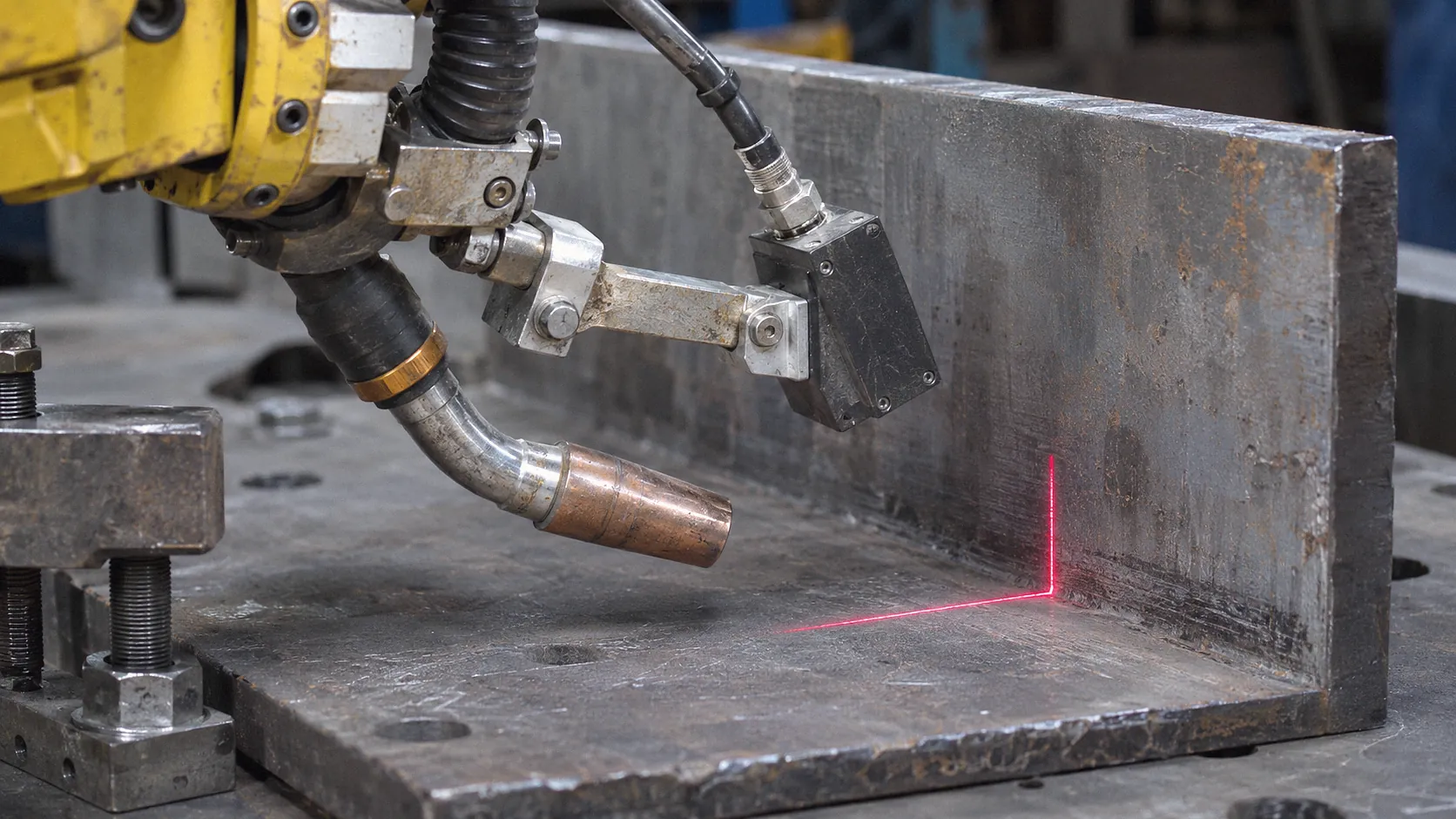
Robotic seam tracking and seam finding let a welding robot follow joints that are not exactly where the program expects. Seam finding locates the joint before welding and shifts the path; seam tracking corrects the path in real time while welding. The main methods are touch sensing, laser sensing and through-arc tracking, and the right one depends on the joint type, material thickness, part variation and cycle time.
This guide explains each method, compares them and gives a way to choose.
Why sensing is needed
A robot repeats its program precisely, but parts and fixtures vary. Mark Oxlade put the problem plainly in The Fabricator: on heavy fabrications, “the joint cannot be placed cost-effectively in the same position for each product.”[1] Cut parts vary, fit-up varies, and heat distorts parts during welding.
Yaskawa Motoman’s Josh Leath separates the two tasks:[2]
- Seam finding locates the weld joint before welding starts, by finding two or more known points on the part and shifting the program path.
- Seam tracking adjusts the weld path in real time during welding. It helps where distortion can occur and on heavy cast parts.
The methods compared
| Method | How it works | Strengths | Limits |
|---|---|---|---|
| Touch sensing (seam finding) | The wire or nozzle touches the part at slow speed; a low-voltage circuit closes on contact | Low complexity and cost; works on all conductive material; does not block joint access | Slow; needs a wire cutter; lap joints over 3 mm only; cannot find square butt joints; limited gap detection |
| Laser point sensing (seam finding) | A non-contact dot sensor on the torch measures the part | Two to five times faster than touch; most joint types; lap joints down to 1/16 in. | Lap joints over 1.5 mm; no square butt joints; reflective materials need evaluation |
| Laser profile scanning (seam finding) | A line or 3D scan captures the joint profile and gap before welding | Gap data before welding; works in all lighting; locates offset and depth | Medium to high complexity; may restrict access; small field of view |
| Through-arc tracking | Arc current and voltage are measured while weaving to detect path error | Low complexity and cost; reliable; supports dual robots and coordinated motion | Needs weaving and thicker material (lap joints from 3 mm); limited by arc physics |
| Laser seam tracking | A torch-mounted laser sensor tracks the seam ahead of the arc | Thin lap joints; travel speeds above 100 in./min; supports weaving | High complexity and cost; restricts joint access; limited tracking radius |
All entries are from Yaskawa Motoman’s comparison.[2]
Oxlade adds practical notes for heavy work: tactile sensing is “cost-effective” and trusted, but mill scale and other material defects can affect the search; a laser reaches restricted areas and is not troubled by surface condition; and “a laser- or vision-based guidance system typically is required for more demanding joint types” where through-arc tracking lacks data.[1]
Combining finding and tracking
Many cells use both. A KUKA case study published by the Association for Advancing Automation describes a cell that checks the part with a tactile sensor before welding, then tracks the seam with an arc sensor during welding, reading current differences between the two sides of the groove to detect torch offset.[3] The robot ran on a linear unit between two positioners.
For multipass welds, Oxlade notes that the same sensing records the root path and offsets the later passes, and that tactile or laser sensing can drive adaptive fill when the joint cross-section or gap changes along its length.[1]
How to choose
Answer these questions with real parts in hand:
- Which joints? Lap, fillet, V-butt or square butt. Square butt joints rule out touch sensing and laser point sensing.[2]
- How thick? Thin lap joints favor laser methods; through-arc tracking needs weaving and thicker material.[2]
- How much variation? Small, consistent offsets suit seam finding; distortion during welding or seams that vary along their length need tracking.
- What cycle time? Touch sensing adds search time to every part; laser methods are faster.
- What access? Torch-mounted sensors make the torch larger, which matters in tight fixtures.
- What material and surface? Mill scale, coatings and reflective aluminum affect each method differently.
Then run trials on parts from the worst end of the tolerance range, not only on good samples.
Sensing does not replace fixtures
Sensing corrects variation; it does not create fit-up. Oxlade notes that tacks must keep the product stable so gaps do not open or close during welding.[1] A good fixture keeps variation within what the sensor can correct. Our guide on welding fixture design covers locating and clamping, and our article on aluminum battery tray welding shows how sensing and fixtures work together on thin aluminum.
How SanSong can help
SanSong’s published robotics cases include laser seam-finding welding of construction-machinery fenders and of steel structures, and a battery frame welding line that combines flexible fixtures with seam finding and tracking. Its engineers design the fixtures, sensing and robot path together for each part.
To choose sensing for your parts, see robotic automation systems, see welding and positioning or send us the parts, joint drawings and tolerances.
Frequently asked questions
What is the difference between seam finding and seam tracking?
Seam finding locates the joint before welding by measuring known points on the part and shifting the program path. Seam tracking adjusts the weld path in real time during welding, which helps where parts distort or seams vary along their length.
Which sensing method is cheapest?
Touch sensing and through-arc seam tracking are the lower-cost options, according to Yaskawa Motoman. Laser point sensing sits in the middle, and laser seam tracking is often high cost.
Can touch sensing find a square butt joint?
No. Yaskawa Motoman lists square butt joints among the joints touch sensing cannot find. It works on most lap and fillet joints and can be used on V-butt joints.
Does sensing replace good fixtures?
No. Sensing corrects variation, but fit-up, gaps and part stability still depend on the parts and fixtures. Tacks and fixtures must keep the part stable so gaps do not open or close during welding.
Sources
- The robotic eye watches over heavy fabrication welding, The Fabricator (Mark Oxlade), .
- Pros and Cons of Robotic Seam Finding and Seam Tracking, Yaskawa Motoman (Josh Leath), .
- Controlled precision: robotic welding with touch and arc sensors, Association for Advancing Automation (case study by Jürgen Warmbold).
Editorial note: written from the public sources listed above and SanSong’s published product information, checked on the dates shown. It is general guidance, not legal or compliance advice. Specifications not yet published by SanSong are confirmed during the project review.