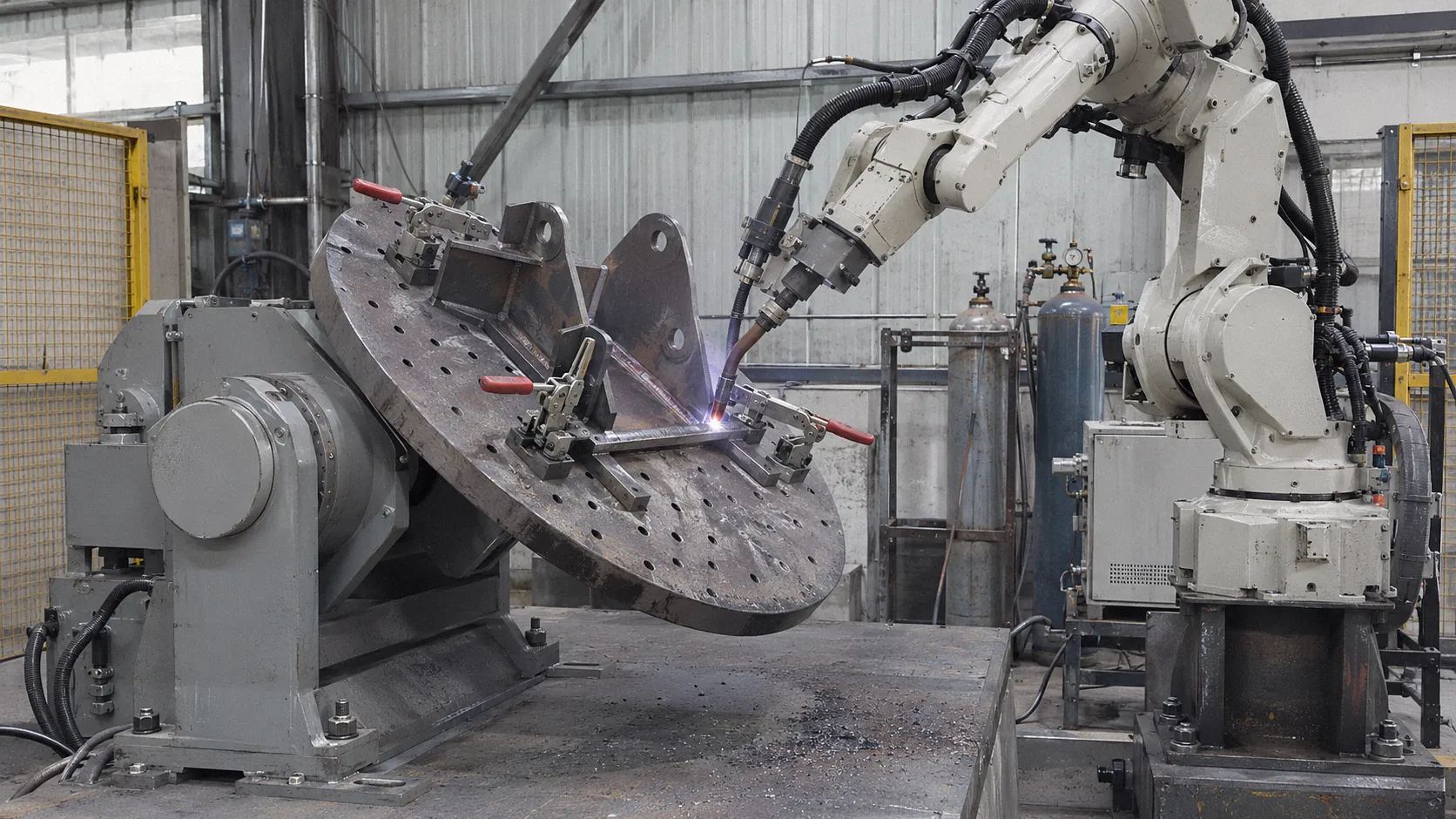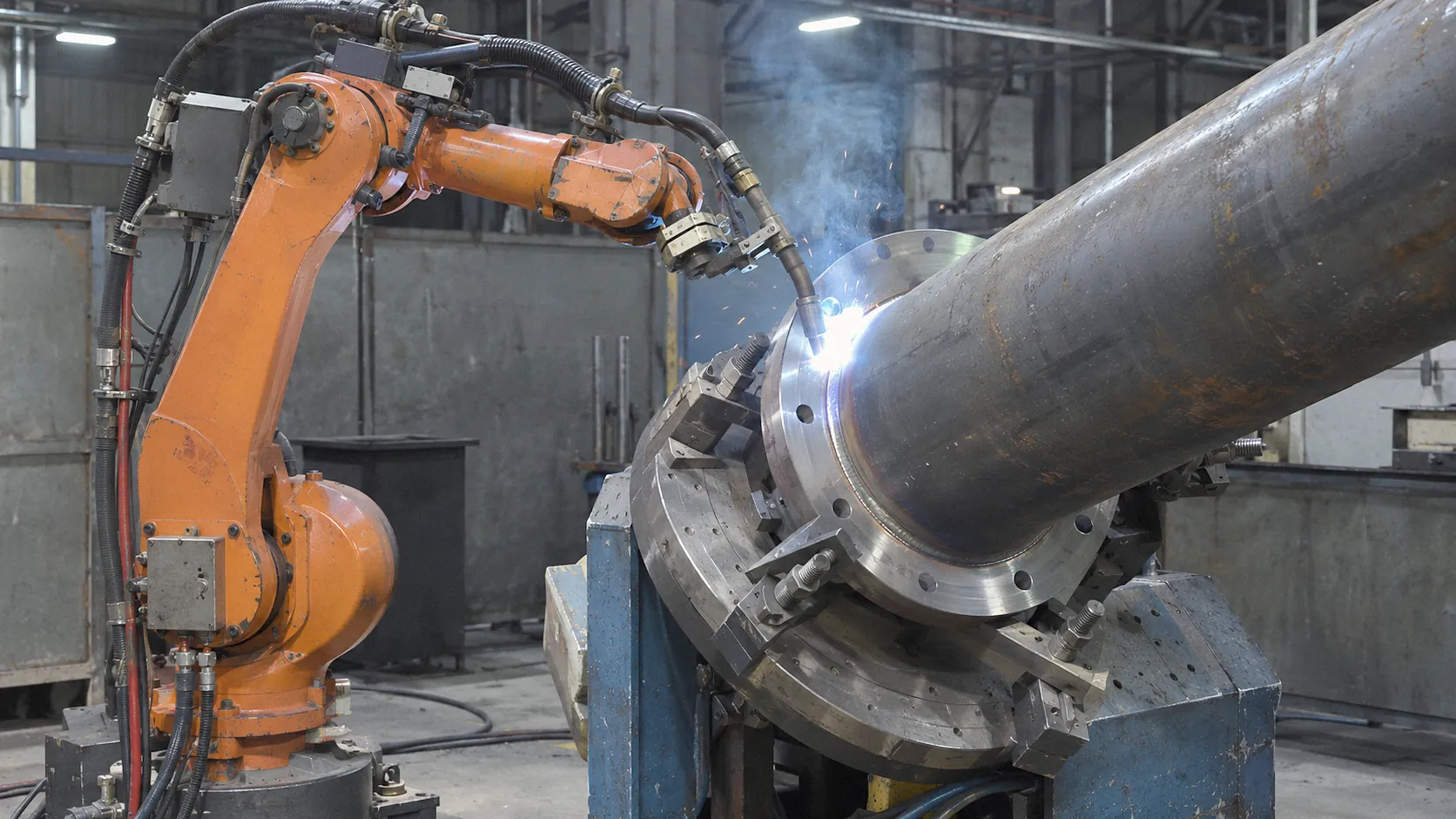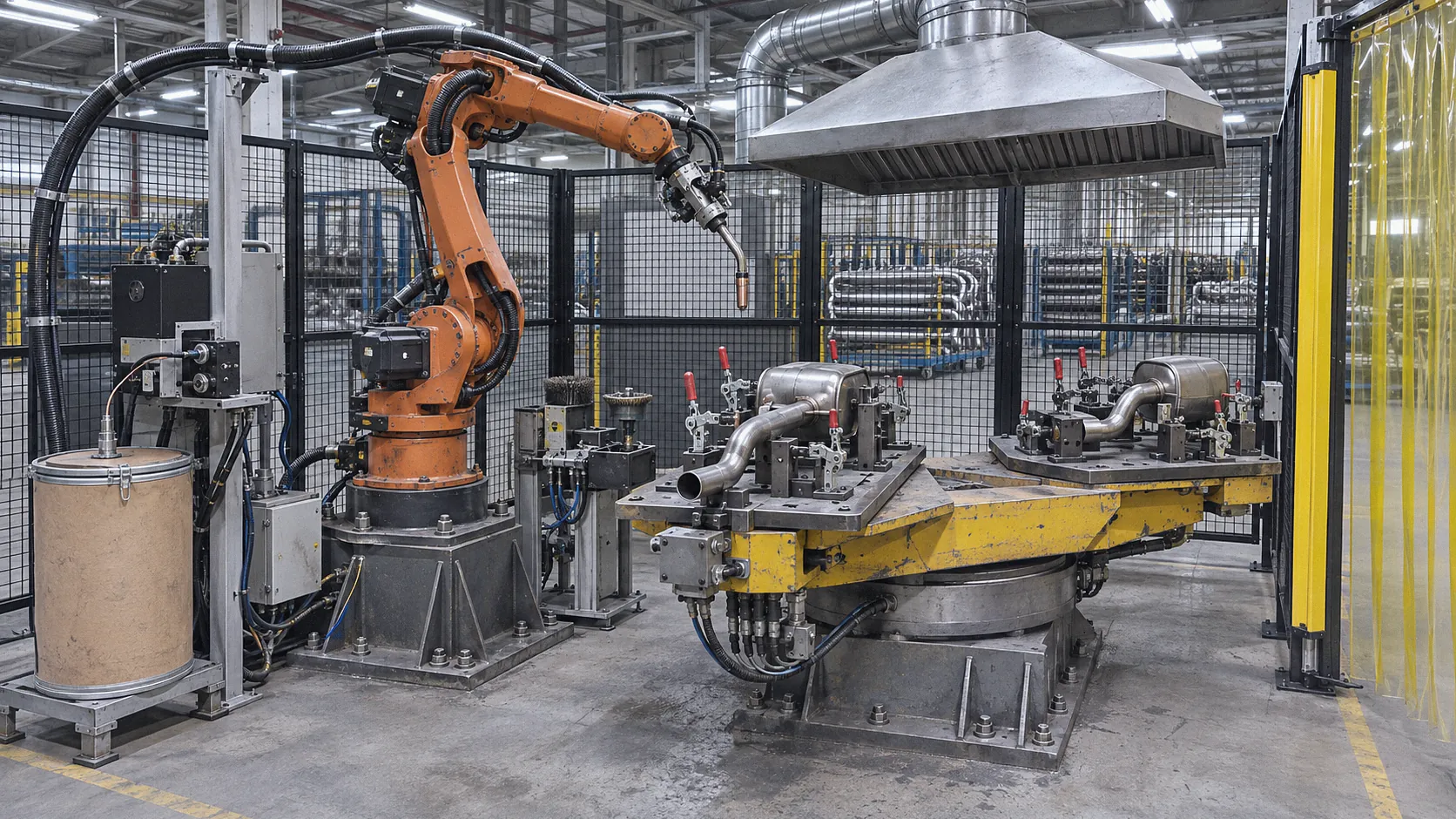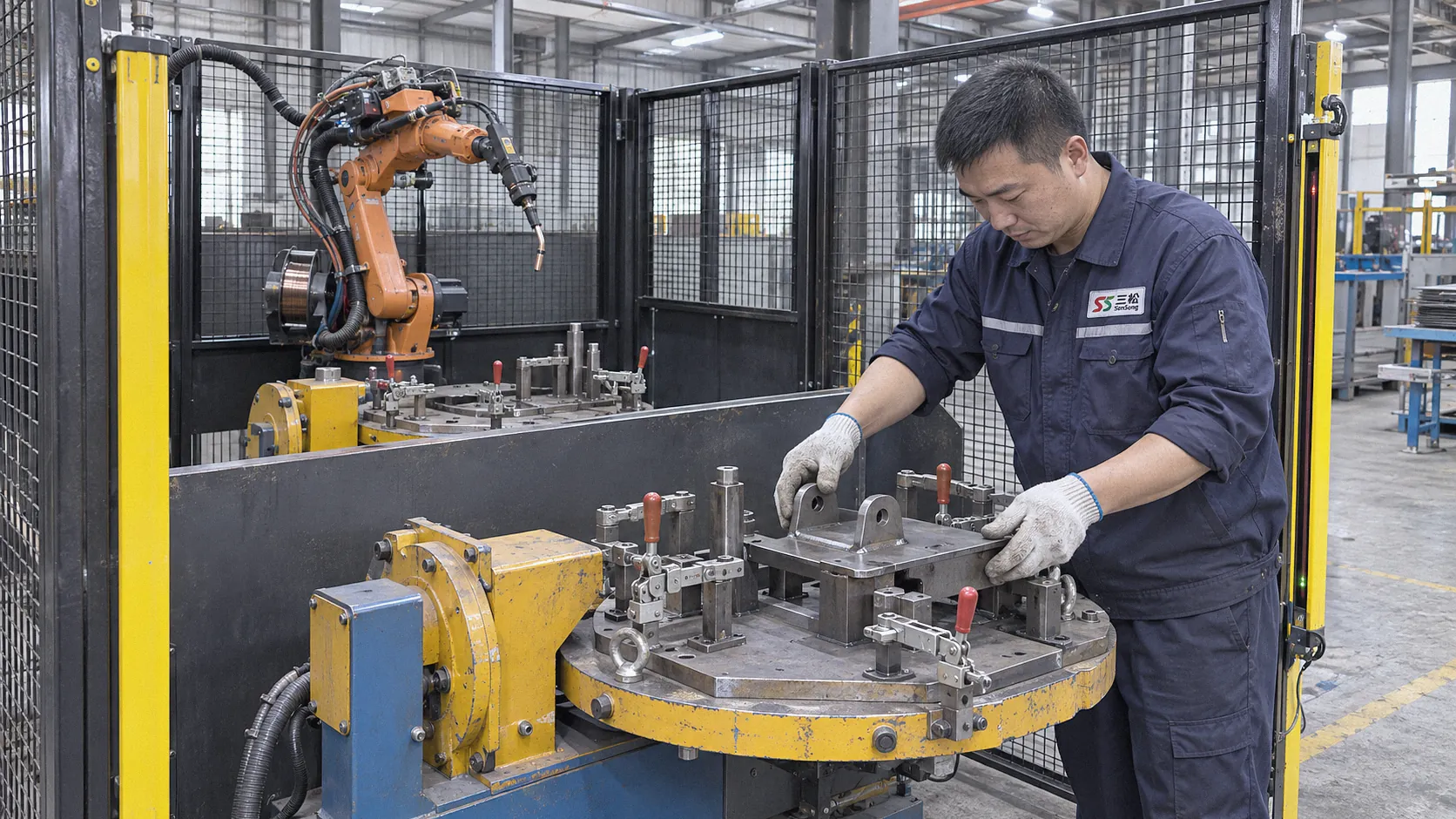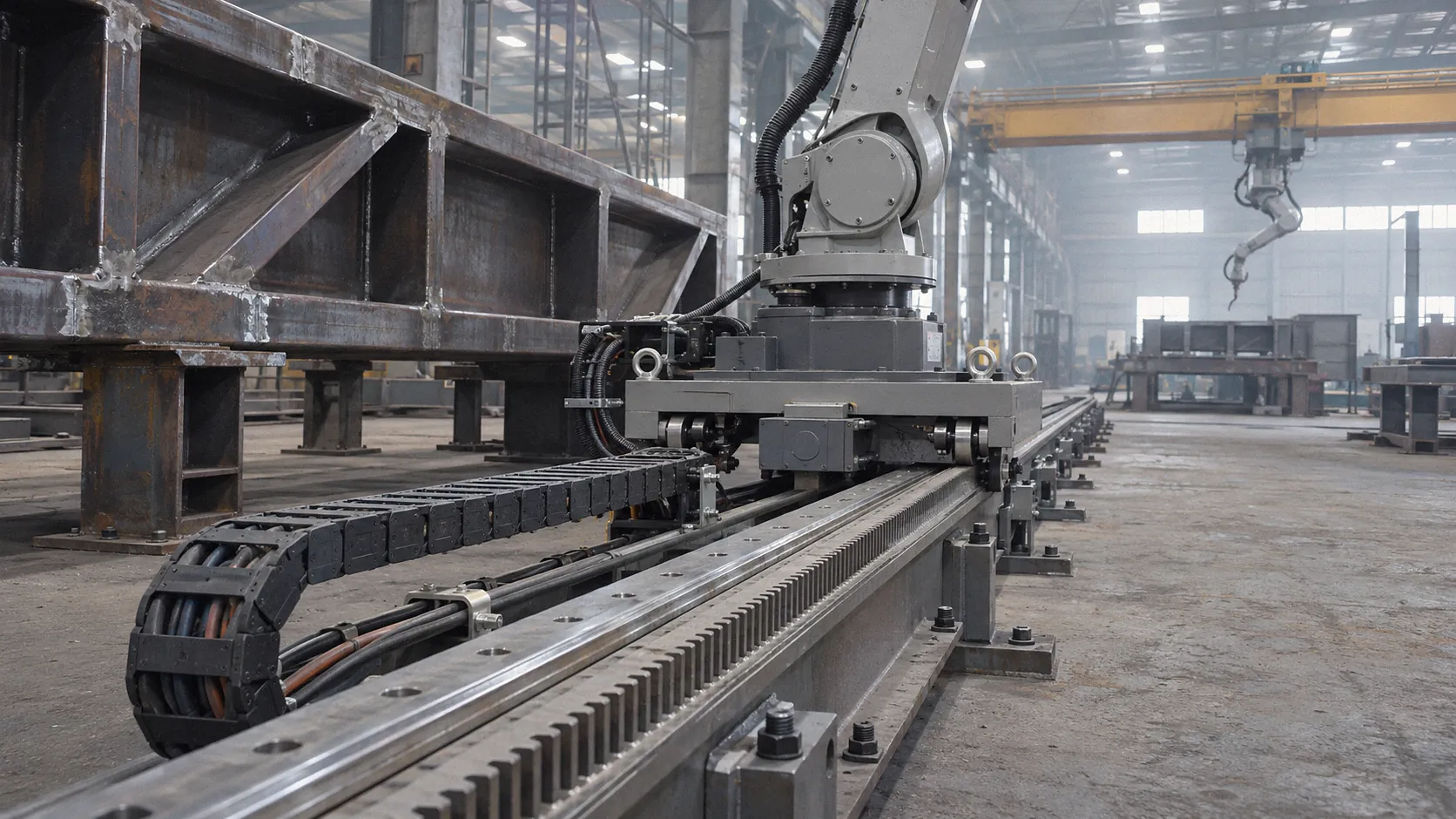
A robot 7th axis is an extra axis added to a six-axis industrial robot, most often a linear track that carries the robot along a rail. The robot controller drives it as an external axis, so the travel is synchronized with the robot’s own motion. A track lets one robot weld long parts, serve several stations or tend several machines. It can run on the floor or overhead, as a track or gantry above the work, and that choice shapes the whole cell.
This guide explains both layouts, how coordinated control works, and what to specify.
What the 7th axis does
A fixed robot can only reach what lies inside its working envelope. A track moves the whole robot, extending that envelope along the rail. Yaskawa describes robot tracks as extending “the action area of robots,” with position and speed “fully synchronized with the robot.”[1]
Josh Leath of Yaskawa Motoman gives typical uses:[2]
- Long parts. A robot on a track can weld a long seam on a large chassis, moving along the rail without stopping.
- Several stations. One robot can serve stations along the track, so a smaller robot can cover more of the floor.
- Machine tending. A robot on a track or gantry can serve several machines or lines.
Floor tracks and overhead tracks compared
The robot can stand on a carriage running on a floor-mounted rail, or hang from a track, beam or gantry above the work.
| Point | Floor track | Overhead track or gantry |
|---|---|---|
| Floor space | Occupies a strip of floor along the rail | Keeps the floor below clear[2] |
| Access to the part | From the side, at robot height | From above; good for large or tall parts |
| Structure | Rail on a prepared floor or base | Columns and beams, or a gantry; building loads to check |
| Load and rigidity | Depends on rail and carriage size | Gantry structures are rigid and suit heavier payloads[2] |
| Maintenance | At floor level | At height; plan access platforms |
| Operator access | The rail can divide the cell | Operators work below; safety zones extend upward |
Yaskawa’s on-track gantry series is one example of an overhead layout: a gantry that runs along a floor track, described as “ideal for welding large workpieces, or working at several stations along the floor,” with tracks of 8 to 24 m and a beam height of 4,000 or 4,500 mm.[3] Several gantries can share one track, with robots working “together or independent of each other.”[3]
Coordinated control
A track is most useful when the controller moves it together with the robot rather than as a separate machine. FANUC describes coordinated motion as synchronizing robots and external axes “so they follow a shared path or timing relationship,” with the robot and external axes programmed as one motion group and “consistent speed and orientation between all coordinated axes.”[4] For welding, that means the torch keeps its speed and angle along a seam while the track moves. Our article on robot and positioner coordinated motion explains the idea in more detail.
What to specify
Travel length alone is not a specification. Before asking for a design, collect:
- Stroke and stations. The positions the robot must reach, on a dimensioned layout, with approach directions.
- Moving load. Robot, carriage, tooling, wire feeder or gripper, hoses and cables; for handling, the heaviest part.
- Speed and cycle. How fast the robot must travel between stations, and whether it welds or handles while moving.
- Accuracy. The positioning accuracy the process needs at each station, and whether seam finding will correct small errors.
- Environment. Spatter, grinding dust or coolant; the rail and drive may need covers.
- Cables. Cable carriers for power, signals, welding cables and media, with room for later additions.
- Installation. Floor flatness and foundations for floor tracks, or building and support structures for overhead tracks.
- Safety. Zone limits, stopping distances and guarding. ISO 10218-2:2025 covers the integration of robot cells, including external axes and other machines in the cell.[5]
Our guide on what belongs in a robot track brief lists these items as a checklist.
What drives the cost
A price per meter does not describe a track, because the cost depends on more than length:
- Length and number of carriages or robots on the track.
- Moving load, which sets the rail, carriage and drive size.
- Required speed, acceleration and positioning accuracy.
- Floor or overhead structure, including columns, beams and foundations.
- Covers, cable carriers and the working environment.
- Integration with the robot controller, safety functions and the rest of the cell.
- Installation, commissioning and transport of long sections.
Send a layout and the moving load, and ask for a quotation against that layout.
How SanSong can help
SanSong lists floor tracks, overhead tracks and general-purpose walking axes among its standard robotics products, alongside its HL series welding positioners, and builds them into welding workstations, welding lines and handling lines. Its engineers design non-standard lines, install and commission robots, and provide maintenance.
To discuss a track, see robot tracks, see robotic automation systems or send us the layout, robot and moving load.
Frequently asked questions
Why is it called the 7th axis?
A typical industrial robot has six axes. An external axis added to the robot controller, such as a linear track, is often called the seventh axis. Positioners and further external axes add more.
Floor track or overhead track: which is better?
Neither is better in general. Floor tracks are simpler to install and service; overhead tracks and gantries keep the floor clear and reach parts from above but need a supporting structure and work at height for maintenance. The layout, part size and access decide.
How much does a robot track cost per meter?
A price per meter is misleading, because the cost depends on the moving load, required accuracy and speed, floor or overhead structure, covers, number of carriages and controller integration as much as on length. Send a layout and the moving load for a quotation.
Can two robots share one track?
Yes, on suitable designs. Yaskawa, for example, describes on-track gantries where several gantries share one track and their robots work together or independently. Collision zones and safety functions must then cover both robots.
Sources
- Robot tracks and rotating bases, Yaskawa Europe.
- Expanding Robot Reach: Tracks, Gantries, and Rotating Bases Unlock New Manufacturing Capabilities, MfgRobots (Josh Leath, Yaskawa Motoman).
- On-Track Gantry series, Yaskawa Europe.
- Coordinated Motion Plus, FANUC America.
- ISO 10218-2:2025 Robotics: Safety requirements, Part 2: Industrial robot applications and robot cells, International Organization for Standardization, .
Editorial note: written from the public sources listed above and SanSong’s published product information, checked on the dates shown. It is general guidance, not legal or compliance advice. Specifications not yet published by SanSong are confirmed during the project review.