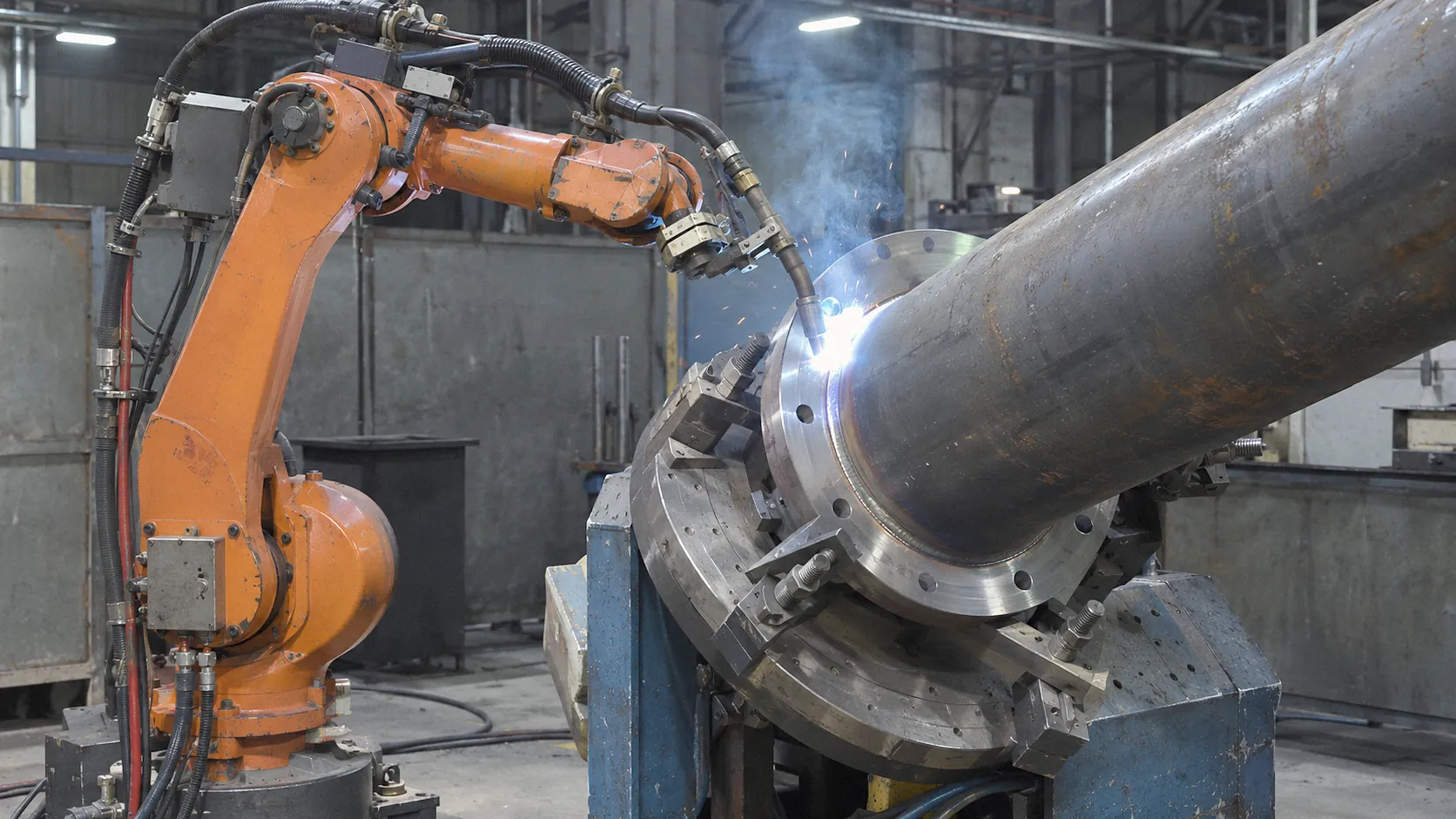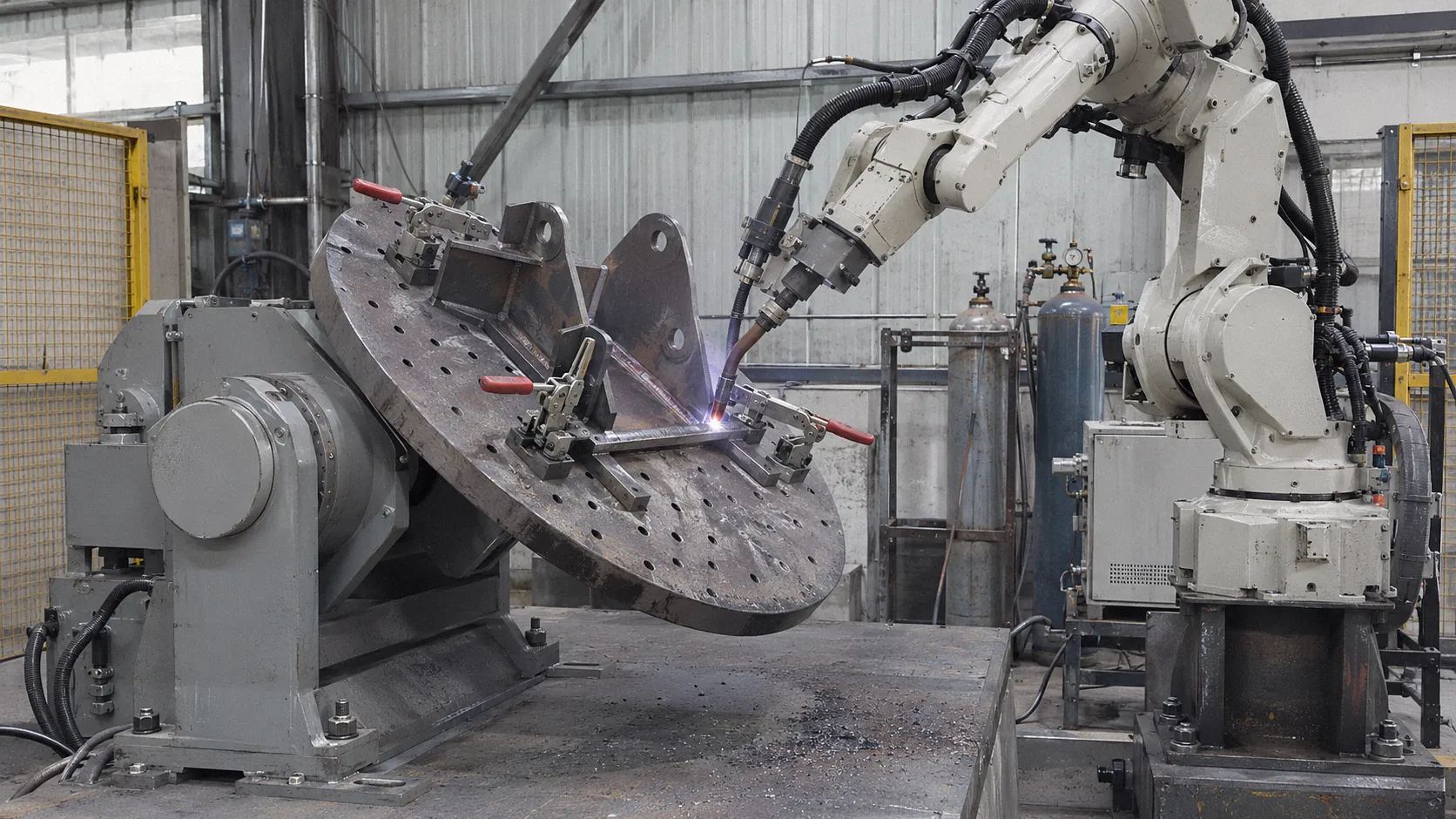
A welding positioner holds the workpiece and turns or tilts it so the welder or robot reaches every joint at a good angle, ideally welding in the flat or horizontal position. In a robot cell, a servo positioner is driven by the robot controller, so part and torch can move together. Sizing a positioner starts with torque, not weight: the combined center of gravity of part and fixture, and its distance from each axis, decide which unit is needed.
This guide explains the types, the torque calculation with a worked example, and what to send for a selection review.
What a positioner does
Welding is easiest and most consistent when the weld pool sits flat or horizontal and the torch has room to work. A positioner brings each joint into that position instead of forcing the welder or robot to weld overhead or reach around the part. For a robot, it also extends access: a robot standing on one side can weld all sides of a part that the positioner turns.
Positioners move in one of two ways in a robot cell:
- Indexing. The positioner turns the part to a set orientation, stops, and the robot welds; then it turns to the next.
- Coordinated motion. The robot controller drives the positioner as external axes during the weld, so torch angle and travel speed stay constant along curved or circular seams. FANUC describes this as keeping the torch “perfectly aligned with the joint” while robot and positioner move together.[1] Our article on coordinated motion covers it in detail.
Main types
Don Burgart’s guide in The Fabricator lists the main families with typical capacity ranges:[2]
| Type | How it moves | Typical capacity (as given by The Fabricator) | Typical use |
|---|---|---|---|
| Manual positioners | Hand-turned, often balanced so the rotation axis passes through the center of gravity | Up to 4,000 lb (about 1.8 t) | Lighter parts, manual welding |
| Floor turntables | Rotation about a vertical axis | 250 to 40,000 lb (about 0.1 to 18 t) | Round or flat parts, circumferential welds |
| Head-and-tailstock | Rotation about a horizontal axis, part held between two ends | Up to 240,000 lb (about 109 t) between head and tailstock | Long parts such as frames and beams |
| Rotate-and-tilt | Rotation plus tilt, two axes | From benchtop units to a workpiece of 1,000,000 lb (about 450 t) | The type most often found in metal fabrication |
Robot cells add multi-station designs, such as two head-and-tailstock stations on a turnover frame, so the operator loads one side while the robot welds the other. See our article on dual-station welding cells.
On rotation accuracy, Burgart notes that a repeatability of ±0.005 in. per inch of radius is “not unusual” for floor turntables,[2] which is ±0.005 mm per mm of radius.
Sizing: torque comes from the center of gravity
Each axis must hold and move a moment, which Burgart defines as weight × arm length, and the center of gravity is found as total moments ÷ total weight.[2] In practice:
- Add up everything that moves: the part, the fixture, clamps and mounting plates.
- Find the combined center of gravity, measured from the positioner’s table surface as reference plane.[2]
- Rotation torque is the weight times the distance of the center of gravity from the rotation axis (its eccentricity).
- Tilt torque is the weight times the distance from the tilt axis to the center of gravity, which includes the height of the center of gravity above the table and any offset between table and tilt axis.
- Compare with the rated rotation and tilt torques, and leave margin for acceleration, braking and future parts.
Worked example (illustrative)
A part and fixture weigh 800 kg together. Their combined center of gravity sits 150 mm off the rotation axis and 400 mm above the table face, and the table face is 200 mm from the tilt axis.
| Axis | Lever arm | Static moment |
|---|---|---|
| Rotation | 0.15 m | 800 kg × 9.81 m/s² × 0.15 m ≈ 1,180 N·m |
| Tilt | 0.40 m + 0.20 m = 0.60 m | 800 kg × 9.81 m/s² × 0.60 m ≈ 4,710 N·m |
The tilt torque here is four times the rotation torque, even though the weight is the same. Moving the fixture so the center of gravity sits lower and closer to the axes would reduce both. Burgart advises mounting the heavy side of the weldment to the table and recalculating the center of gravity whenever parts are added.[2] These numbers are an example, not a rating; ask the supplier to check your actual load.
Other selection points
- Margin. Burgart warns that “a positioner loaded to its maximum capacity 100 percent of the time will have a reduced lifespan,” and advises planning for the largest part you expect, including future growth.[2]
- Clearance. Check swing clearance through the full tilt range, not only in the welding positions. Height problems can be solved with adjustable bases or risers.[2]
- Welding current path. Make sure the welding return current passes through a proper rotary ground rather than through bearings and gears.
- Speed and drive. Welding processes may need different rotation speeds and drive accuracy.[2]
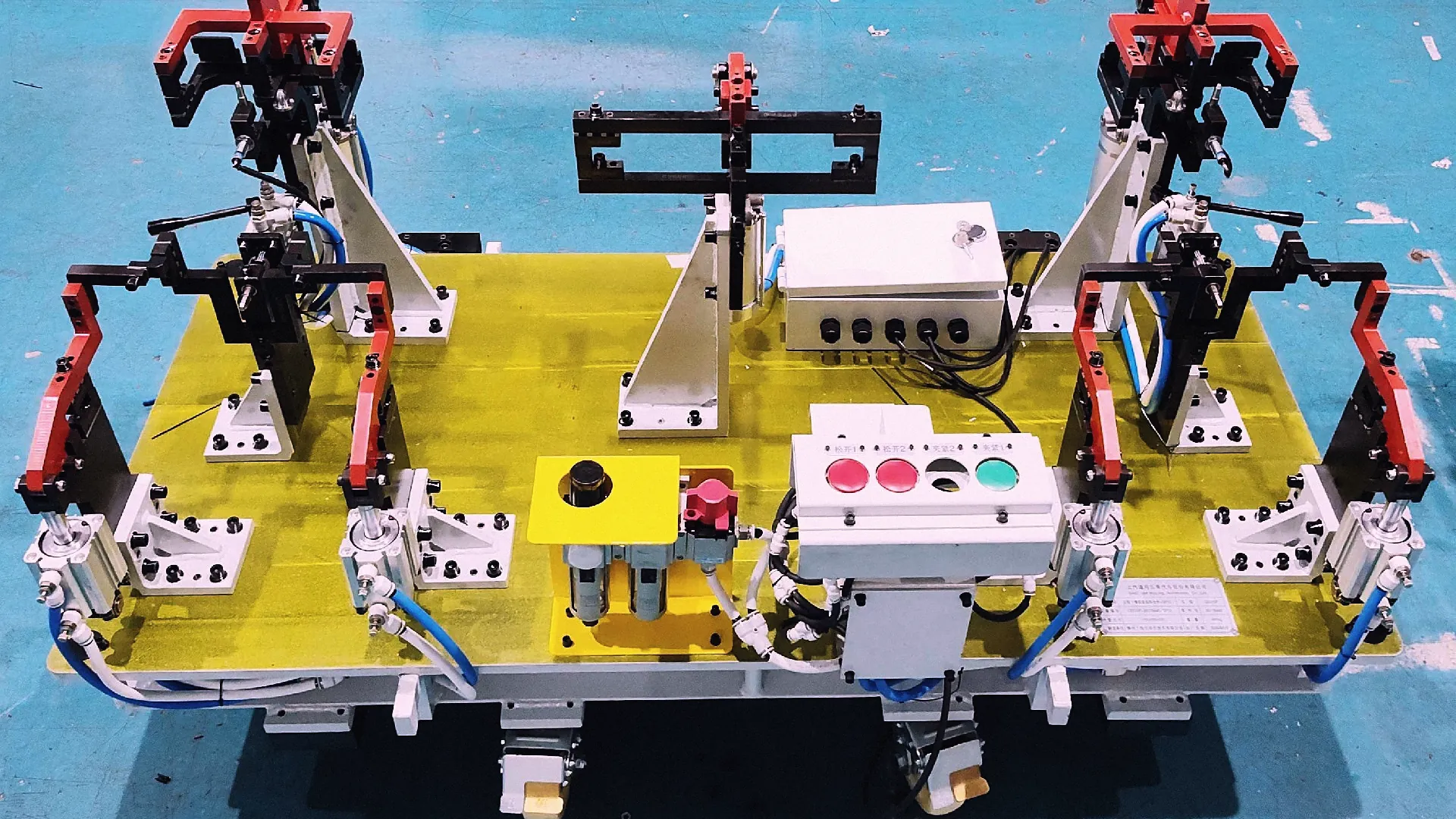
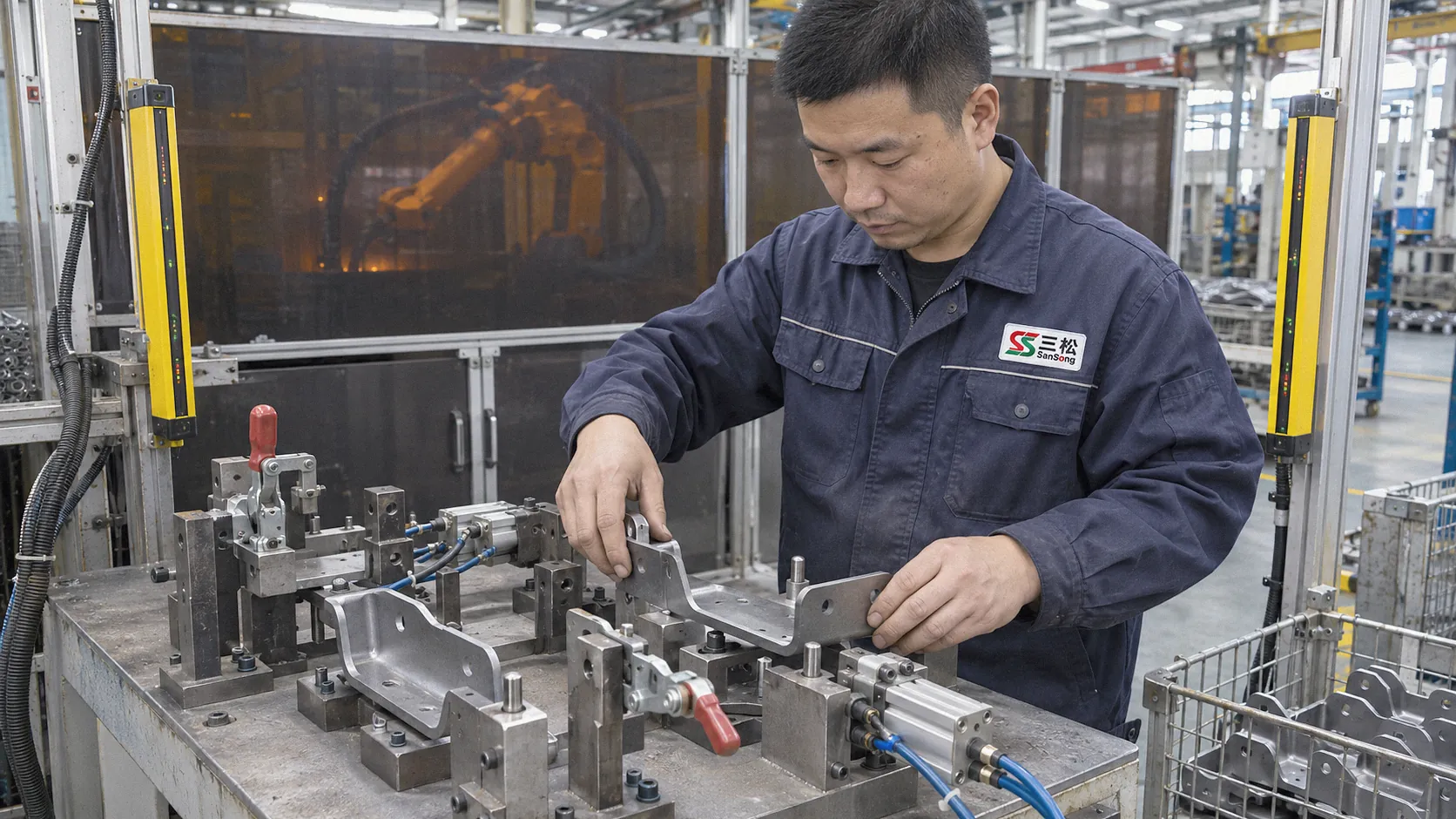
- Fixture. The fixture often weighs as much as the part and sets the center of gravity. Our welding fixture design guide covers locating and clamping.
- People. Burgart recommends consulting the welders who will use the positioner, and considering controls and safety features.[2]
How SanSong can help
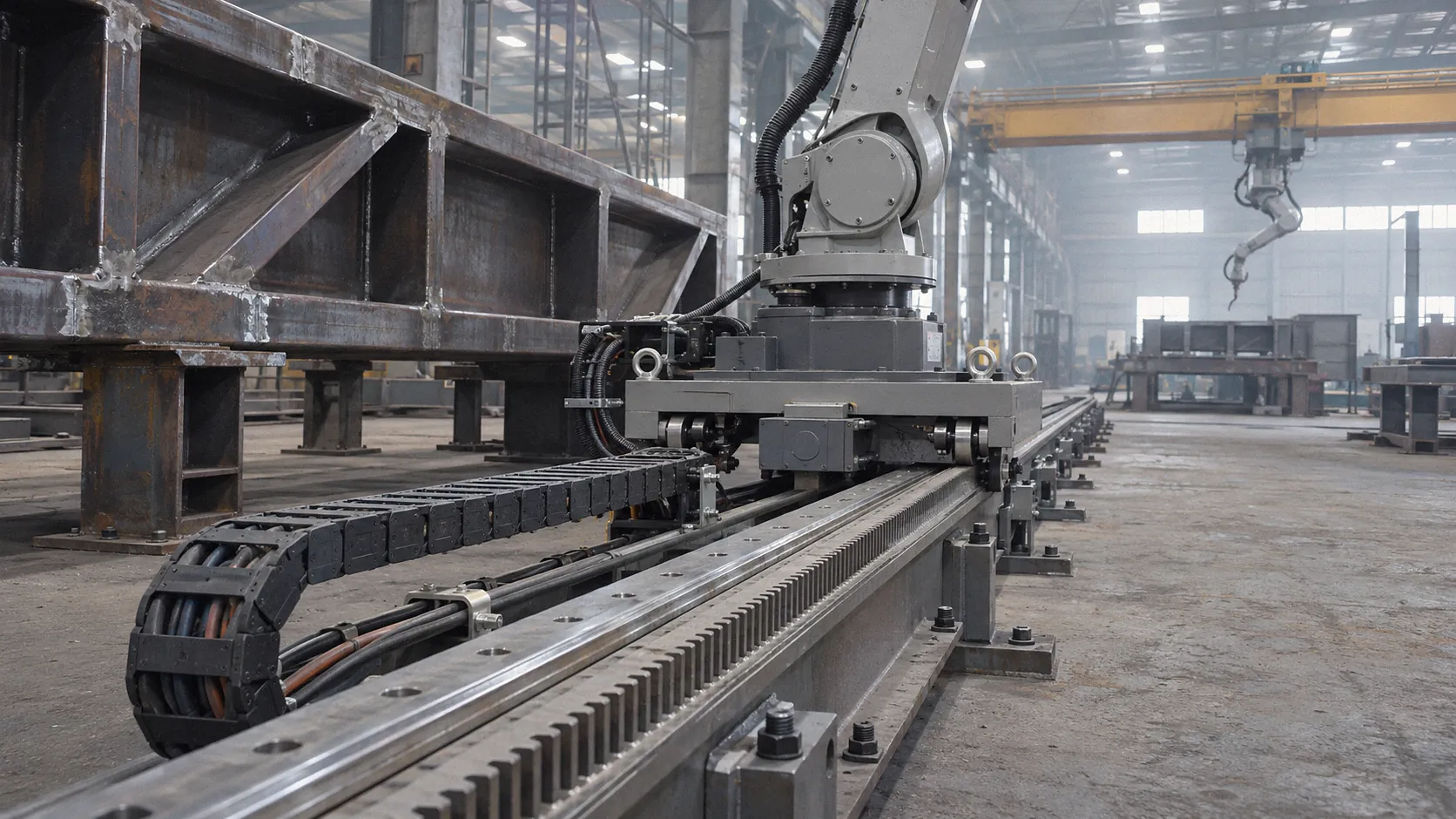
SanSong lists welding positioners among its standard robotics products, with a published range of HL1L, HL1S, HL2C, HL2L, HL2S, HL2U and HL3C configurations, selected and customized for each project.[3] It also builds floor and overhead tracks, welding fixtures, welding workstations and welding lines, and provides installation, commissioning and maintenance.
To size a positioner, see welding positioners, read our guide on how to select a welding positioner, or send us the part and fixture drawings, weights and weld positions.
Frequently asked questions
What is a welding positioner used for?
It holds the workpiece and turns or tilts it so the welder or robot can reach each joint at a good angle, usually in the flat or horizontal position. That improves access, weld quality and speed, and lets a robot weld parts it could not reach from one side.
How do I calculate the torque a positioner needs?
Multiply the weight of part plus fixture by the distance from each axis to the combined center of gravity. Compare the result with the positioner’s rated rotation and tilt torque, and leave margin for acceleration and future parts.
Can a positioner run at its full rated capacity?
It can, but The Fabricator’s guide warns that a positioner loaded to its maximum capacity all the time will have a reduced lifespan. Size for the largest expected part with margin.
Which SanSong positioner models are there?
SanSong’s published range includes HL1L, HL1S, HL2C, HL2L, HL2S, HL2U and HL3C configurations. The right model depends on the workpiece, fixture and station layout, and is confirmed in a selection review.
Sources
- Coordinated Motion Plus, FANUC America.
- Welcome to the world of positioneering, The Fabricator (Don Burgart).
- Welding positioners, SanSong (lzsansong.com).
Editorial note: written from the public sources listed above and SanSong’s published product information, checked on the dates shown. It is general guidance, not legal or compliance advice. Specifications not yet published by SanSong are confirmed during the project review.