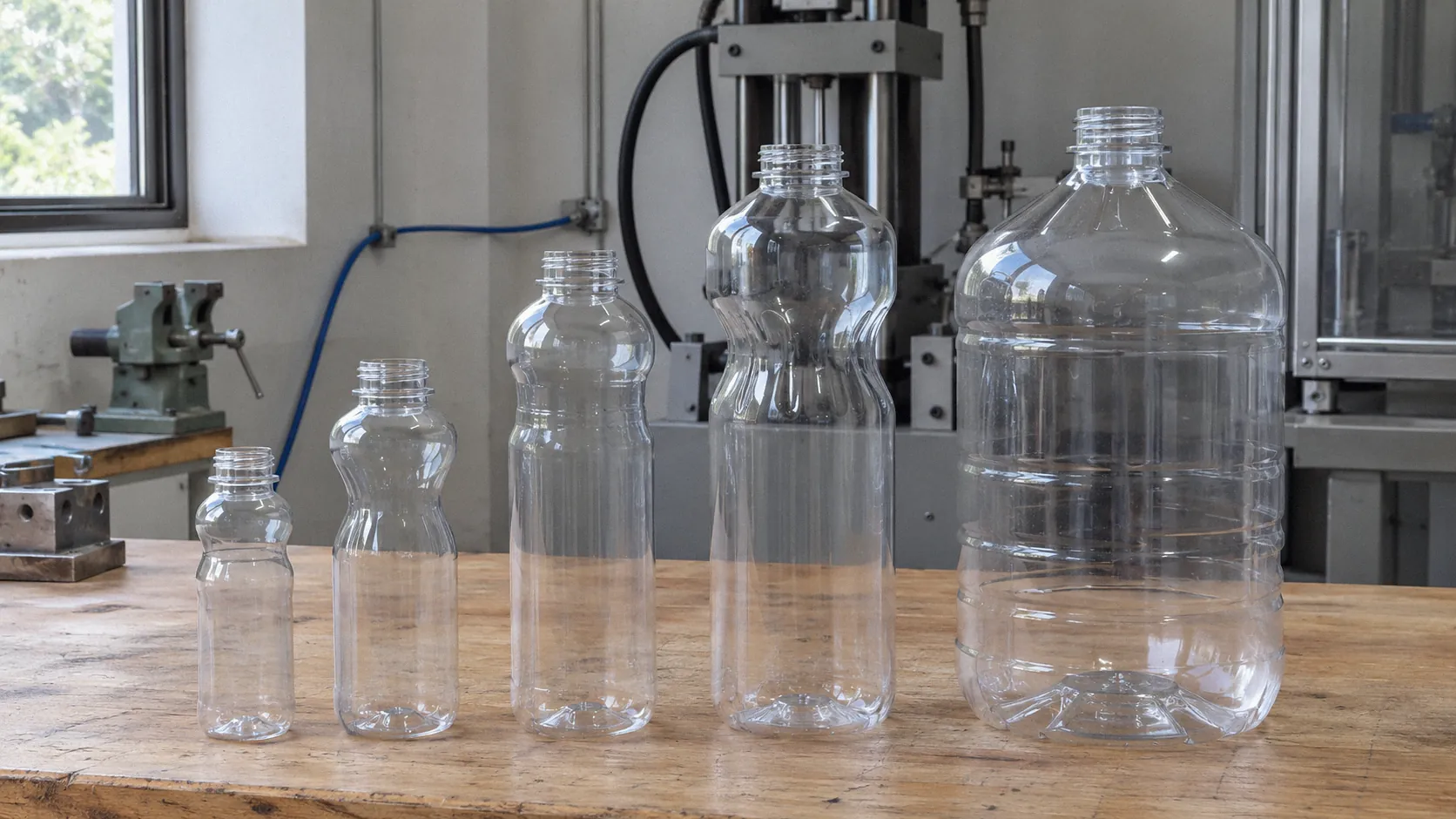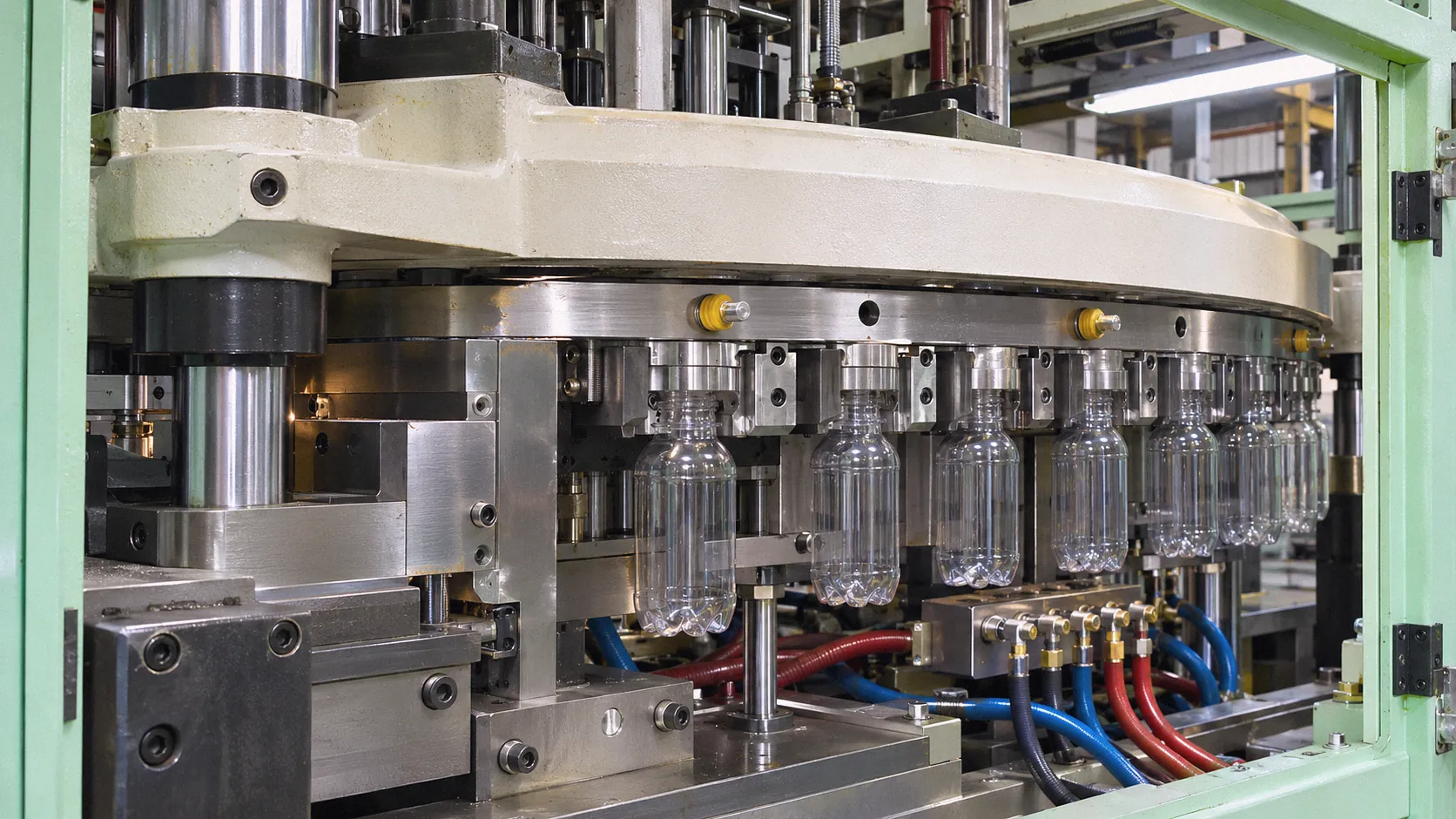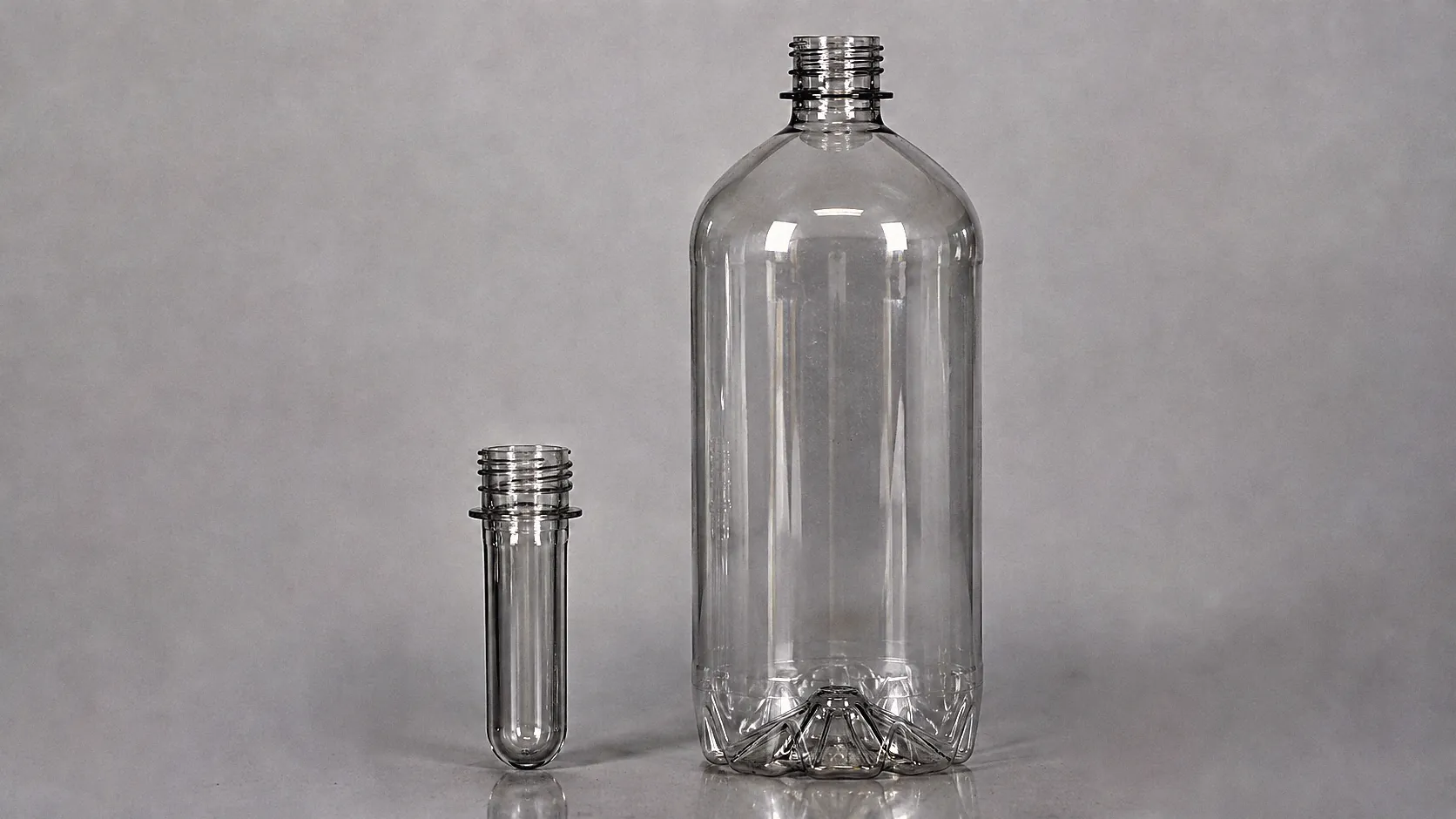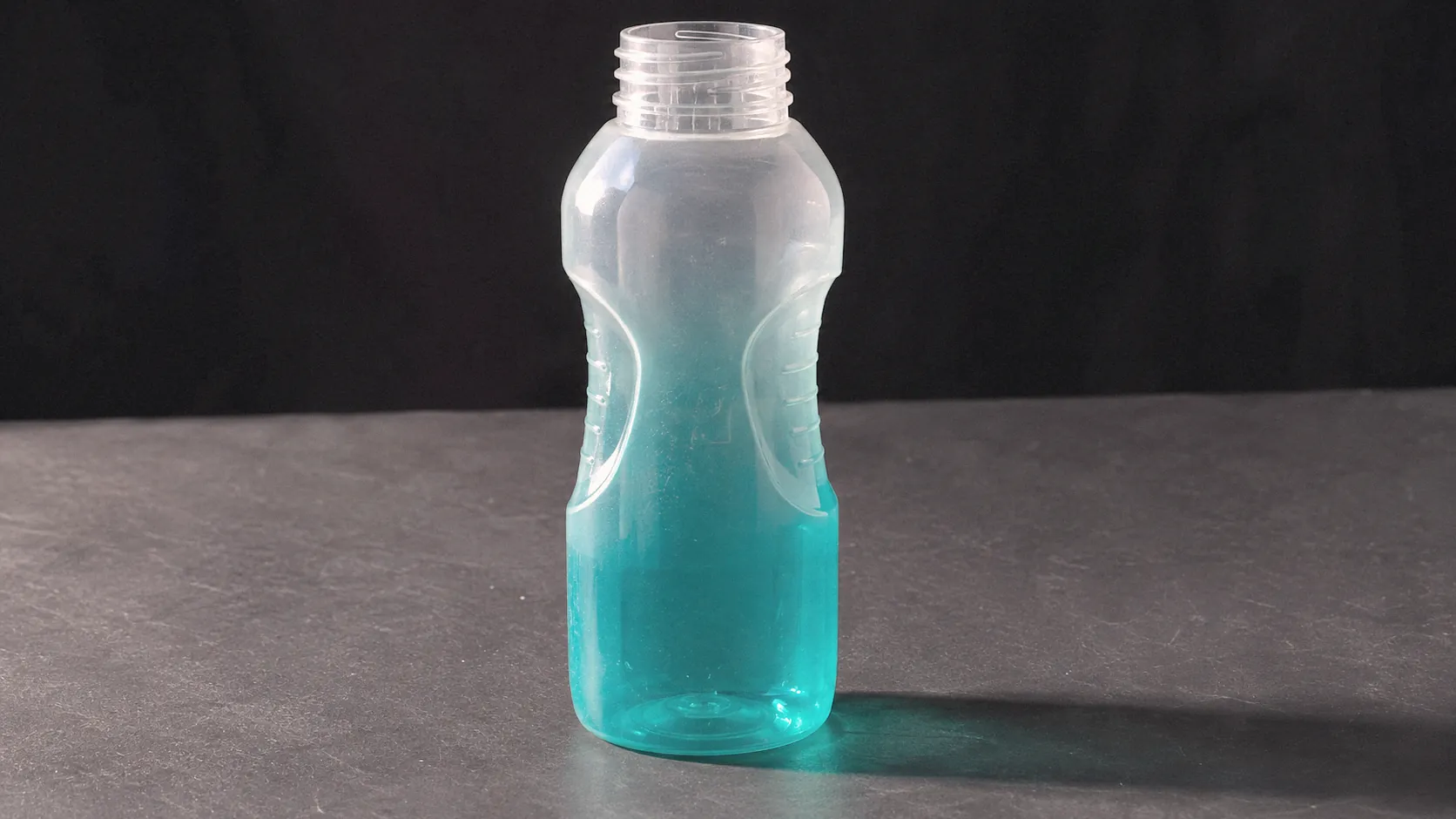
A two-color ISBM machine makes a gradient bottle by putting two colored melts into a single preform with two injection units, then stretching and blowing that preform like any other one-step container. Because the colors are molded into the wall, the gradient needs no printing, spraying or labels, and the container comes off the machine finished.
This guide explains how the process works, what decides where the color transition sits, and what buyers should agree before production. It uses SanSong’s SS-400-60-03-02 two-color machine as the reference.
How a two-color ISBM machine works
A two-color machine is a one-step injection stretch blow molding (also written moulding) machine with a second injection unit. SanSong’s SS-400-60-03-02, for example, uses a main screw of 65 mm and a side screw of 45 mm, an ECKERLE high-speed gear pump from Germany, three servo systems and a magnetic displacement sensor that tracks the injection-core position, with injection-core lift speeds up to 1 m/s.[1]
The rest of the cycle is the standard three-station sequence: the preform is injected, carried by its neck to the blow station, stretched and blown, then ejected. Paul Atkin of Nissei ASB notes that one-step molding leaves preform design unconstrained by stock preforms, which is what allows a preform to be designed around a color transition in the first place.[2]
| SS-400-60-03-02 feature | What it does for a two-color container |
|---|---|
| Two injection units (65 mm main, 45 mm side) | Deliver two separate melts, each with its own color |
| High-speed gear pump | Supplies the hydraulic flow for fast, repeatable moves |
| Three servo systems | Control speeds and positions from cycle to cycle |
| Magnetic displacement sensor on the core | Measures core position so the transition repeats |
| Three stations | Injection, stretch blow, ejection |
Where the gradient ends up
The color transition is created in the preform and then stretched, so the finished gradient is the preform gradient scaled by the stretch. A transition that sits in a short band of the preform becomes a longer, softer band in the bottle, because the wall stretches both lengthwise and around the circumference.
Two things follow:
- Preform design sets the gradient. The position and length of the transition in the preform, and the axial and hoop stretch ratios, decide where the gradient lands. Ottmar Brandau’s working minimums of about 2:1 axially and 4:1 in the hoop direction still apply to two-color preforms.[3]
- Even heating keeps it straight. A preform that is warmer on one side stretches more on that side, which tilts the transition. The same centering and temperature checks used against uneven walls apply here.[3]
Our preform design guide explains how stretch ratios are calculated.
Design choices for gradient containers
Gradient containers are mostly a design decision, and a few choices make production easier:
- Pick compatible melts. Two colors of the same resin family bond and stretch together. Different resins need a compatibility trial and may complicate recycling.
- Define the transition. State where it should start and end on the container, measured from a fixed reference such as the neck support ring, and the tolerance you can accept.
- Choose the colorants early. Masterbatch or liquid color, loading, and transparency all change how the gradient looks. For drinkware and food packaging, the colorants must meet the food-contact rules of your market.
- Plan single-color variants. The SS-400-60-03-02 also runs single-color containers and single-color molds, so one machine can cover a range with and without gradients.
Color approval and quality control
Gradients are judged by eye, so agree an objective standard before production. Useful practice:
- Approve physical master samples for each color pair and keep them under controlled light.
- Record the transition position on approved samples and measure it on production samples at a fixed frequency.
- Agree how far the transition may move and how much color variation is acceptable between cavities.
- Plan color changes: purging both injection units takes time and material, so group production by color pair.
Applications
Two-color gradients are used where appearance sells the product. SanSong’s published applications for its one-step machines include sports bottles and large water jugs, wide-belly and juicer cups, baby straw cups, cosmetic bottles and mascara tubes, all of which can be offered in gradient versions. Our articles on sports bottles and wide-mouth jars and cosmetic containers cover those markets.
How SanSong can help
The SS-400-60-03-02 is SanSong’s three-station two-color one-step ISBM machine: two-color gradient or single-color containers, single-color molds supported, 65 mm and 45 mm screws, an ECKERLE gear pump, three servo systems and magnetic core-position sensing. SanSong designs the preform and molds for each gradient container.
To discuss a gradient design, see the ISBM machines or send us the container drawing, colors and resin. Our guide on bottle material data lists what to include.
Frequently asked questions
Can a two-color ISBM machine also make single-color bottles?
Yes. SanSong’s SS-400-60-03-02 produces two-color gradient containers or single-color containers, and it can run single-color molds.
Can the two colors be different resins?
Usually the two melts are the same resin family in different colors, so they bond in the preform and stretch together. Different resins need a compatibility trial and may affect recyclability, so discuss them before tooling.
How consistent is the color transition from bottle to bottle?
It depends on how repeatably both injection units and the cores move, and on how evenly the preform is heated before stretching. Agree a measured transition position and tolerance with approval samples.
Which products use two-color gradient bottles?
Typical uses are drinkware such as sports bottles and cups, and cosmetic or personal-care packaging, where the gradient replaces printing or spraying to give a premium look.
Sources
- SS-400-60-03-02 three-station two-color ISBM machine, SanSong (lzsansong.com).
- Update on one step injection stretch blow molding, PETnology (Paul Atkin, Nissei ASB), .
- How to Address Uneven Wall Thickness in Stretch Blow Molding, Plastics Technology (Ottmar Brandau).
Editorial note: written from the public sources listed above and SanSong’s published product information, checked on the dates shown. It is general guidance, not legal or compliance advice. Specifications not yet published by SanSong are confirmed during the project review.