
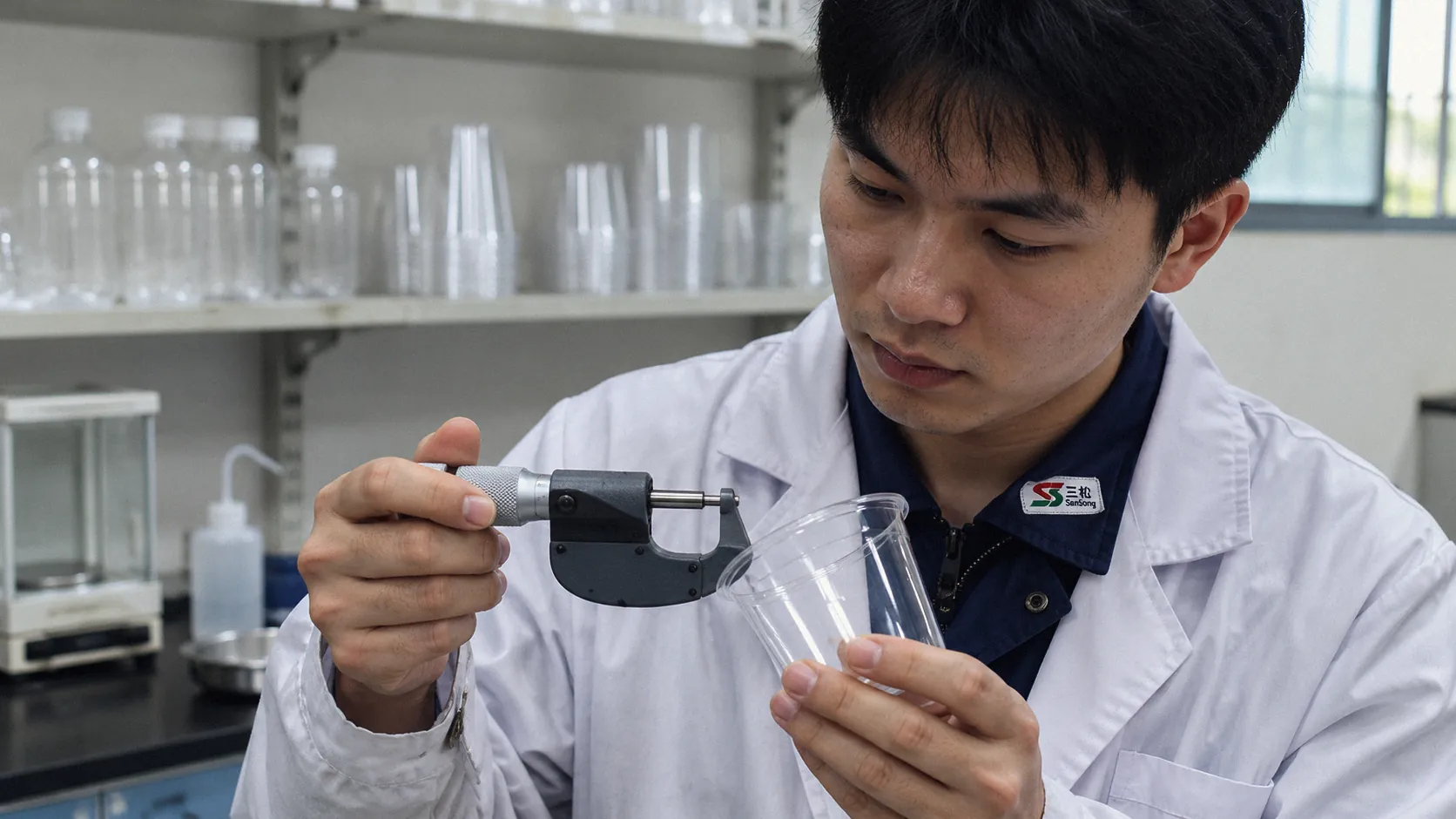
GB 4806 is the series of Chinese national food-safety standards for food-contact materials and articles. For plastic bottles and cups, the key standard is GB 4806.7-2023, Food Contact Plastic Materials and Articles, issued by the National Health Commission on 6 September 2023 and applied since 6 September 2024.[1] It works together with GB 9685 for additives and the GB 31604 series for testing, including GB 31604.1-2023 for migration testing conditions.[2]
This article explains how the framework fits together and what a bottle or cup maker should prepare. It summarizes published sources and is not legal advice.
How the framework fits together
China’s food-contact rules are written as mandatory national food-safety standards, organized in layers. Based on the PackagingLaw.com overview by Keller and Heckman:[2]
| Layer | Standard | Role for a plastic bottle maker |
|---|---|---|
| General requirements | GB 4806.1 | General safety requirements for all food-contact materials; a revision is in draft |
| Material standards | GB 4806 series (for plastics, GB 4806.7-2023) | Requirements for each material type |
| Additives | GB 9685 | Additives permitted in food-contact materials and their limits |
| Testing | GB 31604 series (testing conditions in GB 31604.1-2023) | Migration testing and test methods |
The article lists GB 4806.7-2023 among several 2023 standards, with GB 4806.9-2023, GB 4806.11-2023, GB 4806.13-2023 and GB 4806.14-2023, that took effect on 6 September 2024, along with GB 31604.1-2023. A separate standard for adhesives, GB 4806.15-2024, took effect on 8 February 2025.[2]
What GB 4806.7-2023 covers
ChemLinked’s summary describes GB 4806.7-2023 as applicable to plastic materials and products for food contact, including unsulfurized thermoplastic elastomers and starch-based plastic materials and products.[1] That covers the containers made by injection stretch blow molding (also written moulding): drinking bottles, cups, jugs and food jars, whatever the resin.
The full text is published by the authorities and sold by standards publishers; check it for the requirements that apply to your resin, the intended food types and the conditions of use.
Migration testing
Compliance is shown by testing the finished article. GB 31604.1-2023 prescribes the testing conditions for migration testing of food-contact materials marketed in China.[2] The conditions, such as food simulants, temperature and time, follow the article’s intended use: a cup for hot drinks is tested differently from a bottle for cold water.
Plan testing on production-equivalent containers made from the final resin, colorant and process, because colorants and processing can change results.
Recycled plastics
Recycled content needs separate review in China. PackagingLaw.com reports that China “has yet to issue a general authorization or prohibition on the use of recycled plastic in FCMs” and that the China National Center for Food Safety Risk Assessment had surveyed recycled plastics.[2] If a product for the EU must contain recycled plastic under the EU packaging regulation, check separately whether the same container can be sold for food contact in China.
Practical steps for bottle and cup makers
- Confirm the resin and additives. Ask the resin and masterbatch suppliers for documents showing compliance with the relevant GB 4806 standard and with GB 9685 for additives. Our resin selection guide covers resin choice.
- Define the use conditions. Food types, temperature, contact time and reuse, including dishwashing or hot drinks, decide the test conditions.
- Test the finished article under GB 31604.1-2023 conditions, using an accredited laboratory.
- Keep records linking each lot to resin and colorant batches and process settings.
- Check every export market separately. EU rules differ, notably the EU BPA ban. Baby products need extra care; see our baby bottle guide.
How SanSong can help
SanSong’s one-step ISBM machines make the food-contact containers these standards cover, including sports bottles, large water jugs, cups, juicer cups and baby feeding bottles, from published materials including PCTG copolyesters (Tritan and ECOZEN grades), PET, PETG, PP, PPSU, AS, PS and PC. SanSong supplies the machines and molds and can produce trial samples for testing; compliance of the finished article is established by the container maker’s testing.
To plan a food-contact container, see everyday bottle applications, compare the ISBM machines or send us the container, resin and intended use.
Frequently asked questions
What does GB 4806.7-2023 cover?
It is China’s national food-safety standard for food-contact plastic materials and articles. ChemLinked’s summary says it also covers unsulfurized thermoplastic elastomers and starch-based plastic materials and articles for food contact.
When did GB 4806.7-2023 take effect?
It was issued by the National Health Commission on 6 September 2023 and has applied since 6 September 2024.
Which standard sets migration testing conditions in China?
GB 31604.1-2023 prescribes the testing conditions for migration testing of food-contact materials marketed in China. It took effect on 6 September 2024.
Can recycled plastic be used for food-contact bottles in China?
According to PackagingLaw.com, China has yet to issue a general authorization or prohibition on recycled plastic in food-contact materials. Review any recycled-content plan with a specialist before production.
Sources
- GB 4806.7-2023 National Food Safety Standard: Food Contact Plastic Materials and Articles, ChemLinked.
- China's Modernized Regulation of Packaging and Food-Contact Materials, PackagingLaw.com (Mark Thompson and David J. Ettinger, Keller and Heckman LLP), .
Editorial note: written from the public sources listed above and SanSong’s published product information, checked on the dates shown. It is general guidance, not legal or compliance advice. Specifications not yet published by SanSong are confirmed during the project review.