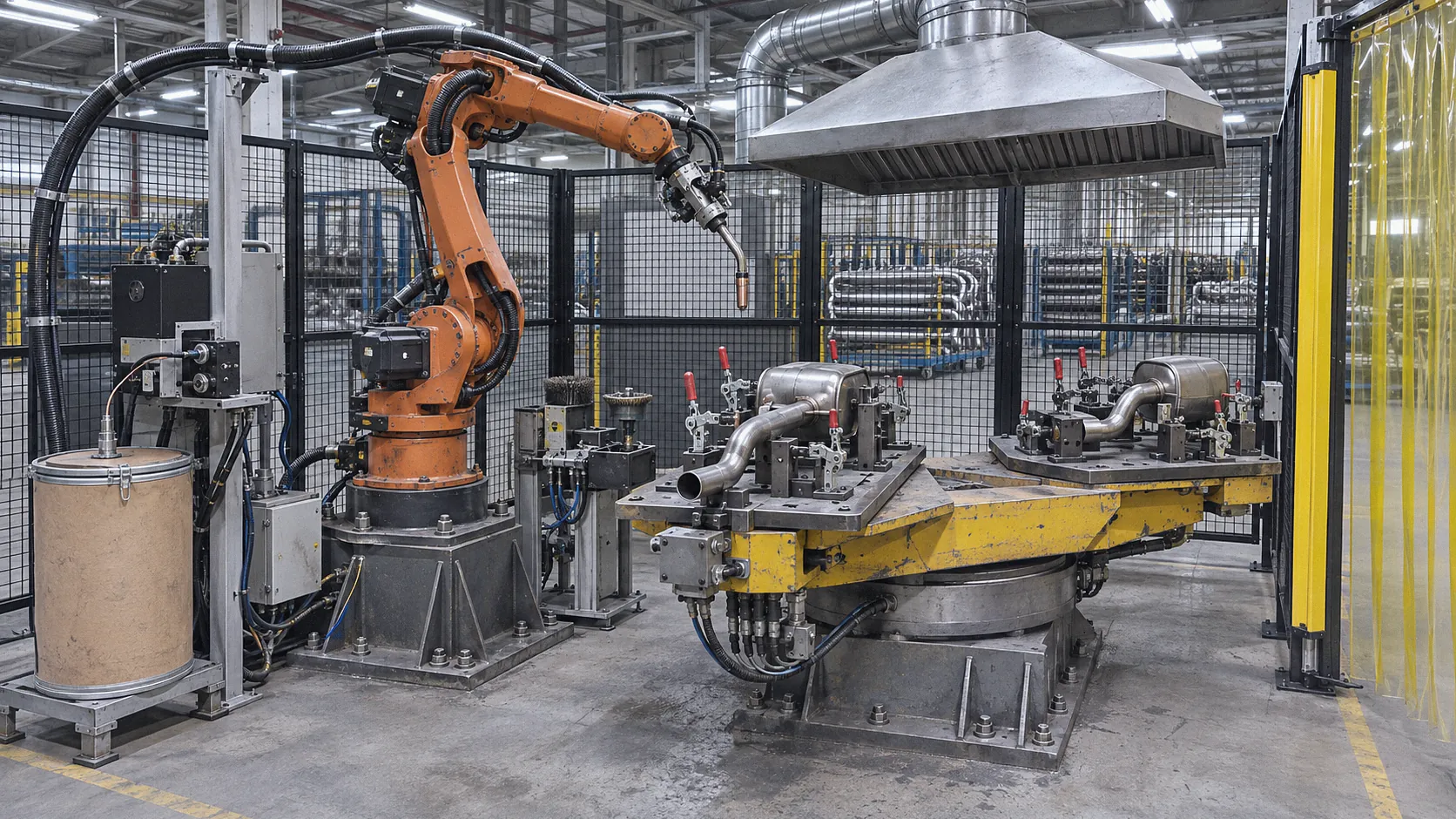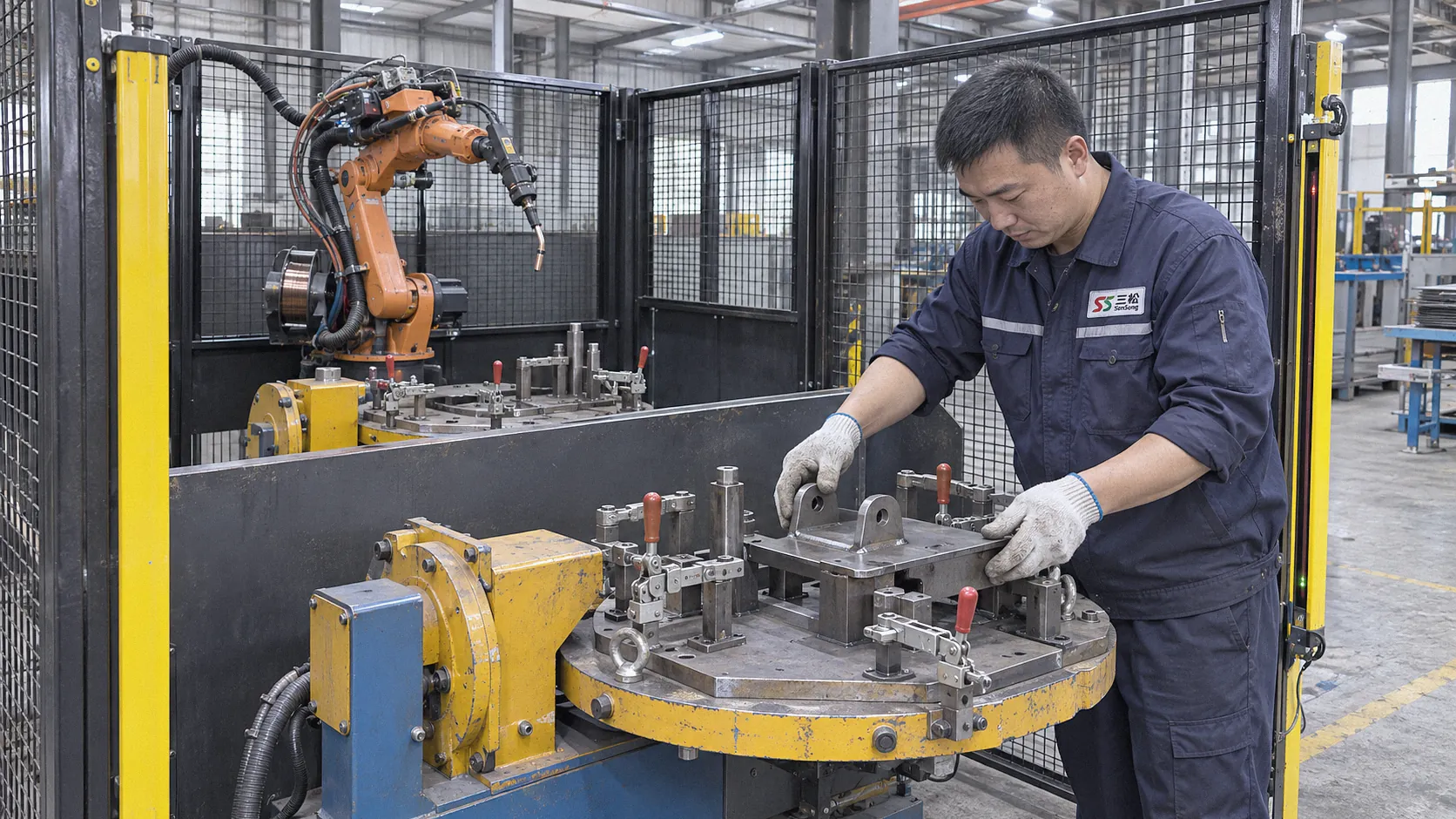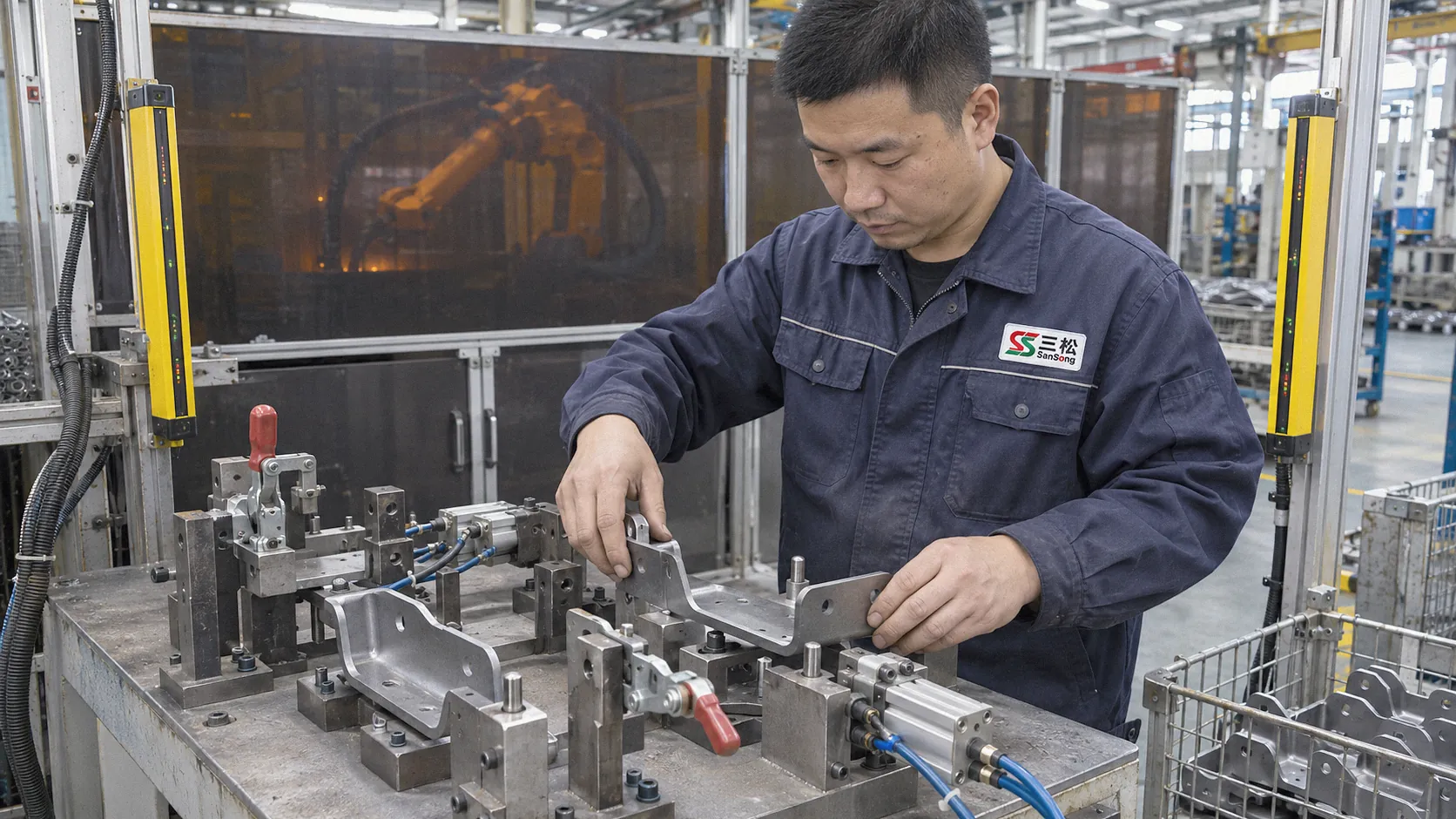
A dual-station welding cell uses one robot to serve two work stations. While the robot welds at one station, the operator unloads the finished part and loads the next one at the other; then the robot switches over. Loading time no longer stops the robot, which raises the share of the shift spent welding. The gain is largest when loading takes about as long as welding, and it depends on keeping the two stations safely separated.
This guide covers layouts, a worked output comparison, safety and when the layout pays off.
How it works
In a single-station cell, the robot waits while the operator unloads and loads. In a dual-station cell, those steps overlap with welding. Fabricating & Metalworking’s description of Yaskawa’s ArcWorld 200 shows the idea: one robot serves two workstations, each with a table or part positioner, and the setup “allows the operator to load one workstation while the robot is servicing the other.”[1]
Common layouts:
| Layout | How the stations swap | Points to plan |
|---|---|---|
| Side by side | The robot turns or travels between two fixed stations | Separation screen, reach to both stations |
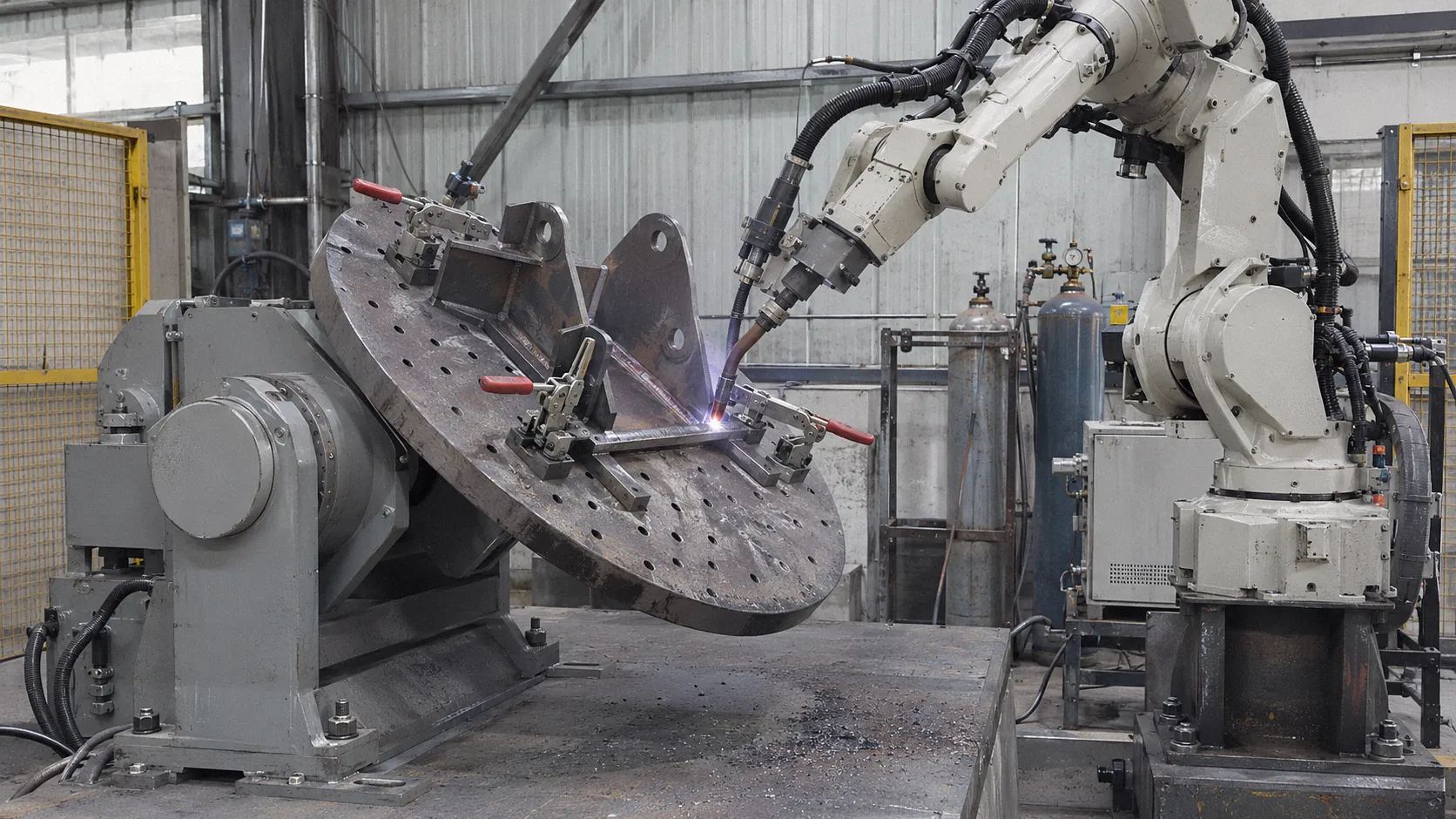
| Two positioners | Each station has its own positioner; the robot welds one while the other is loaded | Positioner sizing, coordinated motion per station |
| Turnover or turntable | A rotating frame turns the loaded side into the robot zone | Swap time, frame size, load on the rotating axis |
| Double slide | Two sliding tables move parts in and out of the robot zone | Slide travel, guarding at the load position |
Stations can be tooled for different parts or used for sequential operations on the same part.[1]
Worked example: what overlap is worth
The figures below are illustrative, to show the method. Use measured times from trials for a real decision.
Assume welding takes 6.0 minutes per part, unloading and loading take 4.0 minutes, and swapping stations takes 0.5 minutes.
| Single station | Dual station | |
|---|---|---|
| Time per part | 6.0 + 4.0 = 10.0 min | max(6.0, 4.0) + 0.5 = 6.5 min |
| Parts per hour | 60 ÷ 10.0 = 6.0 | 60 ÷ 6.5 ≈ 9.2 |
| Share of time the robot welds | 6.0 ÷ 10.0 = 60% | 6.0 ÷ 6.5 ≈ 92% |
Two points follow. First, if loading takes longer than welding, the operator becomes the bottleneck, and the cycle is set by loading plus swap time instead. Second, the gain is smaller when welding is much longer than loading, because the single-station robot was already welding most of the time.
Output over a shift also depends on stops, slowdowns and rejects. ISO 22400-2, as Fabrico summarizes it, measures overall equipment effectiveness as availability × effectiveness × quality ratio.[2] Our article on the welding cell business case uses that framework.
Separating the stations safely
The operator works next to a running cell, so the separation between stations is a safety design in its own right. In the ArcWorld 200 example, an electrically driven barrier door separates the stations, a functional safety unit adds safeguarding between the two stations, and positioner axes are monitored at standstill while the operator interrupts the light curtain.[1] The cell is stated to comply with ANSI/RIA R15.06-2012.[1]
Points to settle:
- Arc and spatter. Screens or doors between stations protect the operator’s eyes and skin.
- Motion at the load station. The positioner or slide at the operator’s station must not move while the operator is in the zone.
- Robot zone limits. The robot must not enter the load station while it is open.
- Restart. The operator confirms loading is complete before the station enters the robot zone.
ISO 10218-2:2025 integrates guidance on manual load and unload stations, as IBF Solutions notes, alongside default performance levels for safety functions such as PL d for protective stop.[3] Our article on ISO 10218:2025 explains the standard.
When a dual-station cell pays off
Fabricating & Metalworking positions the ArcWorld 200 for “small- to medium-sized parts or medium-volume production runs.”[1] In general, the layout pays off when:
- loading and unloading take a large share of the single-station cycle;
- parts and fixtures are small enough to fit two stations within the robot’s reach;
- the product mix allows two fixtures, either the same part or two parts in a sequence.
It fits less well for very large parts, where a track-mounted robot or a long positioner may suit better, and for very long welds, where loading is a small share of the cycle.
Size each station’s positioner for its own part and fixture. The Fabricator’s positioner guide advises planning for the largest anticipated part, including growth, and not running a positioner at full capacity all the time.[4] See our guide on how a welding positioner works.
How SanSong can help
SanSong designs robot welding workstations and welding lines, including a published truck floor double-slide welding line, and supplies its own welding positioners and tracks. Its engineers lay out the stations, fixtures and guarding together, then install and commission the cell.
To compare single-station and dual-station layouts for your part, see robotic automation systems, see welding positioners or send us the part, weld times and volumes. Our article on robotic welding cell components lists what a cell contains.
Frequently asked questions
What is a dual-station welding cell?
A robotic welding cell with two work stations served by one robot. While the robot welds at one station, the operator unloads the finished part and loads the next at the other, then the robot moves over.
How much more output does a dual-station cell give?
It depends on the ratio of welding time to loading time. If loading and unloading take less time than welding, the robot can weld almost continuously. In the worked example in this article, output rises from 6 to about 9 parts an hour.
Is a dual-station cell safe for the operator?
It can be, when the stations are separated by screens or doors and safety functions stop motion at the station where the operator works. Fabricating & Metalworking describes an example with a driven barrier door and standstill monitoring of the positioner while the light curtain is interrupted.
Can the two stations weld different parts?
Yes. Stations can be tooled for different parts or used for sequential operations on the same part, with the robot selecting the program per station.
Sources
- Dual-station cells add versatility to welding applications, Fabricating & Metalworking, .
- OEE according to ISO 22400, Fabrico.
- New standards for industrial robots: EN ISO 10218-1 and -2, IBF Solutions.
- Welcome to the world of positioneering, The Fabricator (Don Burgart).
Editorial note: written from the public sources listed above and SanSong’s published product information, checked on the dates shown. It is general guidance, not legal or compliance advice. Specifications not yet published by SanSong are confirmed during the project review.