ISO 10218-2:2025 is the safety standard for industrial robot applications and robot cells, published in February 2025 together with ISO 10218-1:2025 for the robots themselves.[1] The revision replaces the blanket PL d requirement with safety functions and default performance levels, brings collaborative operation from ISO/TS 15066 into the standard, requires a normal stop, and adds guidance on grippers and manual load stations. For anyone building or buying a welding or handling cell, it changes how safety is specified and documented.
This article summarizes the changes for cell buyers and integrators. It is not a substitute for the standards themselves.
Two parts, two audiences
The 2011 editions were “thoroughly revised,” according to IBF Solutions.[2] The split between the parts stays the same:
- ISO 10218-1:2025 covers industrial robots and is mainly for robot manufacturers. It now defines two robot classes: Class 1 for very low-power robots that pose no significant hazard, with reduced control requirements, and Class 2 for all other industrial robots.[2]
- ISO 10218-2:2025 covers the integration of robot applications and robot cells: design, integration, commissioning, operation, maintenance, decommissioning and disposal, including the integration of other machines and components.[1]
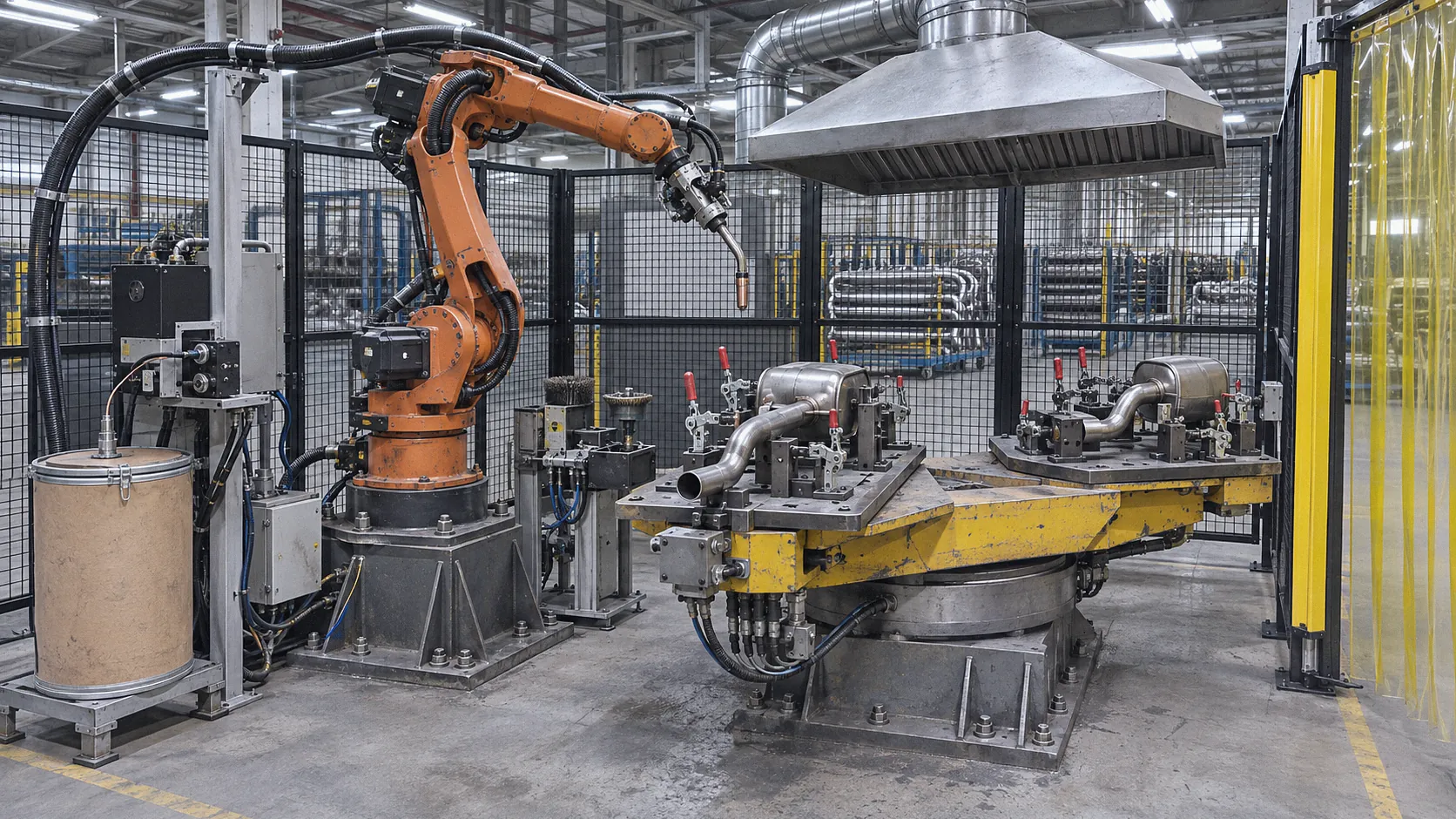
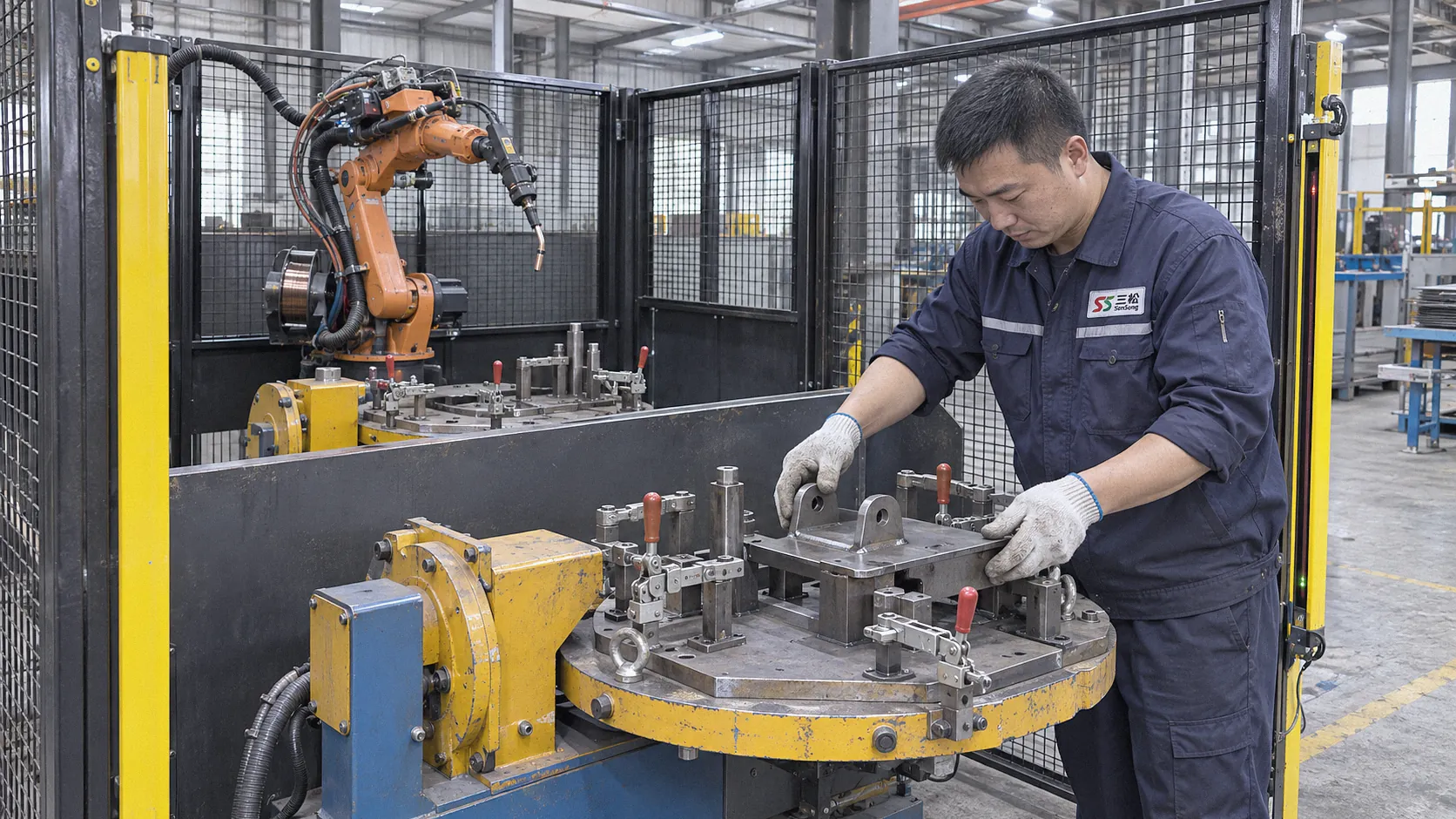
A welding cell built from a robot, a positioner, a track, a welding power source, fixtures and guarding is a robot cell under Part 2, and it is assessed as a whole.
Safety functions with default performance levels
The most significant technical change is how safety integrity is specified. IBF Solutions reports that the blanket requirement of PL d and Category 3 under ISO 13849-1 “has largely been abandoned.” Instead, ISO 10218-2 lists safety functions in an informative annex with default levels:[2]
| Safety function | Default level |
|---|---|
| Emergency stop | PL c or SIL 1 |
| Protective stop | PL d or SIL 2 |
| Enabling function (where used) | PL d or SIL 2 |
| Reduced speed (no more than 250 mm/s) | PL d or SIL 2 |
Designers may deviate from these defaults on the basis of a more comprehensive risk assessment, at the cost of more documentation.[2] In practice, buyers should ask for a list of the cell’s safety functions with the level each achieves, rather than a single PL for the whole cell.
Collaborative operation and normal stop
Two changes affect cells where people work close to robots:[2]
- Collaborative operation from ISO/TS 15066 is now part of ISO 10218-2, covering hand-guided control, speed and separation monitoring, and power and force limiting, with quasi-static and transient contact and force and pressure limit values.
- Normal stop is now a required safety function, separate from emergency stop. It is meant for routine stops such as the end of a shift, and to reduce misuse of the emergency stop.
IBF also notes that guidance from ISO/TR 20218-1 and -2 on gripper systems and manual load and unload stations has been integrated, with changes to mechanical strength, lifting, start and restart interlocks, reset, cybersecurity and risk assessment.[2]
What it means for welding cells
Robotic welding cells combine robot hazards with arc, fume, spatter and heavy-part handling. Points to settle during design:
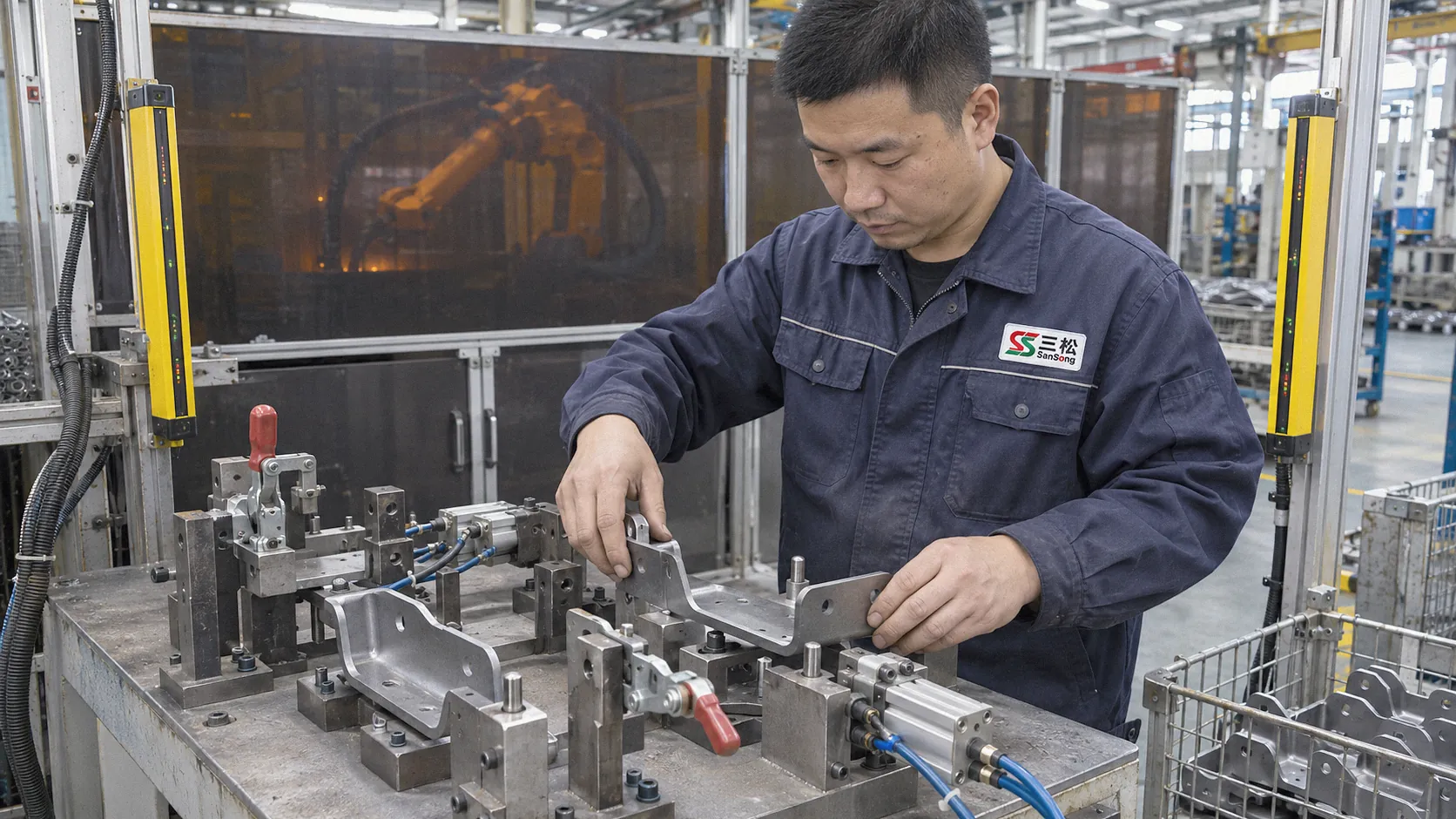
- Loading stations. Operators often load one station while the robot welds at the other. The separation between stations, by fixed screens, positioner design or sensing, is a safety function with its own level. Our article on dual-station welding cells explains the layouts.
- Positioners and tracks. External axes move heavy parts and the robot itself. Their stopping, braking and zone limits belong in the risk assessment. See our articles on robot 7th axis tracks and how a welding positioner works.
- Arc and fume hazards. Screens, curtains and fume extraction are part of the cell design. In the United States, the AWS D16 series covers this field, including AWS D16.1:2026, Specification for Robotic Arc Welding Safety, and D16.3:2026, Risk Assessment Guide for Robotic Arc Welding.[3]
- Teaching and maintenance. Reduced speed, enabling devices and lockout procedures apply when people are inside the cell.
- Normal stop and restart. Define how the cell stops at the end of a shift and how it restarts without surprises.
Our article on robotic welding cell components lists the parts of a cell.
EU harmonization and the Machinery Regulation
In the EU, standards give a presumption of conformity once their references are published in the Official Journal. IBF Solutions reports that the references of EN ISO 10218-1:2025 and EN ISO 10218-2:2025 were published on 7 September 2026 by Commission Implementing Decision (EU) 2026/2015, making them harmonized under the Machinery Directive 2006/42/EC.[2] From 20 January 2027 the Machinery Regulation (EU) 2023/1230 replaces that Directive, and it treats robotics and connected equipment as new risk factors.[4] Our article on the EU Machinery Regulation covers the change.
How SanSong can help
SanSong designs and builds robot welding workstations, welding lines and handling lines, with its own welding positioners, floor and overhead tracks and walking axes, and provides installation, commissioning and maintenance. Safety functions, guarding and documentation are part of each cell’s design and are agreed in the project quotation.
To plan a cell, see robotic automation systems, see welding positioners or send us the part, process and layout. Our guide on automation acceptance lists what to check at handover.
Frequently asked questions
What is the difference between ISO 10218-1 and ISO 10218-2?
ISO 10218-1:2025 covers the industrial robot itself and is aimed at robot manufacturers. ISO 10218-2:2025 covers industrial robot applications and robot cells and is aimed at integrators, from design and integration to commissioning, operation, maintenance and disposal.
Is ISO/TS 15066 still needed for collaborative robots?
Its content has been integrated into ISO 10218-2:2025, including hand guiding, speed and separation monitoring, and power and force limiting with force and pressure limit values.
Are the 2025 editions harmonized in the EU?
Yes. IBF Solutions reports that the references of EN ISO 10218-1:2025 and EN ISO 10218-2:2025 were published in the EU Official Journal on 7 September 2026 by Commission Implementing Decision (EU) 2026/2015, under the Machinery Directive 2006/42/EC.
Which standards cover robotic arc welding safety specifically?
In the United States, AWS publishes the D16 series, including D16.1 Specification for Robotic Arc Welding Safety and D16.3 Risk Assessment Guide for Robotic Arc Welding. They are used together with the robot safety standards.
Sources
- ISO 10218-2:2025 Robotics: Safety requirements, Part 2: Industrial robot applications and robot cells, International Organization for Standardization, .
- New standards for industrial robots: EN ISO 10218-1 and -2, IBF Solutions.
- D16 Committee on Robotic and Automatic Welding, American Welding Society.
- EU Machinery Regulation from 20 January 2027, Pilz.
Editorial note: written from the public sources listed above and SanSong’s published product information, checked on the dates shown. It is general guidance, not legal or compliance advice. Specifications not yet published by SanSong are confirmed during the project review.