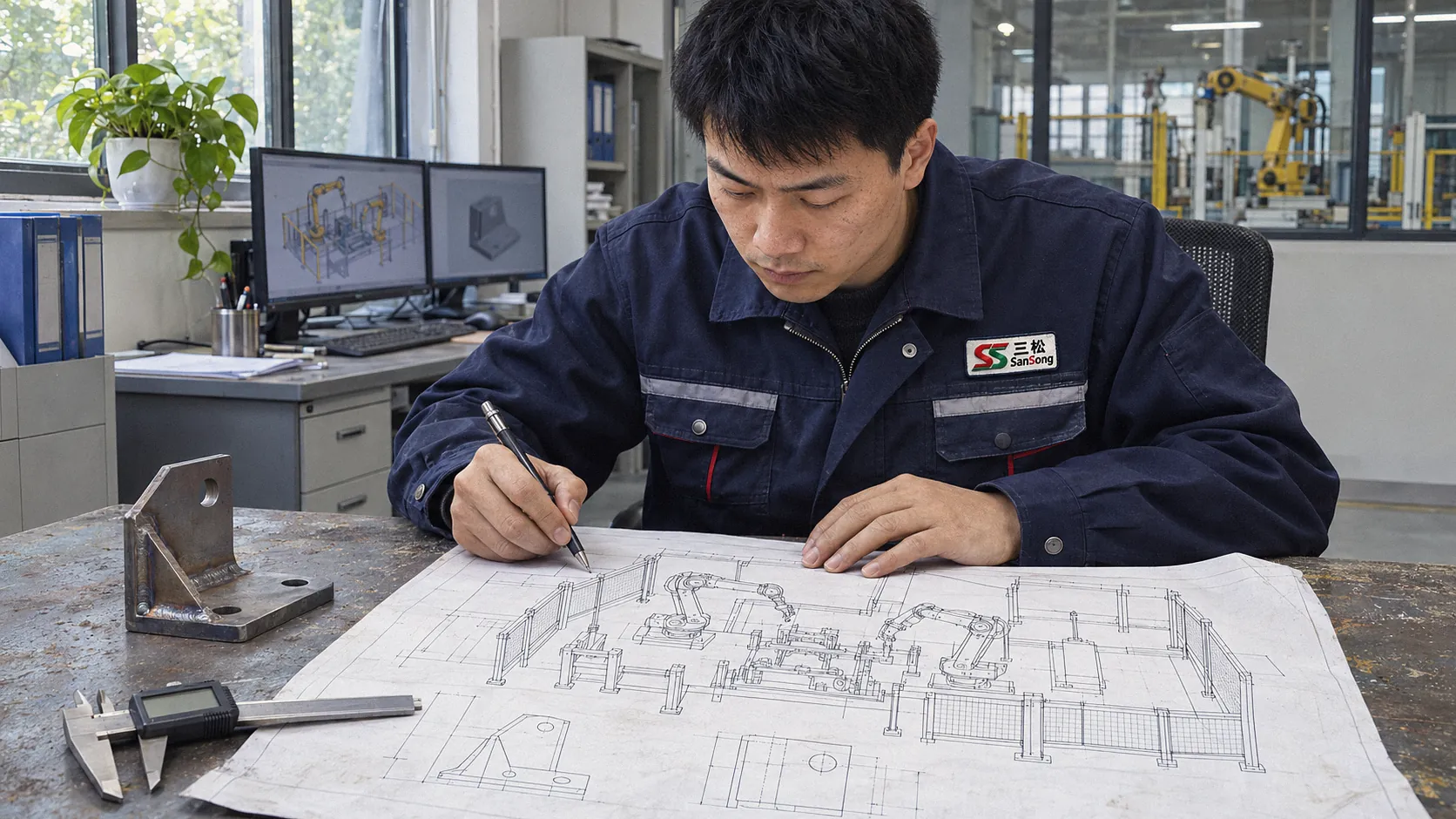
Robotic welding cell cost depends mostly on the parts and welds, the volumes, the number of stations and the fixtures, positioners, sensing, guarding and integration around the robot. A business case then compares that cost with savings you can measure: more output, fewer labor hours, less rework and less weld metal. Build it from your own data, estimate output with overall equipment effectiveness (OEE), and test the result at more than one scenario before deciding.
This guide lists the cost factors, gives the formulas, and ends with the information an integrator needs for a quotation.
What drives the cost
The robot is often a smaller share of a cell than buyers expect. The factors that move the price:
| Cost factor | What changes it |
|---|---|
| Robot and controller | Reach, payload, number of robots, external axes |
| Welding package | Process, power source, torch type, wire supply, torch service station |
| Positioners and tracks | Part weight and center of gravity, number of stations, coordinated motion |
| Fixtures | Number of part variants, manual or automatic clamping, part sensing, changeover |
| Sensing | Touch, laser or through-arc; seam finding or tracking |
| Guarding and safety | Layout, light curtains, doors, arc screens, safety functions |
| Fume extraction | Hood or torch extraction, filtration |
| Integration | Programming, simulation, cell controls, links to the plant |
| Installation and training | Transport, commissioning, operator and maintenance training |
| Ongoing costs | Consumables, spare parts, maintenance, programming of new parts |
Because these depend on the parts, compare quotations on the same scope, not on headline prices.
Estimating output
Start with the cycle time per part, including loading, welding, sensing and station swaps. Then:
- Theoretical parts per hour = 3,600 ÷ cycle time in seconds
- Planned parts per hour = theoretical parts per hour × OEE
- Planned parts per year = planned parts per hour × planned production hours per year
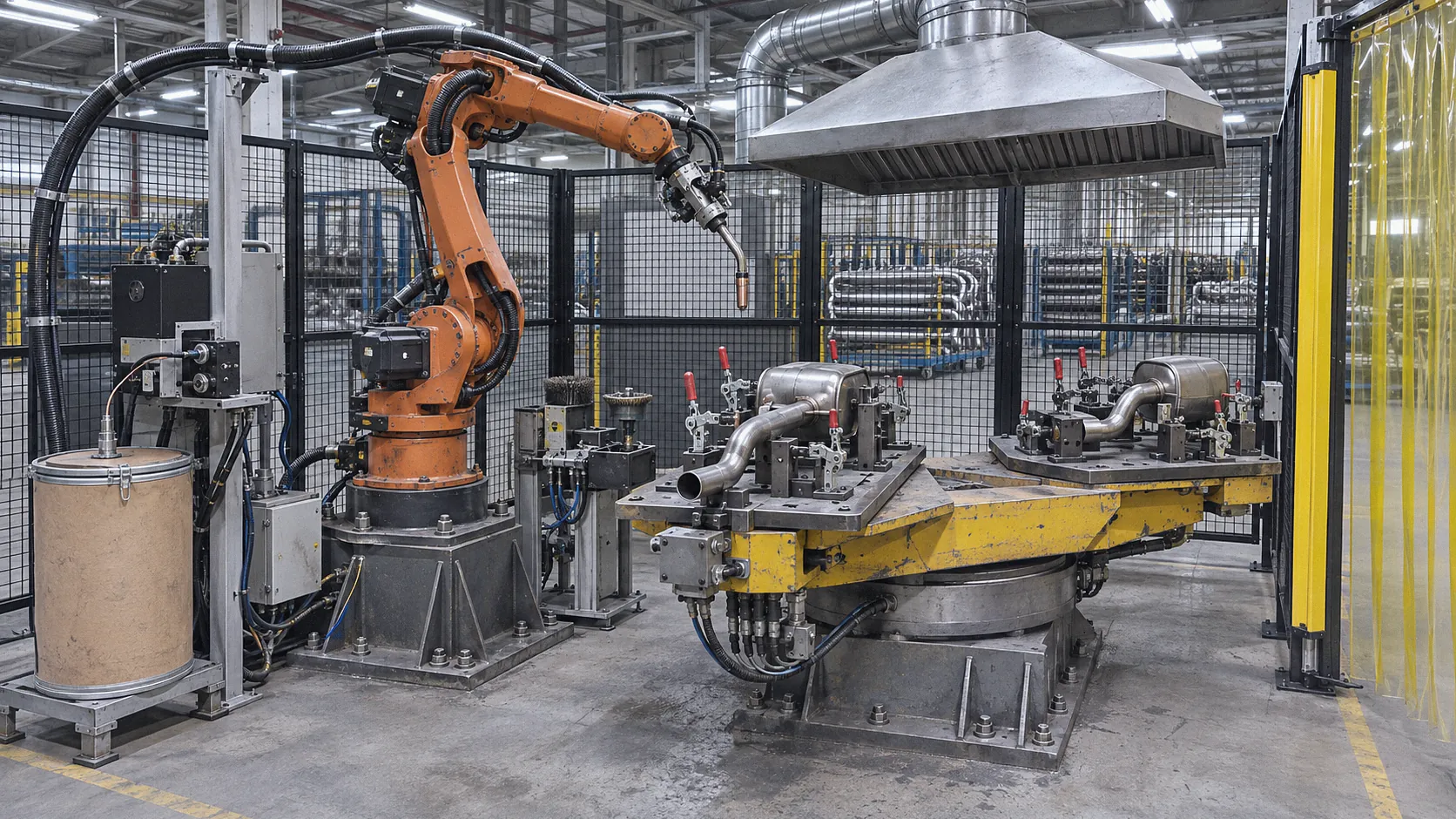
ISO 22400-2, as Fabrico summarizes it, defines OEE as availability × effectiveness × quality ratio, where effectiveness is what most guides call performance.[1] Use your own plant’s history for each factor where you have it. Layout matters: in a dual-station cell, loading overlaps with welding, which Fabricating & Metalworking describes as designed for “high robot utilization.”[2]
Estimating savings
Count only savings you can measure or credibly estimate.
- Labor hours. Annual labor hours saved = (current labor minutes per part − remaining operator minutes per part) × annual parts ÷ 60. Remaining minutes include loading, inspection and touch-up.
- Output. If the cell removes a bottleneck, value the extra parts at their contribution margin, not their price.
- Weld metal and rework. Consistent fit-up reduces overwelding: Lincoln Electric’s guidance notes that poor fit-up can require 125% to 200% more weld metal.[3] Measure current weld metal use and rework hours as a baseline.
- Quality costs. Scrap, repairs, inspection and warranty claims, where records exist.
Simple payback and scenarios
- Annual net savings = labor savings + output value + material and quality savings − added running costs
- Simple payback in years = total investment ÷ annual net savings
Calculate at least three scenarios: expected, lower volume and lower OEE. A case that works only when every assumption goes right is a weak case.
Published cases show what is possible but transfer poorly. A KUKA case study published by the Association for Advancing Automation reports, for one drum-welding cell, 35% shorter manufacturing times than manual work, availability above 95% and a projected payback of three years.[4] Those are one company’s figures for one part; use them to check your method, not as your inputs.
Risks that change the result
- Upstream part quality. Robots need consistent parts. Joint location should repeat within about half the wire diameter, according to Lincoln Electric’s guidance,[3] so cutting and forming may need investment too. See our welding fixture design guide.
- Product mix. Many variants mean more fixtures, programs and changeovers. Our article on robotic welding cell components covers changeover options.
- Programming capacity. New parts need programs; plan who writes them.
- Skills. Operators and technicians need training. AWS publishes D16.5, a training guide for robotic arc welding personnel, and D16.4 for their qualification.[5]
- Ramp-up. OEE is lower in the first weeks; plan the ramp-up in the business case.
What to send for a quotation
An integrator can only quote what is defined. Prepare:
- Part and assembly drawings, with datums and tolerances.
- A weld list: joint type, length, size, position and any quality class.
- Materials, thicknesses and surface condition.
- Current cycle time, staffing and annual volumes per part, with the product mix.
- Available floor space, crane access and utilities.
- Standards, safety requirements and target markets.
- Acceptance criteria: cycle time, quality checks and run-off length.
Our guide on what to send before we quote and our project scope page explain how SanSong reviews a project.
How SanSong can help
SanSong designs and builds welding fixtures, robot welding workstations, welding lines and handling lines, with its own positioners and tracks, and provides installation, commissioning and maintenance. Its engineers can review your parts and data and quote a cell against a defined scope.
To start, see robotic automation systems or send us the drawings, weld list and volumes.
Frequently asked questions
How much does a robotic welding cell cost?
It depends on the parts, welds, volumes, number of stations, positioners, fixtures, sensing, guarding and integration. A figure without those inputs is not meaningful. Send drawings, weld lists and volumes for a quotation.
How do I estimate the output of a welding cell?
Divide 3,600 by the cycle time per part in seconds to get theoretical parts per hour, then multiply by overall equipment effectiveness (OEE), which ISO 22400-2 defines as availability × effectiveness × quality ratio.
What payback should I expect?
Payback is specific to each plant. Calculate it from your own labor rates, volumes, current cycle times and expected OEE, at two or three scenarios. Published case studies report single installations and do not transfer directly.
What should I send to get a welding cell quotation?
Part and assembly drawings, a weld list with lengths, sizes and positions, materials and thicknesses, current cycle time, annual volumes and product mix, tolerances, the available space and utilities, and your acceptance criteria.
Sources
- OEE according to ISO 22400, Fabrico (summary of ISO 22400-2).
- Dual-station cells add versatility to welding applications, Fabricating & Metalworking, .
- Design objectives for robotic welding fixtures, The Fabricator (Geoff Lipnevicius, Lincoln Electric), .
- Controlled precision: robotic welding with touch and arc sensors, Association for Advancing Automation (case study by Jürgen Warmbold).
- D16 Committee on Robotic and Automatic Welding, American Welding Society.
Editorial note: written from the public sources listed above and SanSong’s published product information, checked on the dates shown. It is general guidance, not legal or compliance advice. Specifications not yet published by SanSong are confirmed during the project review.