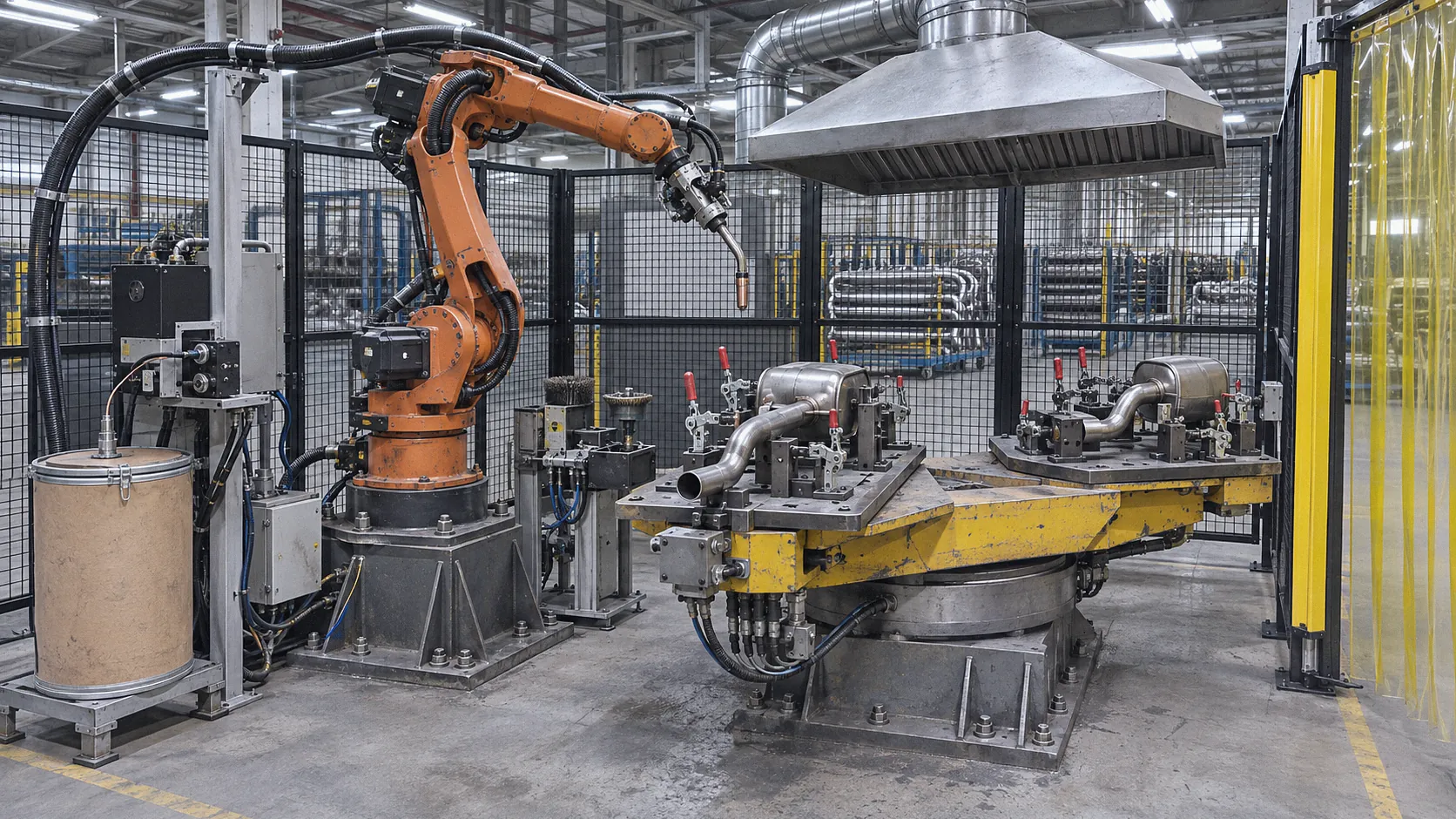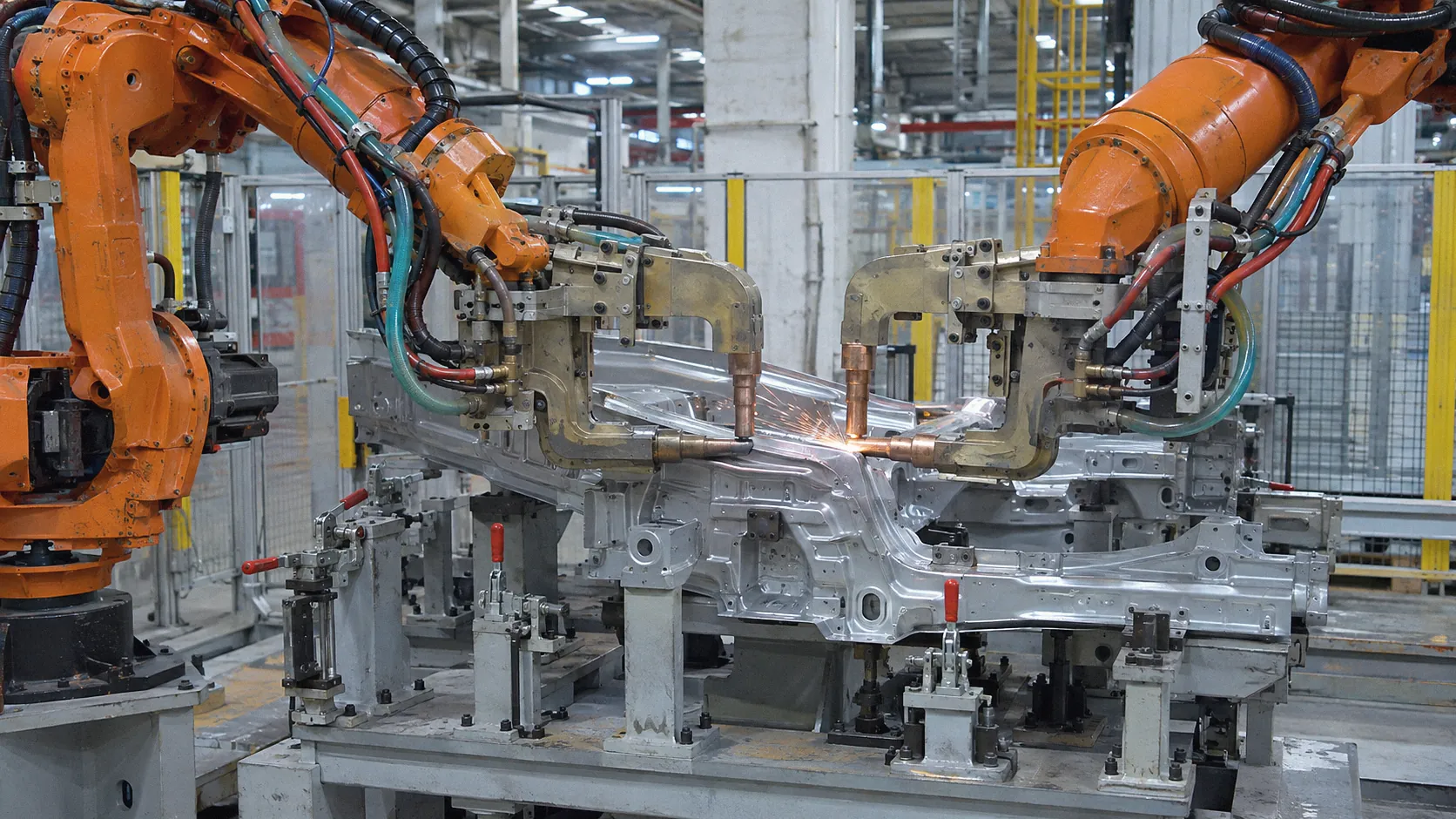
A robotic spot welding line uses industrial robots carrying resistance welding guns to join overlapping sheet-metal parts at discrete points, without filler metal, usually with fixtures and handling robots or conveyors linking several stations. It suits lapped sheet metal with access to both sides of the joint; arc welding suits thicker sections and continuous seams. Weld quality on a line depends on controlling force, current and time, the material and fit-up, and the electrodes.
This guide compares spot and arc welding, describes the parts of a line and sets out how to keep weld quality stable.
How resistance spot welding works
Spot welding passes a high current through overlapping sheets clamped between two electrodes. Resistance at the interface creates local heat, and the electrode force forges a joint called a nugget. Tom Snow’s guide in The Fabricator sums up the settings as force, current and time (“FCT”), and notes that weld force must be in the proper range: too little causes expulsion and ragged welds, too much reduces joint resistance and lowers strength and ductility.[1]
Short weld times limit the heat-affected zone. In Snow’s example, a short, high-current weld gave less marking, more consistent nuggets and higher tensile-shear strength than a long, low-current weld on the same material.[1]
Spot welding or arc welding?
| Point | Resistance spot welding | Arc welding (MIG/MAG) |
|---|---|---|
| Joint | Overlapping sheets (lap joints) | Fillet, butt, lap and corner joints |
| Filler | None | Filler wire |
| Weld | Discrete points | Continuous or stitched seams |
| Thickness | Sheet metal | Sheet to thick plate |
| Access | Electrodes usually reach both sides of the joint | Torch from one side |
| Heat and distortion | Short, local heat input | More heat input along the seam |
| Sealing | Not sealed between spots | Continuous seams can seal |
Snow describes spot welding, properly applied, as a fast, strong and low-cost way to join sheet metal, and notes that shops often turn to slower and more expensive alternatives such as arc welding, clinching, riveting or adhesives when their spot welds fail.[1] Many assemblies use both: spot welds for sheet-metal flanges and arc welds for brackets, thicker parts or seams that must be continuous. Our article on robotic welding cell components covers arc welding cells.
What a spot welding line contains
- Robots with welding guns. C-type or X-type guns sized for the reach into the part, the sheet stack and the force needed.
- Weld controller. Controls current and time; Snow notes that newer controls may monitor current and force in real time, and some use closed-loop control to compensate for material and line-voltage changes.[1]
- Electrode cooling. Snow notes that poor cooling makes tips mushroom, and gives an ideal water temperature of 55 to 65 °F (about 13 to 18 °C), above the dew point, recommending a refrigerated chiller.[1]
- Tip dressing. Dressers restore the electrode contact face on a schedule.
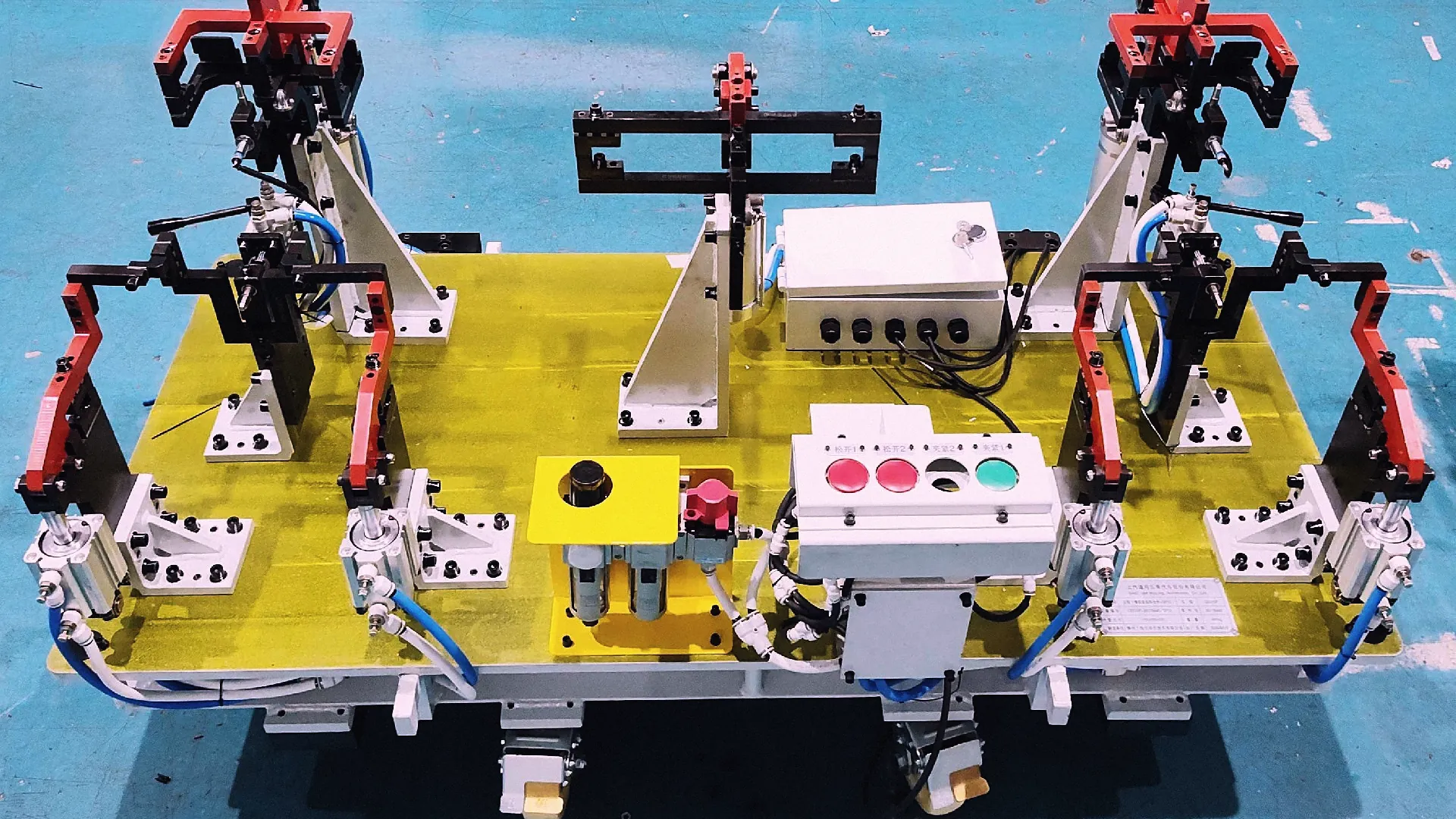
- Fixtures. Locate and clamp the sheets so flanges sit together and the gun can reach each spot. Our welding fixture design guide covers locating and clamping.
- Handling. Robots, slides or conveyors move parts between stations.
- Safety and controls. Guarding, safety functions and a line controller that links stations and records data.
Keeping weld quality stable
TWI notes that “dozens of factors” can influence a spot weld, and recommends setting a welding condition with reasonable tolerance to process variation rather than one that only just works.[2] Its guidance, applied to a line:[2]
- Control the material. Grade, coating type and thickness, and surface cleanliness such as dirt and rust.
- Control the presswork. Poor fit-up and spots too close to sheet edges cause poor or variable welds.
- Set force and time for the stack. Low forces or short times may give acceptable welds that are sensitive to small process changes.
- Check the process at intervals. Check electrode force and welding current, for example daily, and keep records of settings.
- Maintain the electrodes. Set alignment and tip contact face correctly; use a dressing or replacement schedule and good water cooling.
- Test destructively at intervals and keep the records.
- Fix root causes of deviations rather than compensating with ever larger setting changes.
On electrode life, Snow cites research of about 8,000 welds in low-carbon steel, or 3,000 in galvanized steel, without dressing or changing electrodes.[1] Use such figures only as a starting point for your own dressing schedule.
In-process monitoring
Monitors can help, if they are validated. TWI explains that useful signals reflect weld growth, such as dynamic resistance between the electrodes and weld expansion, and that monitor readings must show “sufficient correlation between monitor indication and actual weld quality.”[3] Monitor data can flag secondary-circuit problems and maintenance needs and can be shown as statistical process control charts.[3] Agree in acceptance which monitor limits apply and how destructive tests confirm them; our guide on automation acceptance lists items to agree.
Fixtures and fit-up still decide a lot
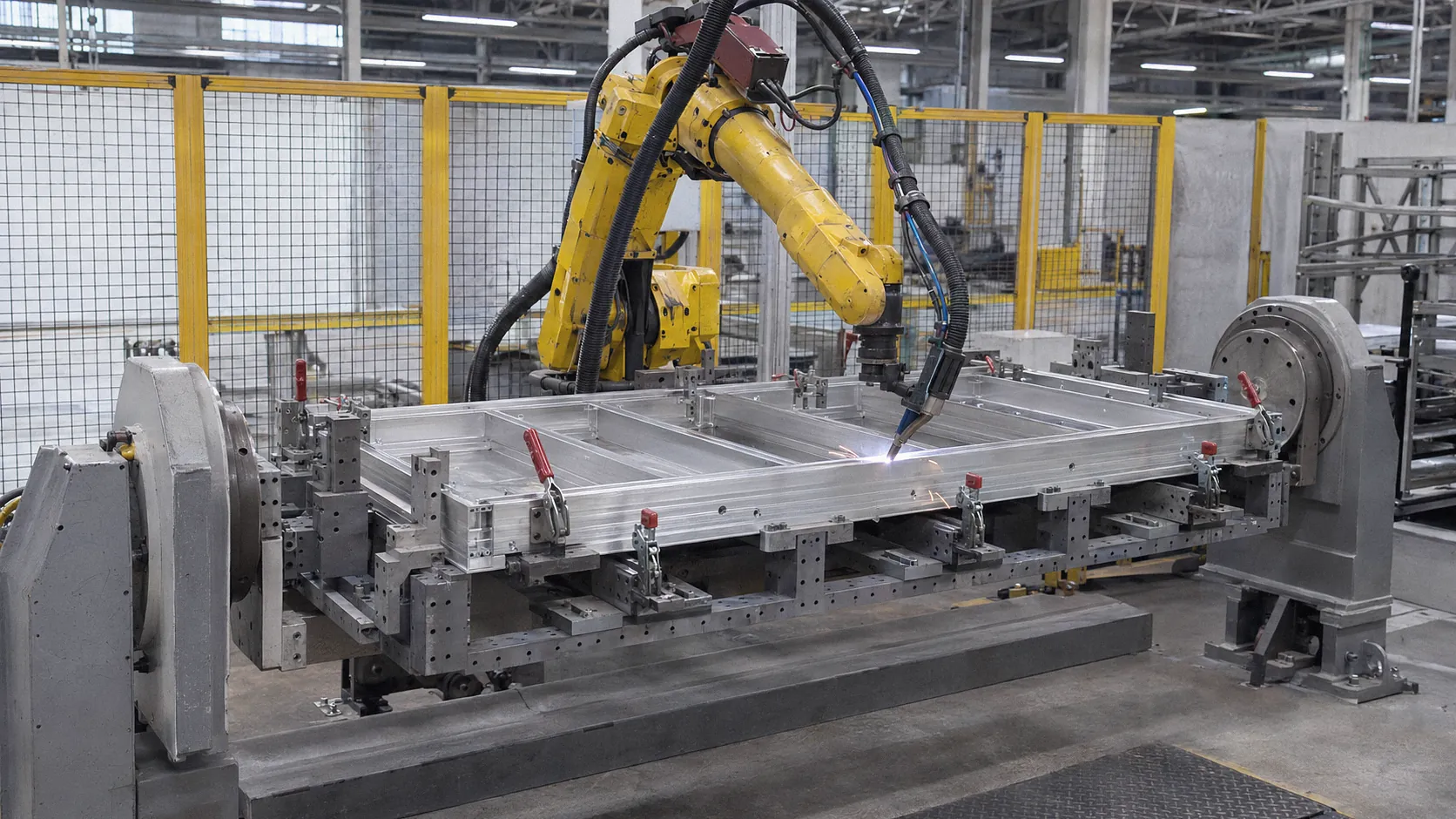
Just as in arc welding, the robot repeats its path exactly, so part position and fit-up come from the fixture and the presswork. Lincoln Electric’s fixture guidance stresses consistent upstream operations such as shearing and bending for consistent fit-up.[4] Budget for fixtures and part quality in the business case, not only for robots and guns.
How SanSong can help
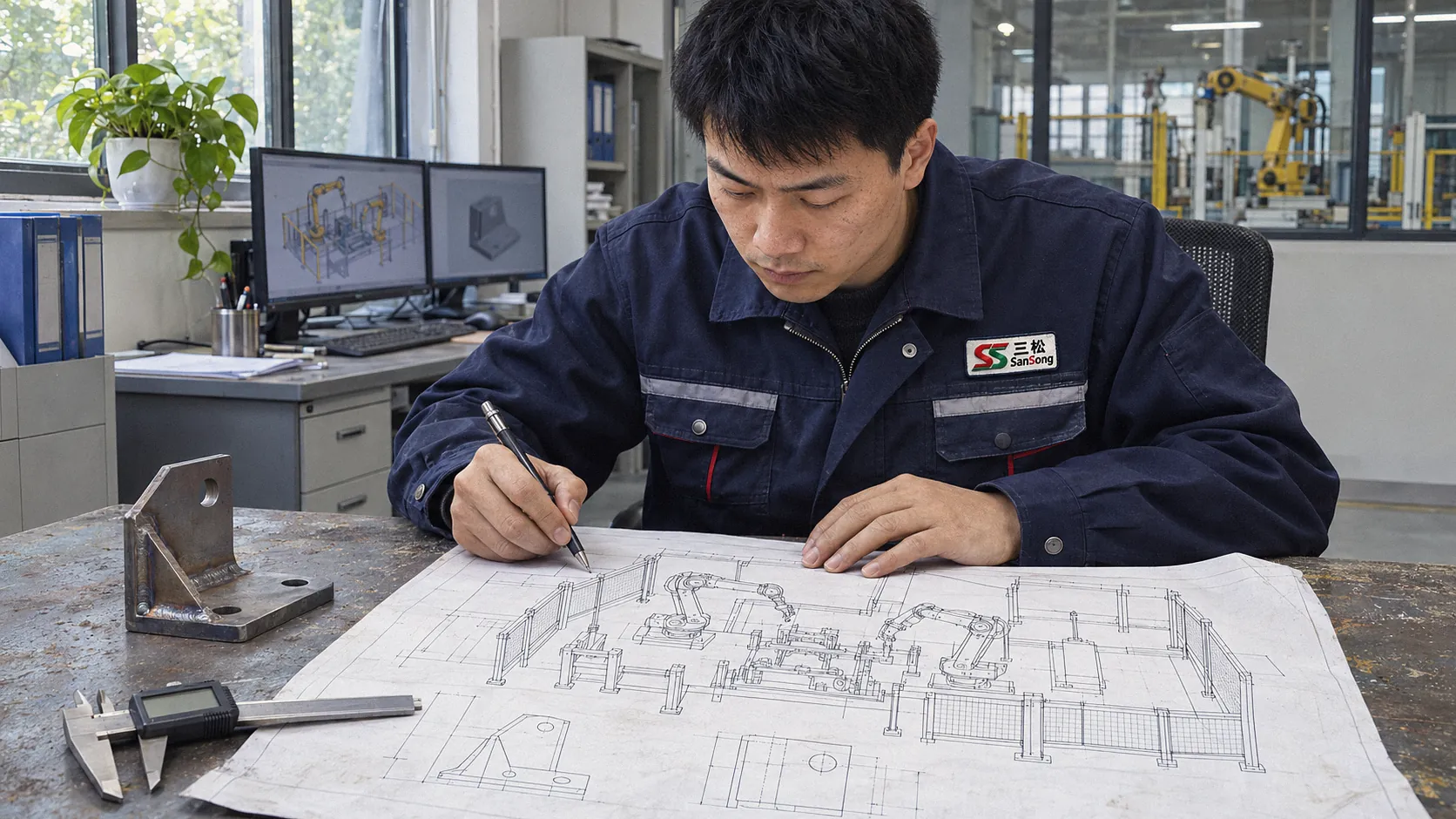
SanSong’s published products include a robot spot welding line built from standard spot welding stations, alongside arc welding workstations, welding fixtures and handling lines for automotive and construction-machinery parts. Its engineers design the fixtures, stations and handling together, then install and commission the line.
To plan a spot welding line, see robotic production lines, see automotive and new-energy applications or send us the part drawings, sheet stacks and volumes.
Frequently asked questions
What is the difference between spot welding and arc welding?
Resistance spot welding joins overlapping sheets at discrete points by passing current through them under electrode force, without filler metal. Arc welding melts filler wire into a joint and can make continuous seams on fillet, butt and lap joints, including thicker sections.
Which parameters control a resistance spot weld?
Electrode force, welding current and weld time, often summarized as FCT. The Fabricator notes that too little force causes expulsion and ragged welds, while too much reduces joint resistance and lowers strength.
How often should spot welding electrodes be dressed?
It depends on material, coating, current and cooling. The Fabricator cites research of about 8,000 welds in low-carbon steel, or 3,000 in galvanized steel, without dressing or changing electrodes. Set a dressing or replacement schedule from your own tests.
How is spot weld quality checked on a line?
TWI advises keeping records of settings, checking electrode force and welding current at intervals such as daily, and keeping records of periodic destructive tests. In-process monitors that track dynamic resistance or weld expansion must be validated against actual weld quality.
Sources
- Resistance spot welding and what to know about the technology, The Fabricator (Tom Snow), .
- What must be done to ensure the quality and consistency of resistance spot welds?, TWI.
- How can I monitor the quality of resistance spot welds?, TWI.
- Design objectives for robotic welding fixtures, The Fabricator (Geoff Lipnevicius, Lincoln Electric), .
Editorial note: written from the public sources listed above and SanSong’s published product information, checked on the dates shown. It is general guidance, not legal or compliance advice. Specifications not yet published by SanSong are confirmed during the project review.