
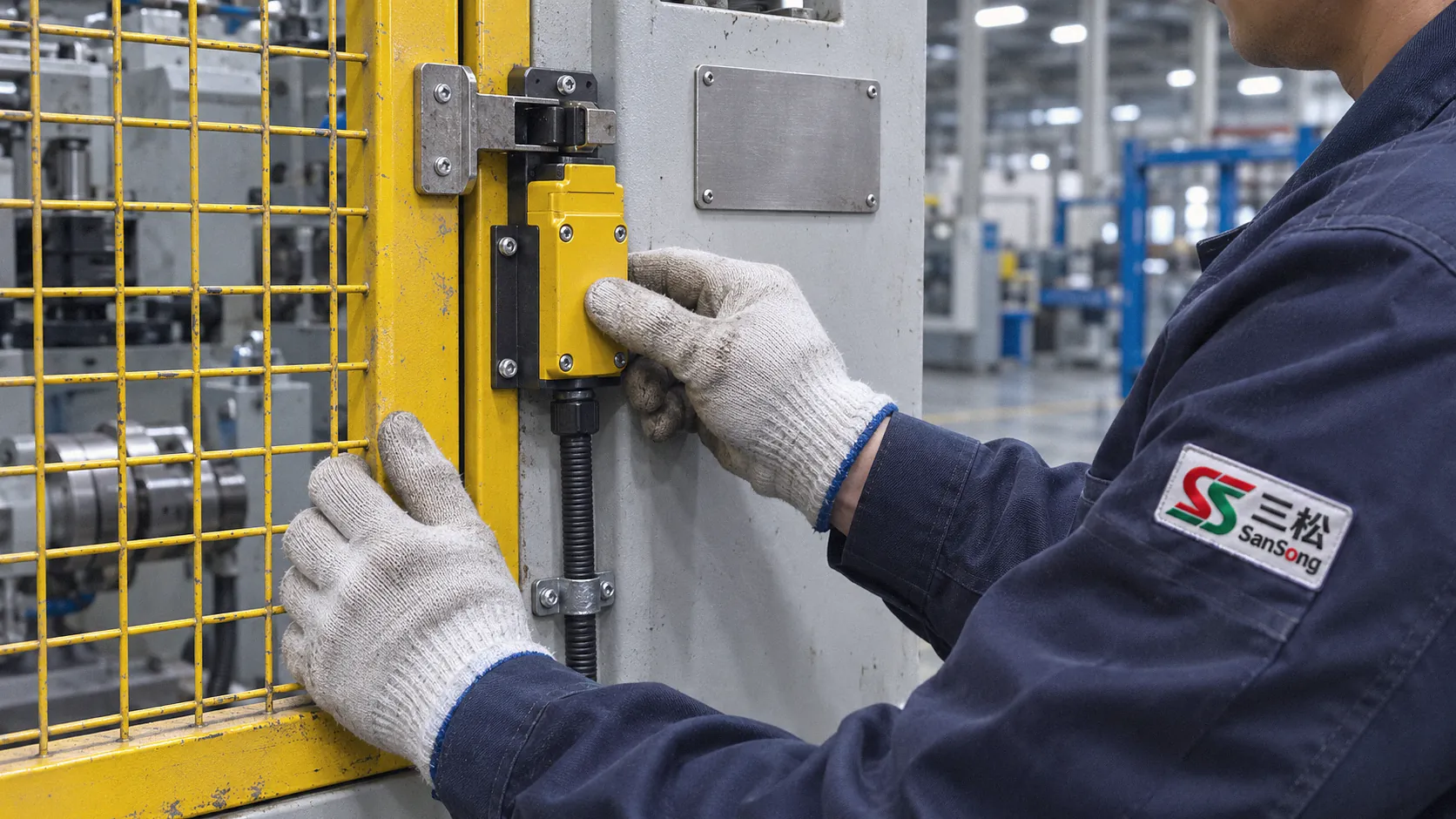
The EU Machinery Regulation, Regulation (EU) 2023/1230 of 14 June 2023, replaces the Machinery Directive 2006/42/EC and applies from 20 January 2027.[1] As a regulation, it applies directly in every member state. It keeps CE marking and the EU declaration of conformity, and adds explicit rules on substantial modification, software and cybersecurity, high-risk machinery and digital instructions. For buyers of imported machines and robot cells, it changes what to agree with the supplier.
This article summarizes published sources for equipment buyers. It is not legal advice; check the regulation and its harmonized standards for your machine.
Key dates
| Date | What happens | Source |
|---|---|---|
| 14 June 2023 | Regulation adopted | EU-OSHA[1] |
| 19 July 2023 | Entry into force | Pilz[2] |
| 20 January 2024 | Rules on notified bodies apply | EU-OSHA[1] |
| 20 January 2027 | Regulation applies; Directive 2006/42/EC is replaced | EU-OSHA[1], Pilz[2] |
| 2 August 2028 | Delegated acts adding AI-related health and safety requirements to Annex III to apply by this date, after the 2026 Digital Omnibus amendment | IBF Solutions[3] |
Some dates in the original publication were miscalculated and corrected by a corrigendum of 4 July 2023; the application date, for example, moved from 14 January 2027 to 20 January 2027.[3] Use the corrected text.
What changes for machines
EU-OSHA summarizes the regulation as setting mandatory health and safety requirements for the design and construction of machinery, with technical details mostly given in harmonized standards. Machinery must meet the essential requirements in Annex III before it is placed on the market or put into service, and compliant products carry CE marking and an EU declaration of conformity.[1]
The main changes compared with the Directive, as Pilz describes them:[2]
- High-risk machinery is listed in Annex I. For six categories, third-party conformity assessment is required, and applying a harmonized standard does not remove that obligation.
- Substantial modification is now defined, and a conformity assessment is required when it occurs.
- Safety components include software as well as physical, digital and mixed components.
- Digital technologies such as AI, connected devices and robotics are treated as new risk factors.
- Protection against corruption is required: cybersecurity threats must not compromise the machine’s safety functions.
- Digital instructions are allowed, with paper on request; the declaration of conformity and the declaration of incorporation for partly completed machinery may also be digital.
EU-OSHA adds that the regulation clarifies “incomplete machinery” and covers newer technologies such as autonomous mobile robots, connected equipment and AI-based safety functions.[1]
Substantial modification: retrofits and added robots
For factories, the rule on substantial modification has direct practical consequences. Pilz puts it plainly: “If a substantial modification has taken place, the operator becomes the manufacturer”.[2] That matters whenever a plant:
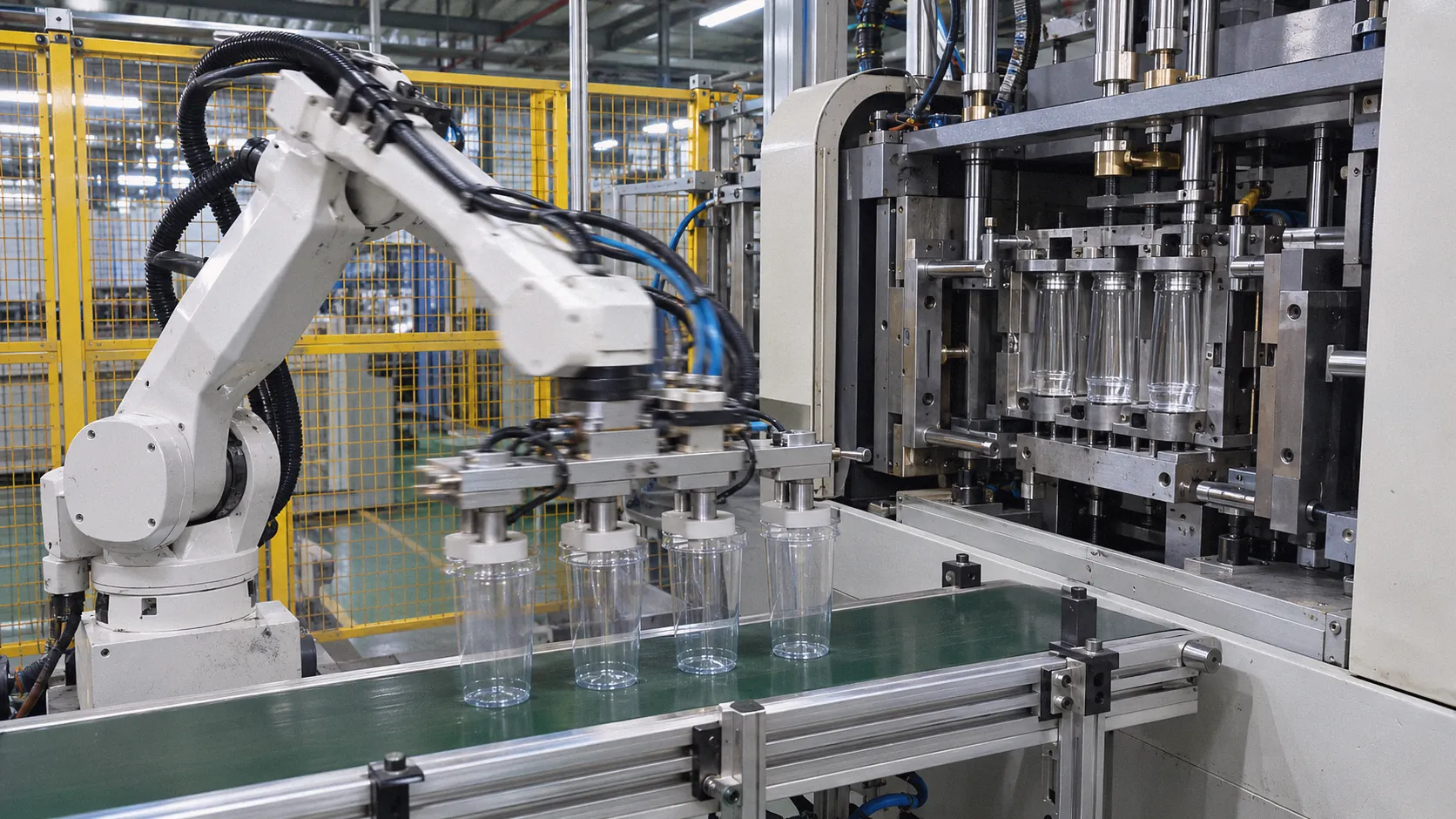
- adds a take-out robot to an installed injection stretch blow molding (also written moulding) machine,
- links machines into a cell or line with shared safety functions,
- changes speeds, guarding or the control system in ways the original manufacturer did not foresee.
Plan such changes with the conformity work in mind, and decide who will act as manufacturer for the modified machine or the assembly. Our article on ISBM take-out robots and our guide on robot retrofits cover the practical side.
Robot cells and lines
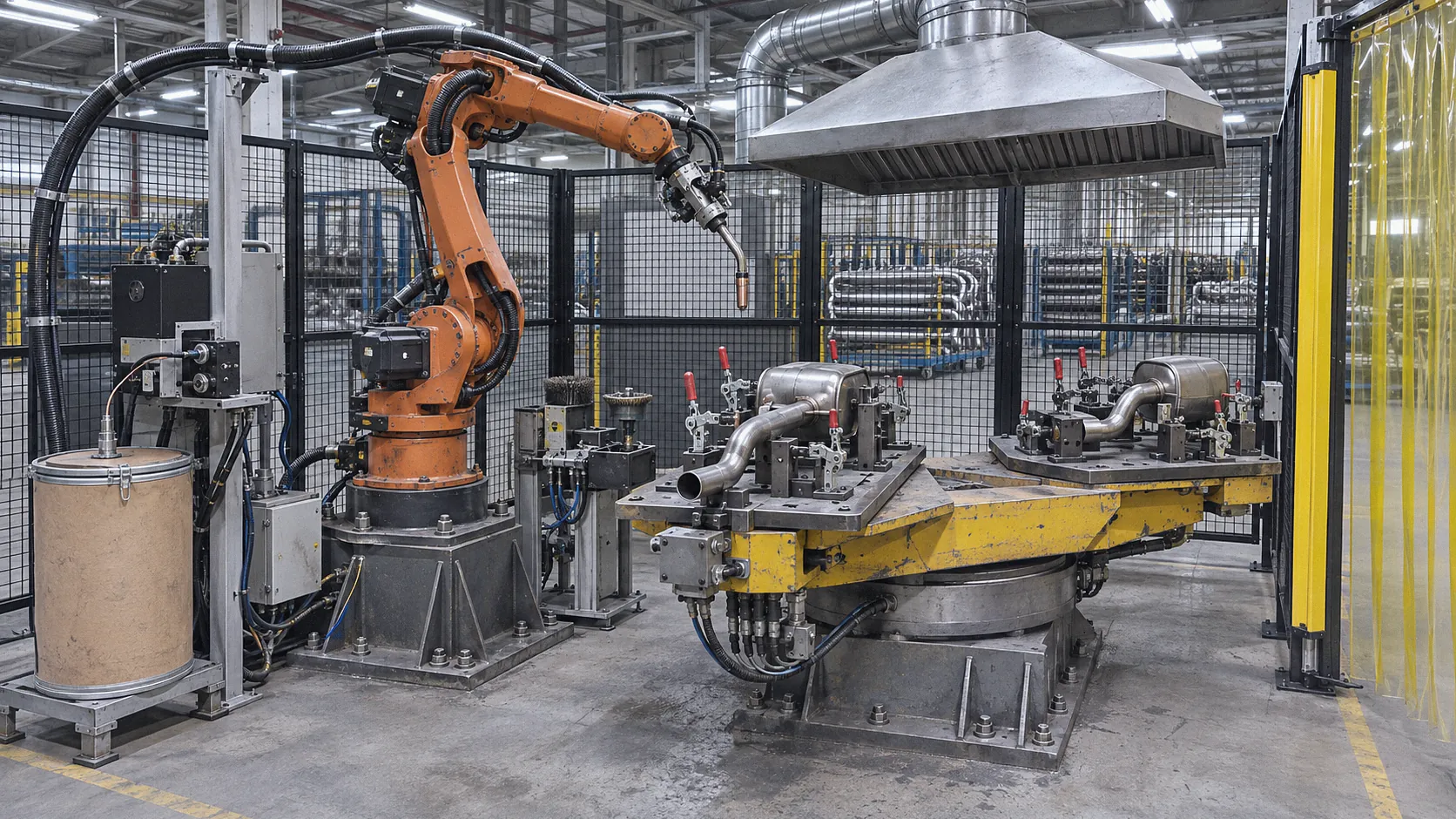
A robot cell combines a robot, a positioner or track, tooling, guarding and controls into one assembly, and it is assessed as a whole. ISO 10218-2:2025 sets the safety requirements for industrial robot applications and robot cells, from design and integration to commissioning, operation and maintenance.[4] Our article on ISO 10218:2025 explains the standard, and the article on robotic welding cell components lists what a welding cell contains.
What to agree when buying an imported machine
For a machine built outside the EU, settle these points in the contract:
- Roles. Who is the manufacturer, who is the importer, and, for a cell or line, who integrates the assembly.
- Conformity route. Whether the machine falls under the high-risk list in Annex I, and if so, which third-party assessment applies.
- Documents. The EU declaration of conformity or declaration of incorporation, the instructions in the required languages (digital or paper), and the parts of the technical documentation the buyer needs.
- Software and connectivity. Software versions of safety functions, how updates are controlled, and how remote access is protected.
- Changes after delivery. Which later modifications the supplier must approve, so that a change does not become a substantial modification by accident.
- Acceptance. How safety functions are tested at acceptance. Our guide on automation acceptance lists items to agree.
How SanSong can help
SanSong builds one-step ISBM machines and robotic automation, including take-out robots, welding positioners, robot tracks, welding cells and production lines. For EU projects, the documents, safety functions and responsibilities are agreed in the project quotation, and SanSong’s engineers can plan a cell or retrofit with the conformity assessment in mind.
To plan a machine or cell for the EU market, see the ISBM machines, see robotic automation systems or send us the application and target market.
Frequently asked questions
When does the EU Machinery Regulation apply?
Regulation (EU) 2023/1230 entered into force on 19 July 2023 and applies from 20 January 2027. Some provisions, such as those on notified bodies, applied earlier, from 20 January 2024.
Does the regulation replace the Machinery Directive?
Yes. It replaces Directive 2006/42/EC. The Directive continues to apply until the regulation applies on 20 January 2027.
What is a substantial modification?
The regulation now defines the term, and a conformity assessment is required when a substantial modification takes place. As Pilz summarizes it, the operator who makes a substantial modification becomes the manufacturer. Check the definition in the regulation before changing an installed machine.
Can machine instructions be supplied digitally?
Yes. Instructions may be supplied in digital form, and the manufacturer must provide paper on the customer’s request. The EU declaration of conformity and the declaration of incorporation may also be digital.
Sources
- Regulation 2023/1230/EU - machinery, European Agency for Safety and Health at Work (EU-OSHA).
- EU Machinery Regulation from 20 January 2027, Pilz.
- Amendments for the Machinery Regulation (EU) 2023/1230, IBF Solutions.
- ISO 10218-2:2025 Robotics: Safety requirements, Part 2: Industrial robot applications and robot cells, International Organization for Standardization, .
Editorial note: written from the public sources listed above and SanSong’s published product information, checked on the dates shown. It is general guidance, not legal or compliance advice. Specifications not yet published by SanSong are confirmed during the project review.