
Skip to content

How one-step injection stretch blow molding works

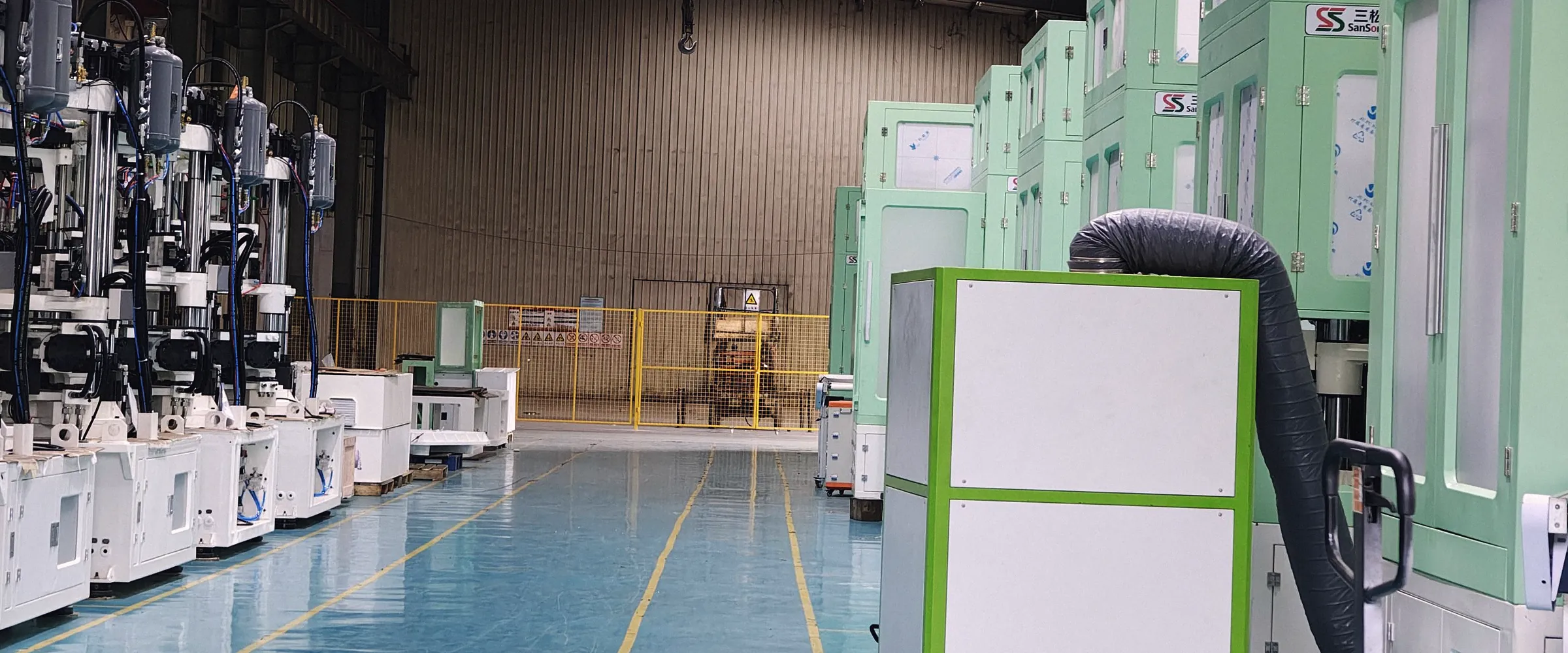
Injection stretch blow molding machines under assembly along a SanSong workshop aisle
Starting point

Container and material review

Scope to discuss

Three / four-station machines and molds

Applications

Plastic bottles and specialised containers

The application

One-step injection stretch blow molding (moulding) connects preform injection and stretch blow molding in one production process.

SanSong offers three-station standard and two-colour machines, and a four-station double-row machine with a conditioning stage.

The container design, resin grade and output requirement determine which configuration should be considered.

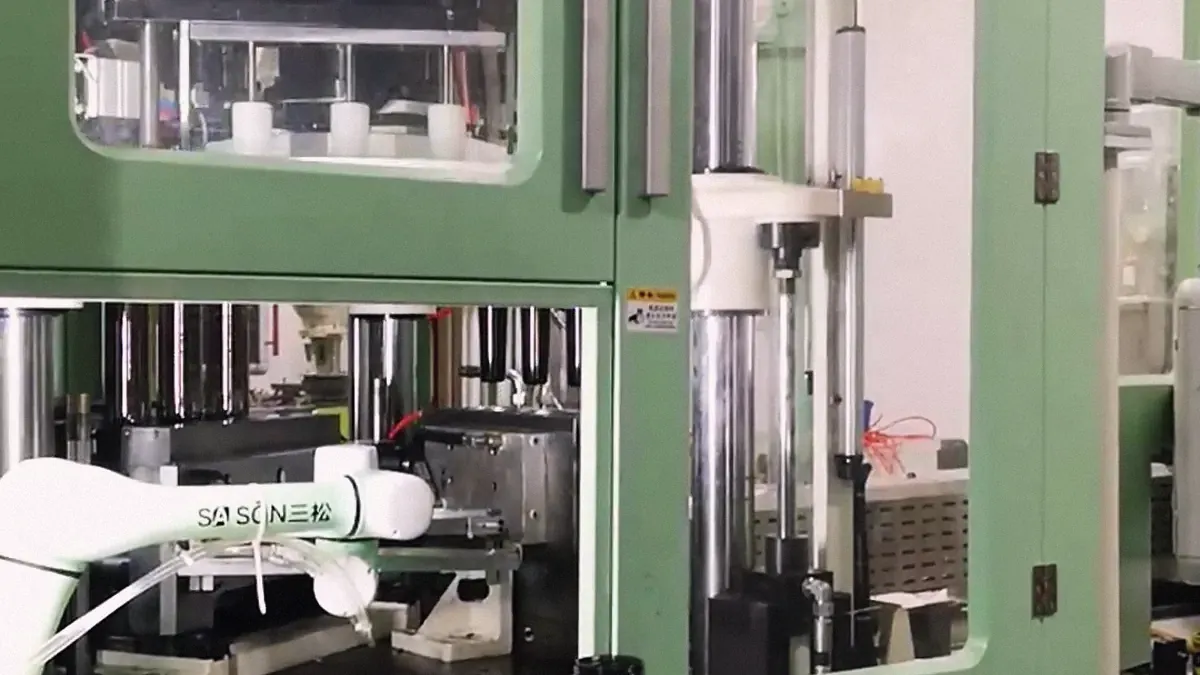
Robot take-out of sports bottles on a SanSong machine

Develop the right specification

A useful brief is the first step

Begin with the bottle drawing or sample, nominal volume, target weight and neck finish. Include the intended packaging use.

Review material grade, appearance and handling needs together with the machine and mold configuration.

Discuss sample trials and agreed inspection points before the production equipment is finalised.

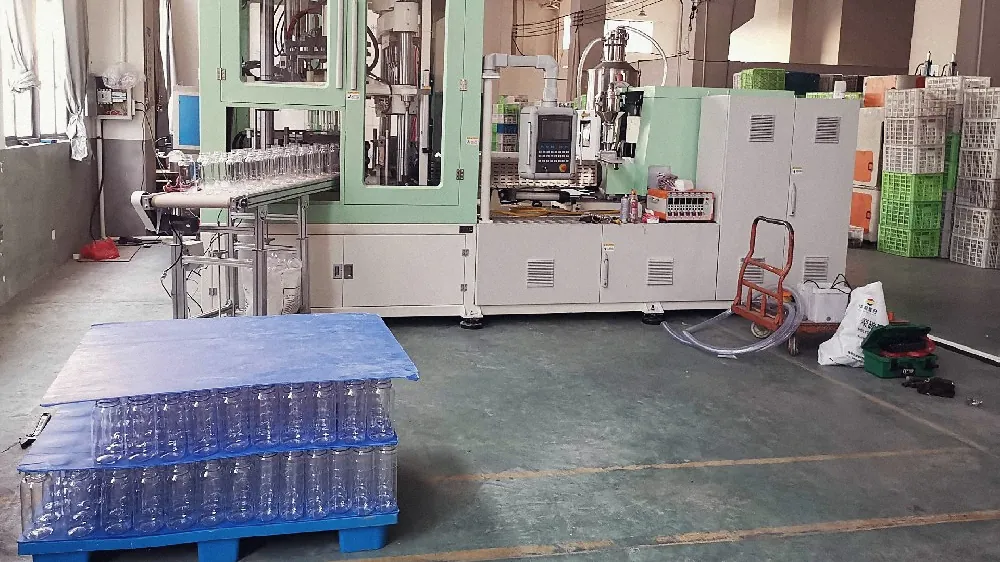
Sports cups from a four-cavity mold beside a SanSong machine

Build the project scope

Five points for the technical discussion

[01] Container brief

Shape, volume, neck finish, material and intended use.

[02] Machine selection

Three-station or four-station configuration for review.

[03] Mold discussion

Cavity arrangement and tooling matched to the container.

[04] Production layout

Utilities, removal and downstream handling requirements.

[05] Project quotation

Technical scope, trials and commercial arrangements.

From proposal to delivery

Agree what the project needs to demonstrate

The proposed process should be checked against the chosen resin grade and container requirements.

Ask the ISBM team for the current technical data and a trial discussion. Published application examples are not a guarantee for every material and bottle combination.

Packaging compliance and market requirements need their own assessment alongside the equipment project.

HOW ONE-STEP ISBM WORKS

From resin to bottle on one machine.

One-step injection stretch blow molding forms the preform and the finished container in a single machine cycle.

  1. Injection

    The resin is melted and injected into the preform mold.

  2. Conditioning

    On four-station machines, a separate station heats or cools the preform to the temperature the process needs. Three-station machines blow the preform while it still holds its injection heat.

  3. Stretch and blow

    A stretch rod draws the preform lengthwise while high-pressure air expands it against the blow mold. Stretching in both directions gives the wall its toughness and clarity.

  4. Release

    The finished container leaves the mold, ready for packing or downstream handling.

ONE STEP OR TWO

Why form the container on one machine.

In two-step production, preforms are molded on one machine, cooled, stored and reheated on a second machine for blowing. One-step ISBM joins the two.

No reheating between machines

The preform goes straight from injection to blowing, so the intermediate cooling and reheating time disappears.

Smaller footprint

One machine takes the place of a preform injection machine and a blow molder, with less floor space.

Steadier quality

A continuous process avoids preforms being deformed or scratched while they are moved between machines.

Lower running cost

Fewer machines, fewer operators, less energy and less floor space.

Less scrap

The preform is exposed to the surroundings for less time, so fewer containers are lost to damage or contamination.

Simpler production

One process to run and plan, with fewer hand-overs between production steps.

SANSONG PROCESS DRAWINGS

Three machines, drawn station by station.

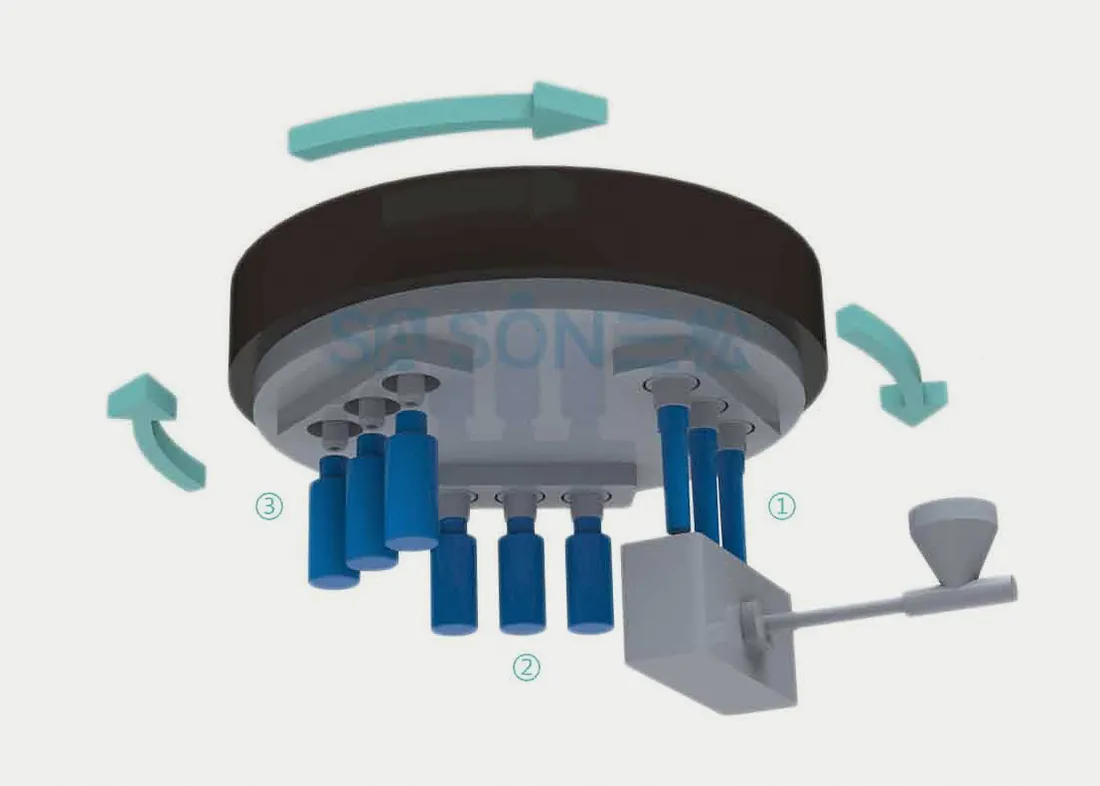
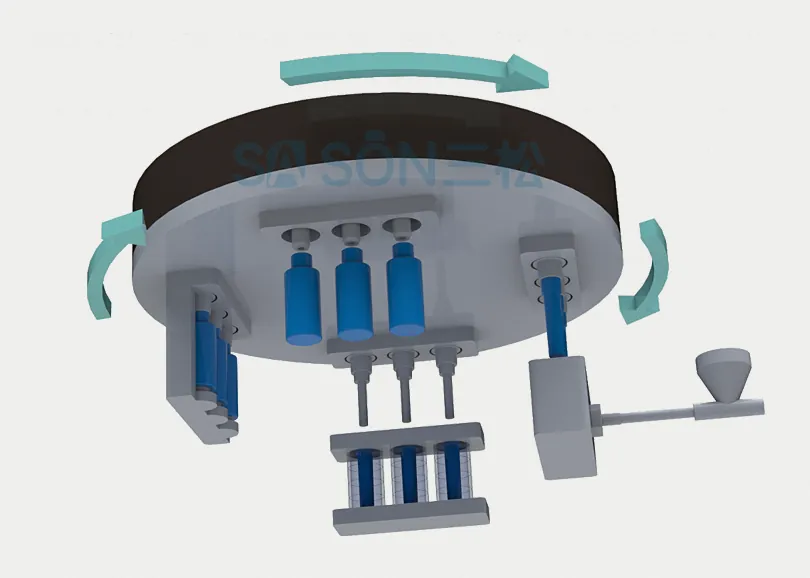
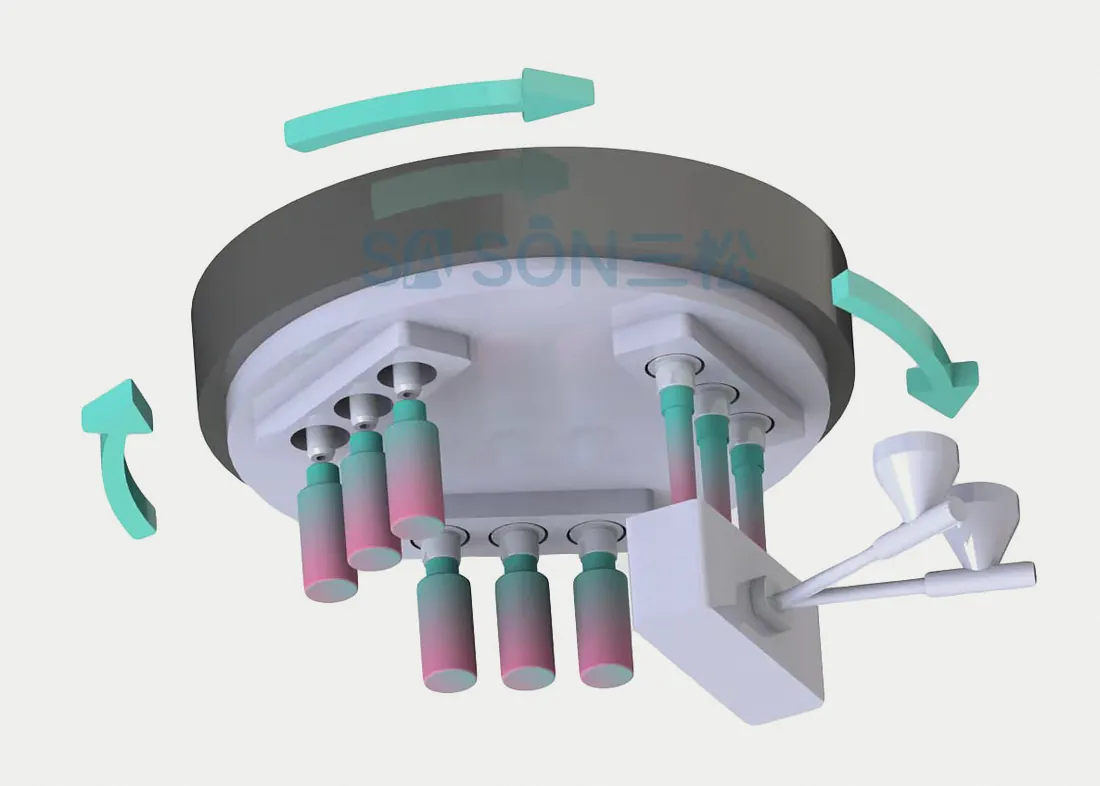
The drawings SanSong publishes for its three ISBM machines. The turntable carries each preform from station to station.

SanSong process drawing of the three-station ISBM cycle: preform injection, stretch blow molding and ejection on one turntable
Three stations: preform injection, stretch blow molding, ejection. SS-400-60-03-01
SanSong process drawing of the four-station double-row ISBM cycle with its conditioning station
Four stations: a conditioning station joins the cycle before stretch blowing, with double-row molds. SS-400-110-04-02
SanSong process drawing of the two-color ISBM cycle with a main and a side injection unit
Two-color: a main and a side injection unit fill the preform in two colors. SS-400-60-03-02
THREE STATIONS OR FOUR

What changes with the fourth station.

Only data SanSong publishes for each model. The right configuration follows the container, the resin and the output.

What changes with the fourth station.
ItemThree-station standardThree-station two-colorFour-station double-row
ModelSS-400-60-03-01SS-400-60-03-02SS-400-110-04-02
StationsPreform injection, stretch blow, ejectionThree, as the standard machinePreform injection, conditioning, stretch blow, ejection
Preform temperatureBlown with the heat left from injectionBlown with the heat left from injectionSet in a separate conditioning station
InjectionSingle injection unitMain and side units, screws 65 / 45 mmNot listed
Molds1 to 12 cavities, containers up to 4.6 LTwo-color and single-color moldsDouble-row molds
ISBM, IBM, EBM AND TWO-STEP

How the blow molding processes differ.

Four common ways to blow a plastic container. SanSong builds one-step ISBM machines only; the other processes are shown for comparison.

How the blow molding processes differ.
ProcessHow the container is formedStretched?Typical useFrom SanSong
One-step injection stretch blow molding (ISBM)A preform is injected, then stretched and blown on the same machine.Yes, lengthwise and aroundClear bottles and jars with an injected neck, such as drinkware, baby bottles and pharmaceutical bottlesYes: 8 one-step ISBM models
Two-step stretch blow molding (reheat SBM)Preforms are molded on an injection machine, stored, then reheated and stretch-blown on a second machine.YesHigh-volume PET bottles from bought-in or stored preformsNo
Injection blow molding (IBM)A preform is injected onto a core rod and blown without stretching.NoSmall bottles with a precise neckNo
Extrusion blow molding (EBM)An extruded tube (parison) is closed in the mold and blown; the neck is trimmed.NoContainers with handles and larger hollow partsNo
BLENDER 3D MECHANICAL ARCHITECTURE

Interactive 3D Kinematics: Rotary ISBM Turret & Split-Mold Cell

Modeled and animated in Blender 4.2 with orthographic CAD contours to clarify clamping, gear-driven indexing, and closed-loop process telemetry alongside real factory documentation.

3D Engineering Process Schematic
Isometric Ortho · 1–12 Cavities · Up to 4.6 L Scope
SCENE 01 · ONE-STEP ROTARY ISBM ARCHITECTURE

Multi-Station Rotary Indexing, Split Blow Clamping & Telemetry

Isometric Blender 4.2 3D schematic illustrating how preform thermal conditioning, radial split blow-mold clamping, vertical stretch-rod actuation, and closed-loop HMI telemetry coordinate within one continuous cycle.

  • Preform Conditioning Dial: Retains residual injection heat through segmented thermal shields before blow transfer.
  • Radial Split Blow Clamping: Indexed clamping carriages lock split steel mold cavities symmetrically around the container axis.
  • Servo Stretch-Blow Stroke: Overhead stretch rod and pneumatic manifold synchronize axial stretch with high-pressure blow air.
  • SPC Process Telemetry: Cycle timing, core displacement, and manifold pressure report to the operator HMI screen.

Kinematic principle model; actual 3-station or 4-station turret geometry follows your confirmed SS-400 model.

Explore ISBM platforms
HONEST PROCESS BOUNDARY DISCLOSURE · CHIEF-ENGINEER REVIEW

When One-Step ISBM Wins — And When Another Process Is Better

WHEN ONE-STEP ISBM WINS

Precision Neck Finish + Zero-Scuff Biaxial Clarity

  • Precision injection-molded neck finishes (threads, wiper necks, snap rings, non-forced inner-thread cups) formed in the same thermal cycle as biaxially stretched walls.
  • Zero preform cold storage, gaylord dumping, or reheat-conveyor ring scuffing — preserving optical surface gloss on thick-wall PETG/AS/PMMA cosmetic jars and droppers.
  • Proven across PPSU/PP baby feeding bottles, wide-mouth pharma packers, apheresis plasma separation cups, Tritan/PCTG/PC sports bottles (up to 4.6 L on SS-400-60-03-01), and two-color vessels (SS-400-60-03-02 / -03-06).
  • Thick-wall or oval/asymmetric profiles step up to 4-station thermal conditioning (SS-400-60-04-01 single-row 1–12 cavities or SS-400-110-04-02 double-row 8–24 cavities).
HONEST PROCESS & CHANGEOVER BOUNDARIES

Where Two-Stage SBM or EBM Wins & Changeover Realities

  • High-speed single-SKU commodity water & CSD lines (> 15,000 bph): Rotary two-stage reheat stretch blow molding achieves lower unit conversion cost when bulk preform transport marks are acceptable; SanSong builds integrated one-step ISBM only.
  • Hollow handleware & automotive pinch-off ducts: Containers requiring integral hollow grab-handles, industrial jerrycans, or parison pinch-off seams belong on extrusion blow molding (EBM); we disclose this upfront during drawing review.
  • Short-run full-mold changeover reality: One-step SKU switches swap injection cavities, core rods, blow molds, and neck rings together — multi-SKU plants should specify quick-change SS-400-60-03-03 or SS-400-60-03-06 and standardize neck finishes.
  • Dual-barrel two-color purge planning: Switching dark-to-light pigments or resins across the dual-unit mixing hot runner on SS-400-60-03-02 / -03-06 requires scheduled barrel purge resin and thermal stabilization minutes.
FAQ

Frequently asked questions

Useful details for your machine and mold enquiry.

What should I send for a bottle project?

Icon Close line

How do I choose three or four stations?

Icon Close line

Can you review an existing mold or machine?

Icon Close line

Which materials are listed by SanSong?

Icon Close line

Is a quoted cycle time valid for every bottle?

Icon Close line

How are trials and delivery arranged?

Icon Close line
Ready to automate your workflow?

Talk to our experts and discover the right solution for your production.
